School of Information, The University of Texas at Austin, Austin, TX, United States.
Center for Health Communication, Moody College of Communication and Dell Medical School, The University of Texas at Austin, Austin, TX, United States.
J Med Internet Res. 2022 Apr 28;24(4):e36463. doi: 10.2196/36463.
The internet has become a major source of health information for general consumers. Web-based health information quality varies widely across websites and applications. It is critical to understand the factors that shape consumers' evaluation of web-based health information quality and the role that it plays in their appraisal and use of health information and information systems.
This paper aimed to identify the antecedents and consequences of consumers' evaluation of web-based health information quality as a means to consolidate the related research stream and to inform future studies on web-based health information quality.
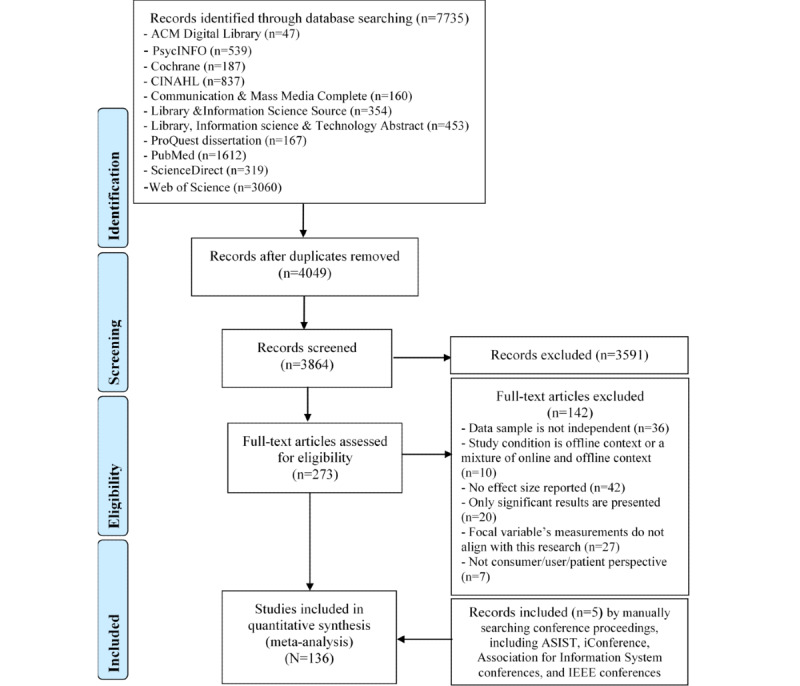
We systematically searched 10 databases, examined reference lists, and conducted manual searches. Empirical studies that investigated consumers' evaluation of web-based health information quality, credibility, or trust and their respective relationships with antecedents or consequences were included.
We included 147 studies reported in 136 papers in the analysis. Among the antecedents of web-based health information quality, system navigability (ρ=0.56), aesthetics (ρ=0.49), and ease of understanding (ρ=0.49) had the strongest relationships with web-based health information quality. The strongest consequences of web-based health information quality were consumers' intentions to use health information systems (ρ=0.58) and satisfaction with health information (ρ=0.46). Web-based health information quality relationships were moderated by numerous cultural dimensions, research designs, and publication moderators.
Consumers largely rely on peripheral cues and less on cues that require more information processing (eg, content comprehensiveness) to determine web-based health information quality. Surprisingly, the relationships between individual differences and web-based health information quality are trivial. Web-based health information quality has stronger effects on cognitive appraisals and behavioral intentions than on behavior. Despite efforts to include various moderators, a substantial amount of variance is still unexplained, indicating a need to study additional moderators. This meta-analysis provides broad and consistent evidence for web-based health information quality relationships that have been fractured and incongruent in empirical studies.
互联网已成为普通消费者获取健康信息的主要来源。网络健康信息的质量在各个网站和应用程序之间差异很大。了解影响消费者对网络健康信息质量评价的因素,以及这些因素在他们对健康信息和信息系统的评价和使用中的作用,至关重要。
本文旨在确定消费者对网络健康信息质量评价的影响因素,以整合相关研究领域,并为网络健康信息质量的未来研究提供信息。
我们系统地搜索了 10 个数据库,查阅了参考文献,并进行了手动搜索。纳入的研究为调查消费者对网络健康信息质量、可信度或信任的评价及其与前因或后果的关系的实证研究。
我们对 136 篇论文中的 147 项研究进行了分析。在网络健康信息质量的前因中,系统可操作性(ρ=0.56)、美学(ρ=0.49)和易于理解(ρ=0.49)与网络健康信息质量的关系最强。网络健康信息质量的最强后果是消费者使用健康信息系统的意愿(ρ=0.58)和对健康信息的满意度(ρ=0.46)。网络健康信息质量的关系受到许多文化维度、研究设计和出版调节因素的调节。
消费者主要依赖于外围线索,而较少依赖于需要更多信息处理的线索(例如,内容全面性)来确定网络健康信息质量。令人惊讶的是,个体差异与网络健康信息质量之间的关系微不足道。网络健康信息质量对认知评估和行为意向的影响大于对行为的影响。尽管努力纳入各种调节因素,但仍有大量的差异无法解释,这表明需要研究其他调节因素。这项元分析为网络健康信息质量关系提供了广泛而一致的证据,这些关系在实证研究中是分散和不一致的。