Department of Genetics, Cell Biology and Development, University of Minnesota, Minneapolis, Minnesota, United States of America.
Stem Cell Institute, University of Minnesota, Minneapolis, Minnesota, United States of America.
PLoS One. 2022 Apr 28;17(4):e0267273. doi: 10.1371/journal.pone.0267273. eCollection 2022.
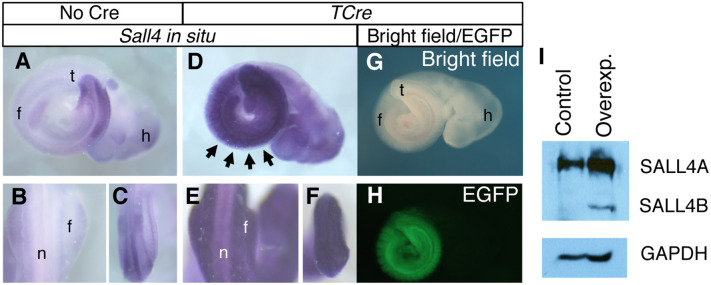
Sall4 encodes a transcription factor and is known to participate in the pluripotency network of embryonic stem cells. Sall4 expression is known to be high in early stage post-implantation mouse embryos. During early post-gastrulation stages, Sall4 is highly expressed in the tail bud and distal limb buds, where progenitor cells are maintained in an undifferentiated status. The expression of Sall4 is rapidly downregulated during embryonic development. We previously demonstrated that Sall4 is required for limb and posterior axial skeleton development by conditional deletion of Sall4 in the T (Brachyury) lineage. To gain insight into Sall4 functions in embryonic development and postnatal digit regeneration, we genetically overexpressed Sall4 in the mesodermal lineage by the TCre transgene and a novel knockin allele of Rosa26-loxP-stop-loxP-Sall4. In significant contrast to severe defects by Sall4 loss of function reported in previous studies, overexpression of Sall4 resulted in normal morphology and pattern in embryos and neonates. The length of limb long bones showed subtle reduction in Sall4-overexpression mice. It is known that the digit tip of neonatal mice has level-specific regenerative ability after experimental amputation. We observed Sall4 expression in the digit tip by using a sensitive Sall4-LacZ knock-in reporter expression. Sall4 overexpression did not alter the regenerative ability of the terminal phalange that normally regenerates after amputation. Moreover, Sall4 overexpression did not confer regenerative ability to the second phalange that normally does not regenerate after amputation. These genetic experiments show that overexpression of Sall4 does not alter the development of the appendicular and axial skeleton, or neonatal digit regeneration. The results suggest that Sall4 acts as a permissive factor rather than playing an instructive role.
Sall4 编码转录因子,已知参与胚胎干细胞的多能性网络。Sall4 的表达在早期植入后小鼠胚胎中较高。在原肠胚晚期,Sall4 在尾芽和远端肢芽中高度表达,祖细胞在未分化状态下维持。Sall4 的表达在胚胎发育过程中迅速下调。我们之前通过 T(Brachyury)谱系中的条件性 Sall4 缺失证明了 Sall4 对于肢和后轴骨骼发育是必需的。为了深入了解 Sall4 在胚胎发育和出生后手指再生中的功能,我们通过 TCre 转基因和 Rosa26-loxP-stop-loxP-Sall4 新型敲入等位基因在中胚层谱系中遗传过表达 Sall4。与之前研究中报道的 Sall4 功能丧失的严重缺陷形成鲜明对比的是,Sall4 的过表达导致胚胎和新生儿的形态和模式正常。Sall4 过表达小鼠的肢长骨长度略有减少。众所周知,新生小鼠的指端在实验性截肢后具有特定水平的再生能力。我们通过使用灵敏的 Sall4-LacZ 敲入报告基因表达来观察指端的 Sall4 表达。Sall4 过表达不会改变通常在截肢后再生的末端指骨的再生能力。此外,Sall4 过表达不会赋予通常在截肢后不会再生的第二指骨再生能力。这些遗传实验表明,Sall4 的过表达不会改变附肢和轴骨骼的发育,或新生儿手指的再生。结果表明,Sall4 作为许可因子发挥作用,而不是发挥指导作用。