Cancer Science Institute of Singapore, Singapore 117599, Singapore.
Harvard Stem Cells Institute, Harvard Medical School, Boston, MA 02115, USA.
Cells. 2022 Aug 20;11(16):2601. doi: 10.3390/cells11162601.
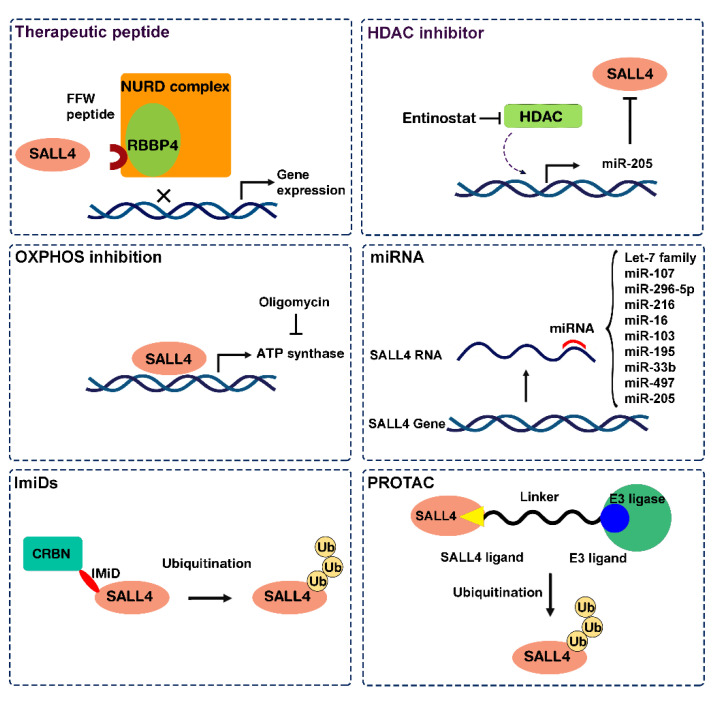
Spalt-Like Transcription Factor 4 (SALL4) is a critical factor for self-renewal ability and pluripotency of stem cells. On the other hand, various reports show tight relation of SALL4 to cancer occurrence and metastasis. SALL4 exerts its effects not only by inducing gene expression but also repressing a large cluster of genes through interaction with various epigenetic modifiers. Due to high expression of SALL4 in cancer cells and its silence in almost all adult tissues, it is an ideal target for cancer therapy. However, targeting SALL4 meets various challenges. SALL4 is a transcription factor and designing appropriate drug to inhibit this intra-nucleus component is challenging. On the other hand, due to lack of our knowledge on structure of the protein and the suitable active sites, it becomes more difficult to reach the appropriate drugs against SALL4. In this review, we have focused on approaches applied yet to target this oncogene and discuss the potential of degrader systems as new therapeutics to target oncogenes.
SALL4 样转录因子 4(SALL4)是干细胞自我更新能力和多能性的关键因素。另一方面,各种报告表明 SALL4 与癌症的发生和转移密切相关。SALL4 通过与各种表观遗传修饰物相互作用,不仅诱导基因表达,还抑制一大簇基因发挥作用。由于 SALL4 在癌细胞中高表达,而在几乎所有成年组织中沉默,因此它是癌症治疗的理想靶点。然而,针对 SALL4 会遇到各种挑战。SALL4 是一种转录因子,设计合适的药物来抑制这种核内成分具有挑战性。另一方面,由于我们对该蛋白的结构和合适的活性位点知之甚少,因此针对 SALL4 开发合适的药物变得更加困难。在这篇综述中,我们重点介绍了迄今为止用于靶向该致癌基因的方法,并讨论了降解系统作为靶向致癌基因的新型治疗方法的潜力。