Institute of Occupational, Social and Environmental Medicine, Goethe-University Frankfurt/Main, Theodor-Stern-Kai 7, Building 9a, 60596, Frankfurt/Main, Germany.
Institute of Biostatistics and Mathematical Modeling, Goethe-University, Frankfurt/Main, Theodor-Stern-Kai 7, Building 11A, 60596, Frankfurt/Main, Germany.
Sci Rep. 2022 Apr 28;12(1):6961. doi: 10.1038/s41598-022-10917-2.
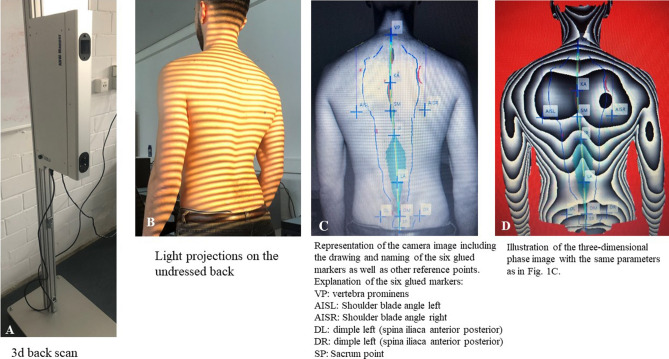
Comparative values are essential for the classification of orthopedic abnormalities and the assessment of a necessary therapy. At present, reference values for the upper body posture for healthy, male adults exist for the age groups of 18-35, 31-40 and 41-50 years. However, corresponding data on the decade of 51 to 60 year-old healthy men are still lacking. 23 parameters of the upper body posture were analyzed in 102 healthy male participants aged 51-60 (55.36 ± 2.78) years. The average height was 180.76 ± 7.81 cm with a weight of 88.22 ± 14.57 kg. The calculated BMI was 26.96 ± 3.92 kg/m. In the habitual, upright position, the bare upper body was scanned three-dimensionally using video raster stereography. Mean or median values, confidence intervals, tolerance ranges and group comparisons, as well as correlations of BMI and physical activity, were calculated for all parameters. The spinal column parameters exhibited a good exploration of the frontal plane in the habitual standing position. In the sagittal plane, a slight, ventral inclination of the trunk with an increased kyphosis angle of the thoracic spine and increased thoracic bending angle was observed. The parameters of the pelvis showed a pronounced symmetry with deviations from the 0° axis within the measurement error margin of 1 mm/1°. The scapula height together with the scapula angles of the right and left side described a slightly elevated position of the left shoulder compared to the right side. The upper body posture is influenced by parameters of age, height, weight and BMI. Primarily there are significant correlations to measurements of trunk lengths D (age: p ≤ 0.02, rho = -0.23; height: p ≤ 0.001, rho = 0.58; weight: p ≤ 0.001, rho = 0.33), trunk lengths S (age: p ≤ 0.01, rho = -0.27; height: p ≤ 0.001, rho = 0.58; weight: p ≤ 0.001, rho = 0.32), pelvic distance (height: p ≤ 0.01, rho = 0.26; weight: p ≤ 0.001, rho = 0.32; BMI: p ≤ 0.03, rho = 0.22) and scapula distance (weight: p ≤ 0.001, rho = .32; BMI: p ≤ 0.01, rho = 0.27), but also to sagittal parameters of trunk decline (weight: p ≤ 0.001, rho = -0.29; BMI: p ≤ 0.01, rho = -0.24), thoracic bending angle (height: p ≤ 0.01, rho = 0.27) and kyphosis angle (BMI: p ≤ 0.03, rho = 0.21). The upper body posture of healthy men between the ages of 51 and 60 years was axially almost aligned and balanced. With the findings of this investigation and the reference values obtained, suitable comparative values for use in clinical practice and for further scientific studies with the same experimental set-up have been established.
比较值对于骨科异常的分类和必要治疗的评估至关重要。目前,已有针对 18-35 岁、31-40 岁和 41-50 岁健康成年男性的上半身姿势参考值。然而,目前仍缺乏针对 51-60 岁健康男性的相应数据。本研究分析了 102 名 51-60 岁健康男性参与者的 23 个上半身姿势参数,这些参与者的平均年龄为 55.36±2.78 岁,平均身高为 180.76±7.81cm,体重为 88.22±14.57kg,计算得出的 BMI 为 26.96±3.92kg/m。在习惯性直立姿势下,使用视频光栅立体摄影术对裸露的上半身进行三维扫描。计算了所有参数的均值或中位数、置信区间、容忍范围和组间比较,以及 BMI 和身体活动的相关性。脊柱参数在习惯性站立位中很好地反映了额状面。在矢状面,观察到躯干轻微的前腹侧倾斜,胸段脊柱后凸角增加,胸段弯曲角增加。骨盆参数显示出明显的对称性,偏离 0°轴的偏差在 1mm/1°的测量误差范围内。与右侧相比,左侧肩胛骨高度和左右侧肩胛骨角度共同描述了左侧肩部的略微抬高位置。上半身姿势受年龄、身高、体重和 BMI 等参数的影响。主要有与躯干长度 D 的显著相关性(年龄:p≤0.02,rho=-0.23;身高:p≤0.001,rho=0.58;体重:p≤0.001,rho=0.33)、躯干长度 S(年龄:p≤0.01,rho=-0.27;身高:p≤0.001,rho=0.58;体重:p≤0.001,rho=0.32)、骨盆距离(身高:p≤0.01,rho=0.26;体重:p≤0.001,rho=0.32;BMI:p≤0.03,rho=0.22)和肩胛骨距离(体重:p≤0.001,rho=0.32;BMI:p≤0.01,rho=0.27),也与躯干下降的矢状参数(体重:p≤0.001,rho=-0.29;BMI:p≤0.01,rho=-0.24)、胸段弯曲角(身高:p≤0.01,rho=0.27)和后凸角(BMI:p≤0.03,rho=0.21)有显著相关性。51-60 岁健康男性的上半身姿势在轴向几乎是对齐和平衡的。通过本研究的发现和获得的参考值,为临床实践和具有相同实验设置的进一步科学研究建立了合适的比较值。