Institute of Occupational Medicine, Social Medicine and Environmental Medicine, Goethe-University Frankfurt/Main, Theodor-Stern-Kai 7, Building 9A, 60590, Frankfurt/Main, Germany.
Department of Orthodontics, School of Dentistry, Goethe University Frankfurt/Main, Frankfurt, Germany.
Sci Rep. 2023 Jan 17;13(1):873. doi: 10.1038/s41598-023-27976-8.
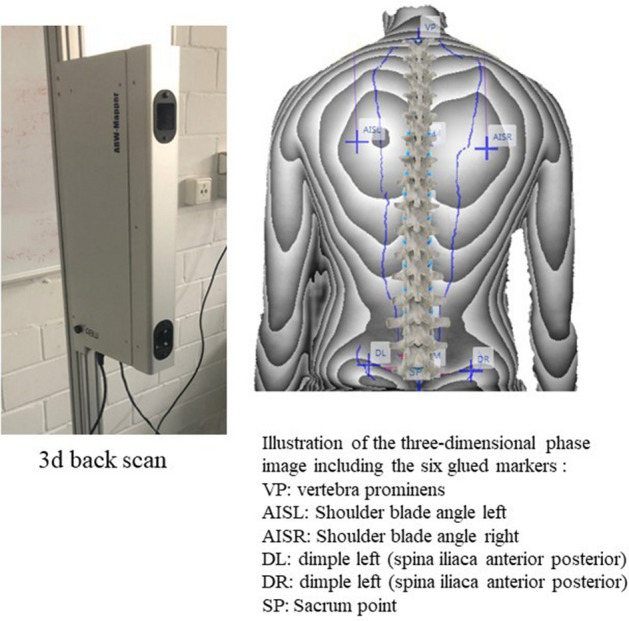
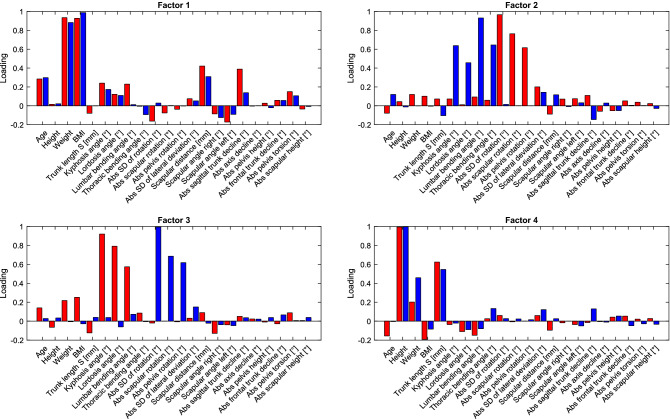
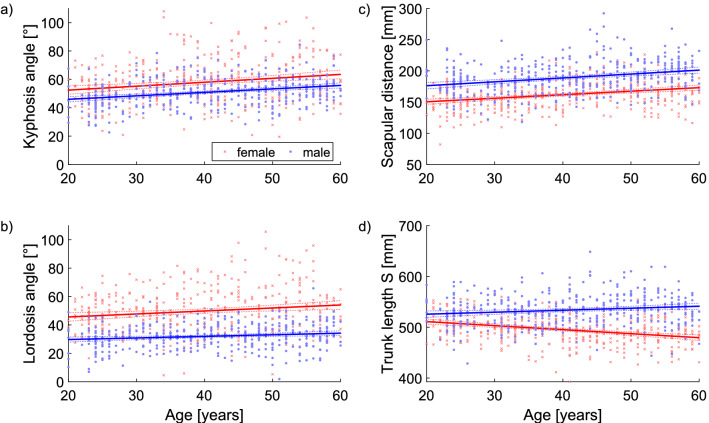
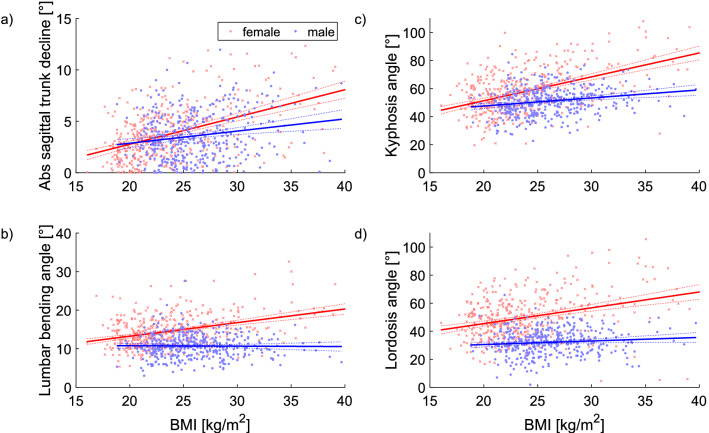
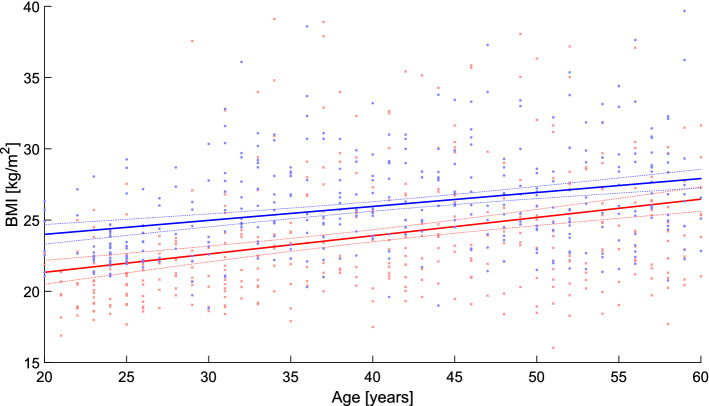
In order to classify and analyze the parameters of upper body posture in clinical or physiotherapeutic settings, a baseline in the form of standard values with special regard to age, sex and BMI is required. Thus, subjectively healthy men and women aged 21-60 years were measured in this project. The postural parameters of 800 symptom-free male (n = 397) and female (n = 407) volunteers aged 21-60 years (Ø♀: 39.7 ± 11.6, Ø ♂: 40.7 ± 11.5 y) were studied. The mean height of the men was 1.8 ± 0.07 m, with a mean body weight of 84.8 ± 13.1 kg and an average BMI of 26.0 ± 3.534 kg/m. In contrast, the mean height of the women was 1.67 ± 0.06 m, with a mean body weight of 66.5 ± 12.7 kg and an average BMI of 23.9 ± 4.6 kg/m. By means of video rasterstereography, a 3-dimensional scan of the upper back surface was measured when in a habitual standing position. The means or medians, confidence intervals, tolerance ranges, the minimum, 2.5, 25, 50, 75, 97.5 percentiles and the maximum, plus the kurtosis and skewness of the distribution, were calculated for all parameters. Additionally, ANOVA and a factor analyses (sex, BMI, age) were conducted. In both sexes across all age groups, balanced, symmetrical upper body statics were evident. Most strikingly, the females showed greater thoracic kyphosis and lumbar lordosis angles (kyphosis: Ø ♀ 56°, Ø♂ 51°; lordosis: Ø ♀ 49°, Ø♂ 32°) and lumbar bending angles (Ø ♀ 14°, Ø♂ 11°) than the males. The distance between the scapulae was more pronounced in men. These parameters also show an increase with age and BMI, respectively. Pelvic parameters were independent of age and sex. The upper body postures of women and men between the ages of 21 and 60 years were found to be almost symmetrical and axis-conforming with a positive correlation for BMI or age. Consequently, the present body posture parameters allow for comparisons with other studies, as well as for the evaluation of clinical (interim) diagnostics and applications.
为了在临床或物理治疗环境中对上身姿势参数进行分类和分析,需要有一个基于年龄、性别和 BMI 的标准值基线。因此,本项目对 21-60 岁的主观健康男性和女性进行了测量。对 800 名无症状男性(n=397)和女性(n=407)志愿者的 800 名无症状男性(n=397)和女性(n=407)志愿者的姿势参数进行了研究,年龄为 21-60 岁(Ø♀:39.7±11.6,Ø♂:40.7±11.5 y)。男性的平均身高为 1.8±0.07m,平均体重为 84.8±13.1kg,平均 BMI 为 26.0±3.534kg/m。相比之下,女性的平均身高为 1.67±0.06m,平均体重为 66.5±12.7kg,平均 BMI 为 23.9±4.6kg/m。通过视频光栅立体摄影术,在习惯性站立位置测量上背部的三维扫描。计算了所有参数的均值或中位数、置信区间、容忍范围、最小值、2.5、25、50、75、97.5 百分位数和最大值,以及分布的峰度和偏度。此外,还进行了方差分析和因子分析(性别、BMI、年龄)。在所有年龄段的两性中,都表现出平衡、对称的上身静态。最显著的是,女性的胸椎后凸和腰椎前凸角度(后凸:Ø♀56°,Ø♂51°;前凸:Ø♀49°,Ø♂32°)和腰椎弯曲角度(Ø♀14°,Ø♂11°)大于男性。肩胛骨之间的距离在男性中更为明显。这些参数也随着年龄和 BMI 的增加而增加。骨盆参数与年龄和性别无关。21-60 岁女性和男性的上身姿势几乎是对称的,与 BMI 或年龄呈正相关。因此,本研究的体位参数可与其他研究进行比较,也可用于临床(中期)诊断和应用的评估。