Department of Nuclear Medicine, University Hospital Zurich, Rämistrasse 100, 8091, Zurich, Switzerland.
Center for Molecular Cardiology, University of Zurich, 8952, Schlieren, Switzerland.
J Nucl Cardiol. 2023 Feb;30(1):62-73. doi: 10.1007/s12350-022-02968-9. Epub 2022 Apr 28.
Myocardial perfusion imaging by positron emission tomography (PET-MPI) is the current gold standard for quantification of myocardial blood flow. F-flurpiridaz was recently introduced as a valid alternative to currently used PET-MPI probes. Nonetheless, optimum scan duration and time interval for image analysis are currently unknown. Further, it is unclear whether rest/stress PET-MPI with F-flurpiridaz is feasible in mice.
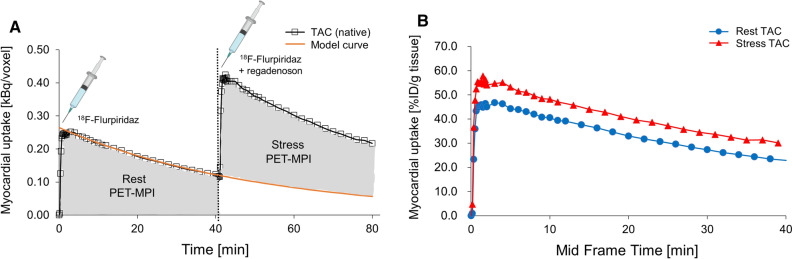
Rest/stress PET-MPI was performed with F-flurpiridaz (0.6-3.0 MBq) in 27 mice aged 7-8 months. Regadenoson (0.1 µg/g) was used for induction of vasodilator stress. Kinetic modeling was performed using a metabolite-corrected arterial input function. Image-derived myocardial F-flurpiridaz uptake was assessed for different time intervals by placing a volume of interest in the left ventricular myocardium.
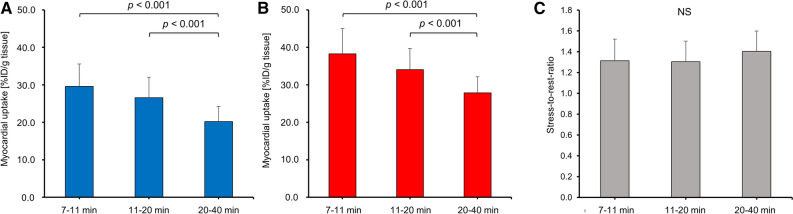
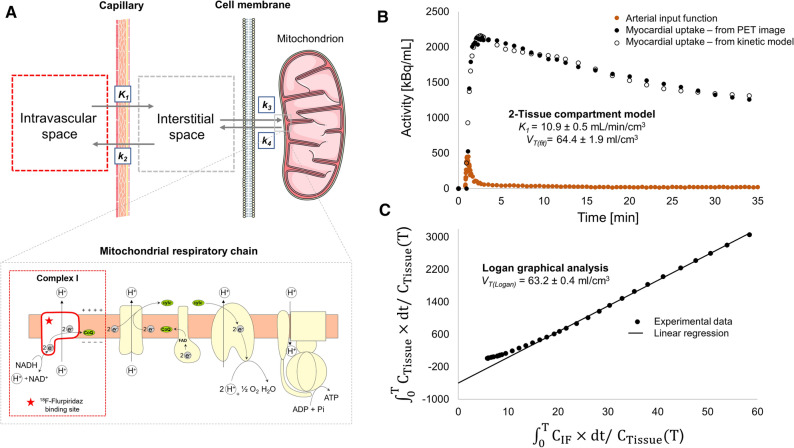
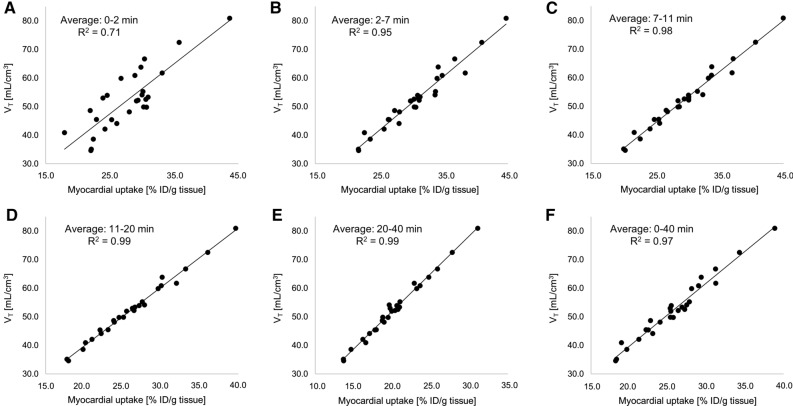
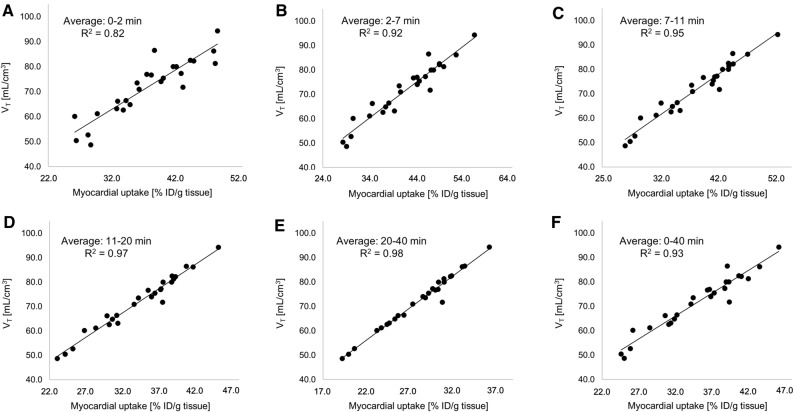
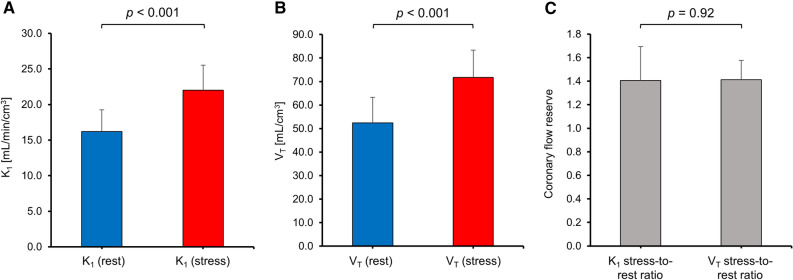
Tracer kinetics were best described by a two-tissue compartment model. K ranged from 6.7 to 20.0 mL·cm·min, while myocardial volumes of distribution (V) were between 34.6 and 83.6 mL·cm. Of note, myocardial F-flurpiridaz uptake (%ID/g) was significantly correlated with K at rest and following pharmacological vasodilation for all time intervals assessed. However, while Spearman's coefficients (r) ranged between 0.478 and 0.681, R values were generally low. In contrast, an excellent correlation of myocardial F-flurpiridaz uptake with V was obtained, particularly when employing the averaged myocardial uptake from 20 to 40 min post tracer injection (R ≥ 0.98). Notably, K and V were similarly sensitive to pharmacological vasodilation induction. Further, mean stress-to-rest ratios of K, V, and %ID/g F-flurpiridaz were virtually identical, suggesting that %ID/g F-flurpiridaz can be used to estimate coronary flow reserve (CFR) in mice.
Our findings suggest that a simplified assessment of relative myocardial perfusion and CFR, based on image-derived tracer uptake, is feasible with F-flurpiridaz in mice, enabling high-throughput mechanistic CFR studies in rodents.
正电子发射断层扫描(PET-MPI)心肌灌注显像是目前量化心肌血流的金标准。F-氟比拉嗪最近被引入作为目前使用的 PET-MPI 探针的有效替代物。尽管如此,目前还不知道最佳的扫描持续时间和图像分析时间间隔。此外,尚不清楚 F-氟比拉嗪在小鼠中是否可行进行静息/应激 PET-MPI。
在 27 只 7-8 月龄的小鼠中进行 F-氟比拉嗪(0.6-3.0 MBq)静息/应激 PET-MPI。使用雷加登素(0.1 µg/g)诱导血管扩张剂应激。使用校正代谢物的动脉输入函数进行动力学建模。通过在左心室心肌中放置感兴趣的体积,评估不同时间间隔的图像衍生的 F-氟比拉嗪摄取。
示踪剂动力学最好用两室模型来描述。K 值范围为 6.7 至 20.0 mL·cm·min,而心肌分布容积(V)范围为 34.6 至 83.6 mL·cm。值得注意的是,在所有评估的时间间隔内,静息和药物扩张后的心肌 F-氟比拉嗪摄取(%ID/g)与 K 均呈显著相关。然而,尽管斯皮尔曼系数(r)范围在 0.478 到 0.681 之间,但 R 值通常较低。相比之下,获得了心肌 F-氟比拉嗪摄取与 V 的极好相关性,尤其是当使用注射示踪剂后 20 至 40 分钟的平均心肌摄取时(R ≥ 0.98)。值得注意的是,K 和 V 对药物诱导的血管扩张同样敏感。此外,K、V 和 F-氟比拉嗪摄取的平均应激/静息比值几乎相同,表明 F-氟比拉嗪摄取可用于估计小鼠的冠状动脉血流储备(CFR)。
我们的研究结果表明,基于图像衍生示踪剂摄取,使用 F-氟比拉嗪在小鼠中进行相对心肌灌注和 CFR 的简化评估是可行的,从而能够在啮齿动物中进行高通量机制性 CFR 研究。