Department of Internal Medicine, Diabetes Center, Amsterdam University Medical Center, Location VU University Medical Center, Amsterdam, The Netherlands.
Department of Internal Medicine, Amsterdam Diabetes Center, Amsterdam University Medical Centers (Amsterdam UMC), Location VU University Medical Center (VUMC), De Boelelaan 1117 (room ZH 4A63), 1081 HV, Amsterdam, The Netherlands.
Cardiovasc Diabetol. 2022 Apr 28;21(1):63. doi: 10.1186/s12933-022-01492-x.
Sodium-glucose cotransporter-2 inhibitors (SGLT2i) and glucagon-like peptide-1 receptor agonists (GLP-1RA) lower blood pressure (BP). When SGLT2i and GLP-1RA are combined, synergistic effects on BP have been observed. The mechanisms underlying these BP reductions are incompletely understood. The aim of this study was to assess the mechanisms underlying the BP reduction with the SGLT2i dapagliflozin, GLP-1RA exenatide, and dapagliflozin-exenatide compared with placebo in people with obesity and type 2 diabetes.
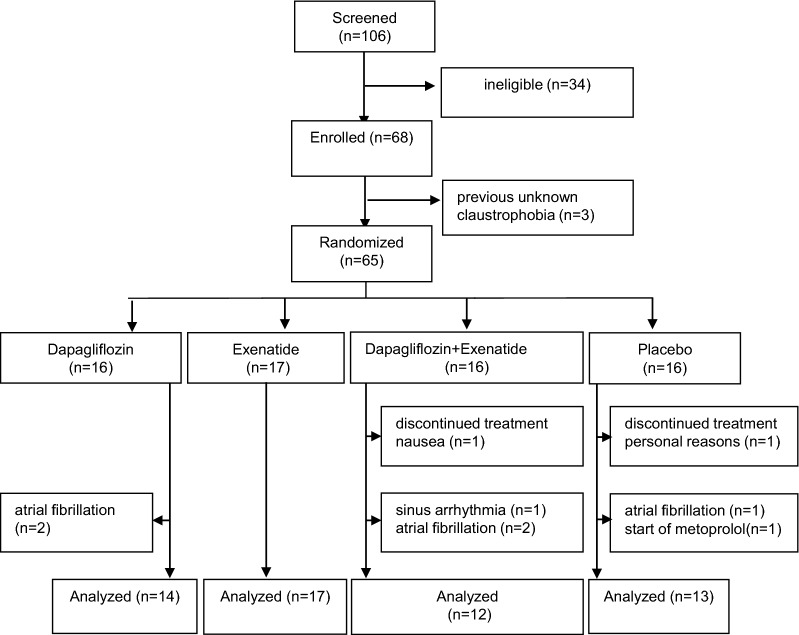
Sixty-six people with type 2 diabetes were randomized to 16 weeks of dapagliflozin 10 mg/day, exenatide 10 µg twice daily, dapagliflozin-exenatide, or placebo treatment. The effect of treatments on estimates of: (1) plasma volume (calculated by Strauss formula, bioimpedance spectroscopy, hematocrit, (2) autonomic nervous system activity (heart rate variability), (3) arterial stiffness (pulse wave applanometry), (4) systemic hemodynamic parameters including peripheral vascular resistance, cardiac output and stroke volume (all derived from non-invasively systemic hemodynamic monitoring), and (5) natriuresis (24-hour urine collection) were assessed after 10 days and 16 weeks of treatment.
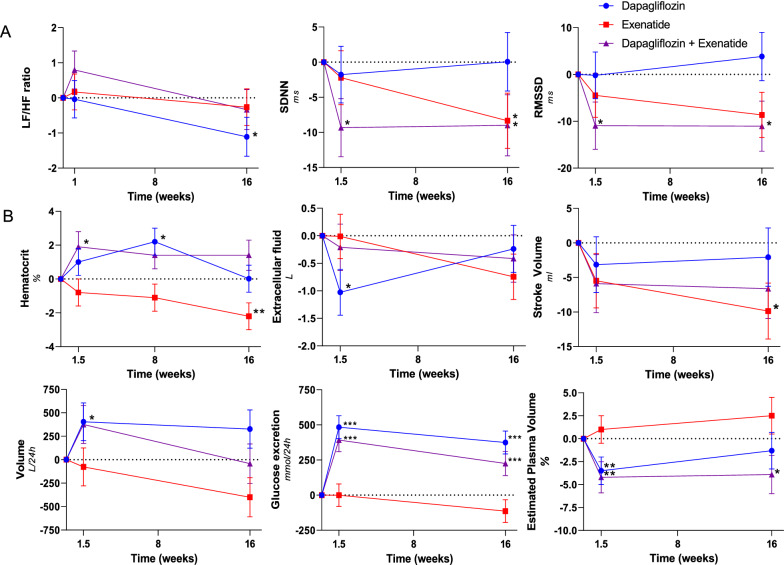
After 10 days, dapagliflozin reduced systolic BP (SBP) by - 4.7 mmHg, and reduced plasma volume. After 16 weeks, dapagliflozin reduced SBP by - 4.4 mmHg, and reduced sympathetic nervous system (SNS) activity. Exenatide had no effect on SBP, but reduced parasympathetic nervous system activity after 10 days and 16 weeks. After 10 days, dapagliflozin-exenatide reduced SBP by - 4.2 mmHg, and reduced plasma volume. After 16 weeks, dapagliflozin-exenatide reduced SBP by - 6.8 mmHg, and the reduction in plasma volume was still observed, but SNS activity was unaffected.
The dapagliflozin-induced plasma volume contraction may contribute to the initial SBP reduction, while a reduction in SNS activity may contribute to the persistent SBP reduction. Dapagliflozin-exenatide resulted in the largest decrease in SBP. The effect on plasma volume was comparable to dapagliflozin monotherapy, and SNS activity was not reduced, therefore other mechanisms are likely to contribute to the blood pressure lowering effect of this combination, which need further investigation. Trial registration Clinicaltrials.gov, NCT03361098.
钠-葡萄糖共转运蛋白 2 抑制剂(SGLT2i)和胰高血糖素样肽-1 受体激动剂(GLP-1RA)可降低血压(BP)。当 SGLT2i 和 GLP-1RA 联合使用时,观察到对 BP 的协同作用。这些 BP 降低的机制尚不完全清楚。本研究的目的是评估在肥胖和 2 型糖尿病患者中,与安慰剂相比,SGLT2i 达格列净、GLP-1RA 艾塞那肽和达格列净-艾塞那肽对 BP 降低的机制。
66 例 2 型糖尿病患者被随机分为 16 周的达格列净 10mg/天、艾塞那肽 10μg 每日 2 次、达格列净-艾塞那肽或安慰剂治疗。在 10 天和 16 周治疗后,评估治疗对以下指标的影响:(1)血浆容量(通过 Strauss 公式、生物电阻抗光谱法、血细胞比容计算),(2)自主神经系统活动(心率变异性),(3)动脉僵硬(脉搏波平板仪),(4)全身血流动力学参数,包括外周血管阻力、心输出量和每搏量(均通过非侵入性全身血流动力学监测获得),(5)排钠量(24 小时尿液收集)。
在 10 天内,达格列净降低收缩压(SBP)-4.7mmHg,并降低血浆容量。在 16 周时,达格列净降低 SBP-4.4mmHg,并降低交感神经活性(SNS)。艾塞那肽对 SBP 无影响,但在 10 天和 16 周时降低副交感神经活性。在 10 天内,达格列净-艾塞那肽降低 SBP-4.2mmHg,并降低血浆容量。在 16 周时,达格列净-艾塞那肽降低 SBP-6.8mmHg,且仍观察到血浆容量减少,但 SNS 活性不受影响。
达格列净引起的血浆容量收缩可能导致初始 SBP 降低,而 SNS 活性降低可能导致持续的 SBP 降低。达格列净-艾塞那肽可使 SBP 下降最大。其对血浆容量的影响与达格列净单药治疗相当,且 SNS 活性未降低,因此该联合用药的降压作用可能还有其他机制,需要进一步研究。
Clinicaltrials.gov,NCT03361098。