Department of Global Public Health and Primary Care, Section for General Practice, University of Bergen, Bergen, Norway.
Department of Health, Research Unit for General Practice, NORCE Norwegian Research Centre AS, Bergen, Norway.
Scand J Prim Health Care. 2022 Jun;40(2):173-180. doi: 10.1080/02813432.2022.2069711. Epub 2022 Apr 29.
Examine characteristics and time trends of respiratory tract infection (RTI) consultations in Norwegian primary care and compare consultations in daytime general practice and out-of-hours (OOH) services.
Registry-based study using reimbursement claims data.
All in-person primary care consultations during 2006-2015.
All patients visiting primary care during the study period.
The main outcome variable was RTI consultations. Differences regarding service type (general practice or OOH services) and changes over time were investigated. We report associations with patient age and sex, season, point-of-care C-reactive protein (CRP) test use, and sickness certificate issuing.
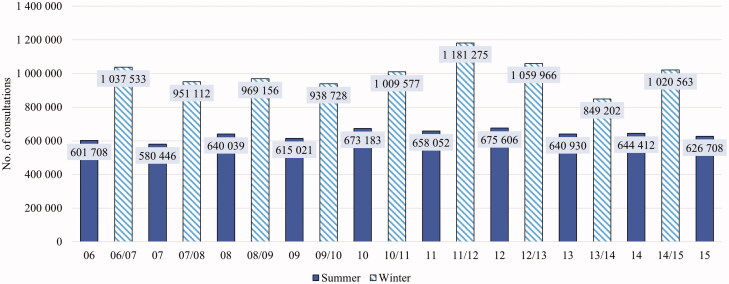
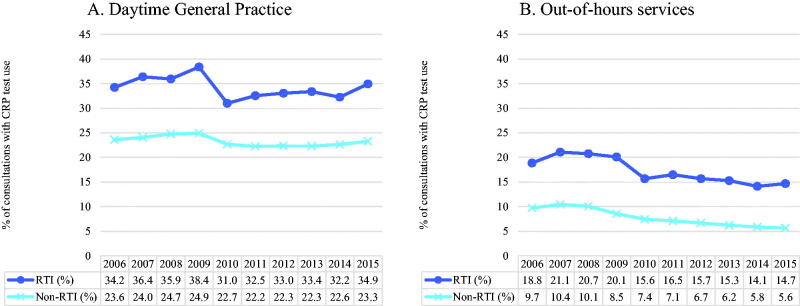
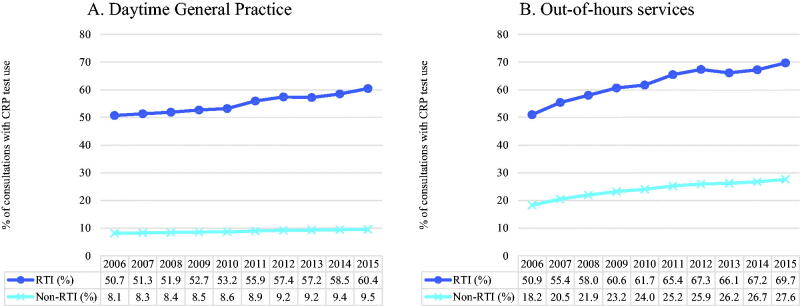
RTI consultations ( = 16 304 777) represented 11.6% of all consultations ( = 140 199 637) in primary care over the ten-year period. The annual number of RTI consultations per 1000 inhabitants decreased from 335 to 314, while the number of consultations for any reason increased. Of RTI consultations, 83.2% occurred in general practice. OOH services had a higher proportion of RTI consultations (21.4%) compared with general practice (10.6%). Young children (0-4 years) represented 18.9% of all patients in RTI consultations. CRP testing was used in 56.2% of RTI consultations, and use increased over time. Sickness certificates were issued in 31.9% of RTI consultations with patients of working age (20-67 years).
Most RTI consultations occurred in general practice, although the proportion was higher in OOH services. Laboratory testing and/or issuing of sickness certificates were part of most consultations. This could be an important reason for seeking health care. Key PointsPatients with a respiratory tract infection (RTI) are mostly managed in primary care, where they represent much of the workload.Most consultations for RTIs took place in daytime general practice, but out-of-hours services had a higher proportion of RTI consultations.RTIs were the dominating reason for encounter among young children both in out-of-hours services and daytime general practice.CRP tests were used in over half of RTI consultations, and their use expanded over time.
研究挪威初级保健中呼吸道感染(RTI)咨询的特点和时间趋势,并比较日间全科医疗和非工作时间(OOH)服务的咨询情况。
基于登记的研究,使用报销索赔数据。
2006-2015 年所有面对面的初级保健咨询。
研究期间所有就诊初级保健的患者。
主要观察变量为 RTI 咨询。调查了服务类型(全科医疗或 OOH 服务)和随时间变化的差异。我们报告了与患者年龄和性别、季节、即时 C 反应蛋白(CRP)检测使用和病假条开具相关的结果。
10 年间,RTI 咨询( = 16 304 777)占初级保健中所有咨询( = 140 199 637)的 11.6%。每 1000 名居民的 RTI 咨询年就诊次数从 335 次减少到 314 次,而所有原因的咨询就诊次数增加。在 RTI 咨询中,83.2%发生在全科医疗中。与全科医疗(10.6%)相比,OOH 服务的 RTI 咨询比例(21.4%)更高。幼儿(0-4 岁)占所有 RTI 咨询患者的 18.9%。56.2%的 RTI 咨询患者接受了 CRP 检测,且检测使用率随时间增加。有工作年龄(20-67 岁)的 RTI 咨询患者中有 31.9%开具了病假条。
大多数 RTI 咨询发生在全科医疗中,尽管 OOH 服务中的比例更高。实验室检测和/或开具病假条是大多数咨询的一部分。这可能是寻求医疗保健的一个重要原因。关键点:患有呼吸道感染(RTI)的患者主要在初级保健机构就诊,在初级保健机构中,RTI 占了大部分工作量。大多数 RTI 咨询是在日间全科医疗中进行的,但 OOH 服务中的 RTI 咨询比例更高。幼儿无论是在 OOH 服务还是日间全科医疗中,RTI 都是主要的就诊原因。超过一半的 RTI 咨询患者接受了 CRP 检测,且该检测的使用率随时间增加。