Department of Biochemistry, Schlich School of Medicine and Dentistry, Western University, London, ON, N6A 5C1, Canada.
Lambton College, 1457 London Rd, Sarnia, ON, N7S 6K4, Canada.
Sci Rep. 2022 Apr 29;12(1):7010. doi: 10.1038/s41598-022-11053-7.
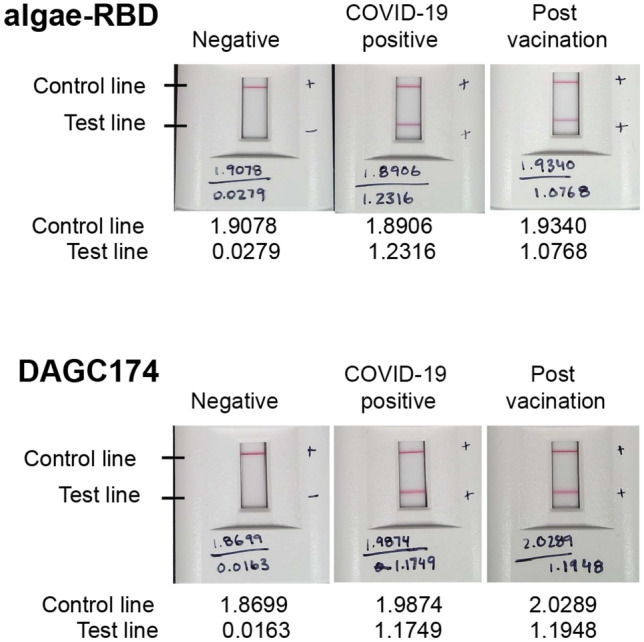
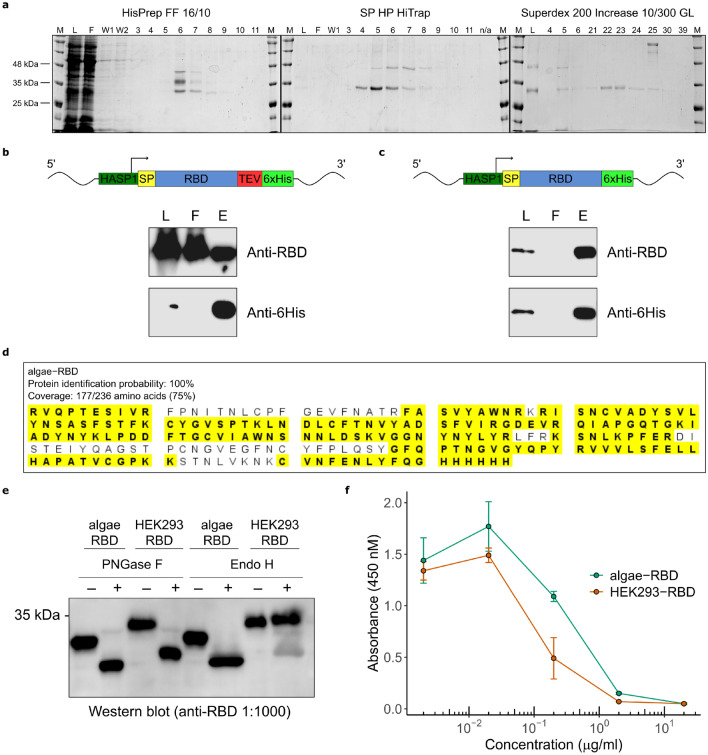
The worldwide COVID-19 pandemic caused by the SARS-CoV-2 betacoronavirus has highlighted the need for a synthetic biology approach to create reliable and scalable sources of viral antigen for uses in diagnostics, therapeutics and basic biomedical research. Here, we adapt plasmid-based systems in the eukaryotic microalgae Phaeodactylum tricornutum to develop an inducible overexpression system for SARS-CoV-2 proteins. Limiting phosphate and iron in growth media induced expression of the receptor-binding domain (RBD) of the SARS-CoV-2 spike protein from the P. tricornutum HASP1 promoter in the wild-type strain and in a histidine auxotrophic strain that alleviates the requirement for antibiotic selection of expression plasmids. The RBD was purified from whole cell extracts (algae-RBD) with yield compromised by the finding that 90-95% of expressed RBD lacked the genetically encoded C-terminal 6X-histidine tag. Constructs that lacked the TEV protease site between the RBD and C-terminal 6X-histidine tag retained the tag, increasing yield. Purified algae-RBD was found to be N-linked glycosylated by treatment with endoglycosidases, was cross-reactive with anti-RBD polyclonal antibodies, and inhibited binding of recombinant RBD purified from mammalian cell lines to the human ACE2 receptor. We also show that the algae-RBD can be used in a lateral flow assay device to detect SARS-CoV-2 specific IgG antibodies from donor serum at sensitivity equivalent to assays performed with RBD made in mammalian cell lines. Our study shows that P. tricornutum is a scalable system with minimal biocontainment requirements for the inducible production of SARS-CoV-2 or other coronavirus antigens for pandemic diagnostics.
由 SARS-CoV-2 β冠状病毒引起的全球 COVID-19 大流行凸显了需要采用合成生物学方法来创建可靠且可扩展的病毒抗原来源,用于诊断、治疗和基础生物医学研究。在这里,我们改编真核微藻三角褐指藻中的基于质粒的系统,开发用于 SARS-CoV-2 蛋白的诱导型过表达系统。在生长培养基中限制磷酸盐和铁可诱导野生型菌株和缓解表达质粒抗生素选择要求的组氨酸营养缺陷型菌株中,SARS-CoV-2 刺突蛋白的受体结合域(RBD)从 P. tricornutum HASP1 启动子表达。RBD 从全细胞提取物(藻类-RBD)中纯化,产量受到以下发现的影响:表达的 RBD 中 90-95%缺乏遗传编码的 C 末端 6X-组氨酸标签。在 RBD 和 C 末端 6X-组氨酸标签之间缺少 TEV 蛋白酶位点的构建体保留了标签,从而提高了产量。纯化的藻类-RBD 经内切糖苷酶处理后发现是 N-连接糖基化的,与抗 RBD 多克隆抗体发生交叉反应,并抑制了从哺乳动物细胞系中纯化的重组 RBD 与人类 ACE2 受体的结合。我们还表明,藻类-RBD 可用于侧向流动分析装置,以从供体血清中检测 SARS-CoV-2 特异性 IgG 抗体,其灵敏度与在哺乳动物细胞系中进行的 RBD 测定相当。我们的研究表明,三角褐指藻是一种可扩展的系统,对于 SARS-CoV-2 或其他冠状病毒抗原的诱导生产,其生物控制要求最低,可用于大流行诊断。