• 文献检索
  • 文档翻译
  • 深度研究
  • 学术资讯
  • Suppr Zotero 插件Zotero 插件
  • 邀请有礼
  • 套餐&价格
  • 历史记录
应用&插件
Suppr Zotero 插件Zotero 插件浏览器插件Mac 客户端Windows 客户端微信小程序
定价
高级版会员购买积分包购买API积分包
服务
文献检索文档翻译深度研究API 文档MCP 服务
关于我们
关于 Suppr公司介绍联系我们用户协议隐私条款
关注我们

Suppr 超能文献

核心技术专利:CN118964589B侵权必究
粤ICP备2023148730 号-1Suppr @ 2026

文献检索

告别复杂PubMed语法,用中文像聊天一样搜索,搜遍4000万医学文献。AI智能推荐,让科研检索更轻松。

立即免费搜索

文件翻译

保留排版,准确专业,支持PDF/Word/PPT等文件格式,支持 12+语言互译。

免费翻译文档

深度研究

AI帮你快速写综述,25分钟生成高质量综述,智能提取关键信息,辅助科研写作。

立即免费体验

美国发育障碍儿童的口腔健康需求:一项基于人群的研究。

Oral health needs of U.S. children with developmental disorders: a population-based study.

机构信息

Public Health Sciences Texas A&M University College of Dentistry, 3302 Gaston Avenue, Dallas, TX, 75246, USA.

Department of Comprehensive Dentistry, Texas A&M University College of Dentistry, 3302 Gaston Avenue, Dallas, TX, 75246, USA.

出版信息

BMC Public Health. 2022 Apr 29;22(1):861. doi: 10.1186/s12889-022-13237-2.

DOI:10.1186/s12889-022-13237-2
PMID:35488224
原文链接:https://pmc.ncbi.nlm.nih.gov/articles/PMC9055681/
Abstract

BACKGROUND

Children with Special Health Care Needs (CSHCN) have higher rates of oral diseases and tooth decay compared with the general population. Children with developmental disorders/ disabilities (DD) are a subset of CSHCN whose oral health has not been specifically addressed. Therefore, this study had two objectives: to describe the oral health needs (OHN) of children with DD compared with children without DD; and to assess barriers to access to care, utilization of dental services, and their association with oral health needs for children with DD.

METHODS

This cross-sectional study utilized a sample of 30,530 noninstitutionalized children from the 2018 National Survey of Children's Health (NSCH). Analysis was conducted using descriptive and inferential statistics.

RESULTS

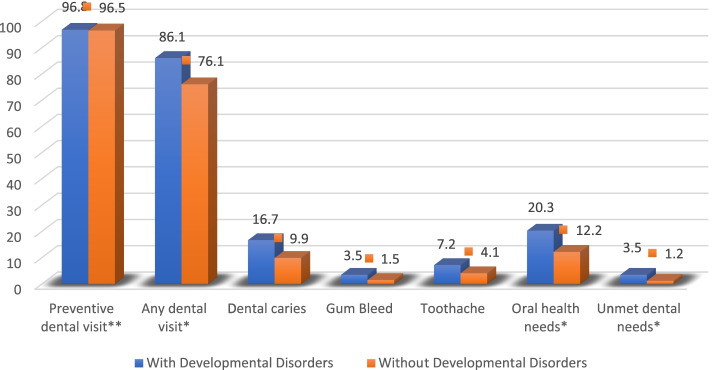
The analysis identified 6501 children with DD and 24,029 children without DD. Children with DD had significantly higher prevalence of OHN (20.3% vs. 12.2%, respectively), unmet dental needs (3.5% vs 1.2%), and utilization of any dental visits (86.1% vs 76.1%), (P-value < . 001). The adjusted logistic model identified four factors that contributed to the higher odds of OHN among children with DD: poverty (< 100% of the Federal Poverty Level (AOR = 2.27, CI: 1.46-3.51), being uninsured (AOR = 2.12, 95% CI: 1.14-3.95), a high level of disability (AOR = 1.89, CI: 1.23-2.78), and living in the western United States (AOR = 1.61, CI: 1.09-2.37.

CONCLUSION

Despite higher utilization of dental services, children with DD had poorer oral health and more unmet dental needs than children without DD. Advocacy efforts and policy changes are needed to develop affordable access that assesses, as early as possible, children with DD whose conditions impact their ability a great deal so that their potential OHN may be alleviated more effectively.

摘要

背景

与一般人群相比,有特殊健康需求的儿童(CSHCN)的口腔疾病和龋齿发病率更高。患有发育障碍/残疾(DD)的儿童是 CSHCN 的一个亚组,他们的口腔健康尚未得到专门关注。因此,本研究有两个目标:描述与无 DD 的儿童相比,有 DD 的儿童的口腔健康需求(OHN);并评估获得护理的障碍、利用牙科服务的情况,及其与有 DD 的儿童口腔健康需求的关联。

方法

本横断面研究利用了 2018 年全国儿童健康调查(NSCH)的 30530 名非机构化儿童样本。使用描述性和推断性统计方法进行分析。

结果

分析确定了 6501 名患有 DD 的儿童和 24029 名没有 DD 的儿童。患有 DD 的儿童的OHN(分别为 20.3%和 12.2%)、未满足的牙科需求(分别为 3.5%和 1.2%)和任何牙科就诊的利用率(分别为 86.1%和 76.1%)的比例明显更高(P 值<.001)。调整后的逻辑模型确定了四个因素导致 DD 儿童OHN 的几率更高:贫困(<100%联邦贫困水平(AOR=2.27,CI:1.46-3.51))、没有保险(AOR=2.12,95%CI:1.14-3.95))、高水平残疾(AOR=1.89,CI:1.23-2.78)和居住在美国西部(AOR=1.61,CI:1.09-2.37)。

结论

尽管牙科服务利用率较高,但与无 DD 的儿童相比,患有 DD 的儿童的口腔健康状况较差,未满足的牙科需求更多。需要开展宣传活动和政策改革,以提供负担得起的服务,尽早评估那些病情严重影响其能力的 DD 儿童,以便更有效地缓解他们的潜在OHN。
https://cdn.ncbi.nlm.nih.gov/pmc/blobs/84db/9055681/cdb3454b50b7/12889_2022_13237_Fig1_HTML.jpg

相似文献

1
Oral health needs of U.S. children with developmental disorders: a population-based study.美国发育障碍儿童的口腔健康需求:一项基于人群的研究。
BMC Public Health. 2022 Apr 29;22(1):861. doi: 10.1186/s12889-022-13237-2.
2
Caregiver Burdens and Preventive Dental Care for Children with Autism Spectrum Disorder, Developmental Disability and/or Mental Health Conditions: National Survey of CSHCN, 2009-2010.自闭症谱系障碍、发育障碍和/或心理健康状况儿童的照料者负担与预防性牙科护理:2009 - 2010年全国儿童特殊健康护理需求调查
Matern Child Health J. 2016 Dec;20(12):2573-2580. doi: 10.1007/s10995-016-2083-0.
3
Utility of a summative scale based on the Children with Special Health Care Needs (CSHCN) Screener to identify CSHCN with special dental care needs.基于特殊儿童健康保健需求筛选器的总结性量表对有特殊口腔保健需求的特殊儿童健康保健需求的识别作用。
Matern Child Health J. 2012 Aug;16(6):1164-72. doi: 10.1007/s10995-011-0894-6.
4
Children with special health care needs enrolled in the State Children's Health Insurance Program (SCHIP): patient characteristics and health care needs.参加州儿童健康保险计划(SCHIP)的有特殊医疗保健需求的儿童:患者特征与医疗保健需求。
Pediatrics. 2003 Dec;112(6 Pt 2):e508.
5
Capturing Unmet Therapy Need Among Young Children With Developmental Delay Using National Survey Data.利用全国调查数据了解发育迟缓幼儿未满足的治疗需求
Acad Pediatr. 2016 Mar;16(2):145-53. doi: 10.1016/j.acap.2015.05.003. Epub 2015 Jul 14.
6
Unmet need for routine and specialty care: data from the National Survey of Children With Special Health Care Needs.常规和专科护理的未满足需求:来自全国特殊医疗需求儿童调查的数据。
Pediatrics. 2004 Feb;113(2):e109-15. doi: 10.1542/peds.113.2.e109.
7
Association between adverse childhood experiences among children with special healthcare needs and dental care utilization.特殊医疗需求儿童的不良童年经历与口腔保健利用之间的关联。
J Public Health Dent. 2022 Mar;82(2):194-203. doi: 10.1111/jphd.12450. Epub 2021 Mar 9.
8
Respite care for children with special health care needs.为有特殊医疗需求的儿童提供临时护理。
Arch Pediatr Adolesc Med. 2009 Jan;163(1):49-54. doi: 10.1001/archpediatrics.2008.504.
9
Assistive technology needs, functional difficulties, and services utilization and coordination of children with developmental disabilities in the United States.美国发育障碍儿童的辅助技术需求、功能困难以及服务利用与协调情况。
Assist Technol. 2018;30(2):100-106. doi: 10.1080/10400435.2016.1265023. Epub 2017 Jan 31.
10
Disparities in Quality and Access to Care for Children with Developmental Disabilities and Multiple Health Conditions.发育障碍和多种健康状况儿童在医疗质量和可及性方面的差异。
Matern Child Health J. 2017 Jan;21(1):36-44. doi: 10.1007/s10995-016-2091-0.

引用本文的文献

1
Autism spectrum disorders and childhood caries: a comprehensive Mendelian randomization study.自闭症谱系障碍与儿童龋齿:一项全面的孟德尔随机化研究。
BMC Pediatr. 2025 Jul 2;25(1):484. doi: 10.1186/s12887-025-05839-7.
2
Pediatric Manifestations in the Orofacial Region: A Retrospective Analysis of Different Forms, Risk Factors and Species Distribution.口腔面部区域的儿科表现:不同形式、危险因素及菌种分布的回顾性分析
J Fungi (Basel). 2025 May 7;11(5):363. doi: 10.3390/jof11050363.
3
Oral Care Experiences of Children with Down Syndrome: Caregiver and Dentist Perspectives.

本文引用的文献

1
Dental Caries Risk Varies Among Subgroups of Children with Special Health Care Needs.患有特殊医疗需求的儿童亚组中龋齿风险各不相同。
Pediatr Dent. 2019 Sep 15;41(5):378-384.
2
Preventive dental care use for children with special health care needs in Washington's Access to Baby and Child Dentistry program.华盛顿“儿童口腔健康计划”中特殊保健需求儿童的预防性牙科保健使用情况。
J Am Dent Assoc. 2019 Jan;150(1):42-48. doi: 10.1016/j.adaj.2018.08.026. Epub 2018 Oct 24.
3
Oral Health for US Children with Special Health Care Needs.美国有特殊医疗需求儿童的口腔健康。
唐氏综合征患儿的口腔护理经历:照顾者与牙医的观点
Healthcare (Basel). 2025 Apr 26;13(9):999. doi: 10.3390/healthcare13090999.
4
Level of support/commitment and behavior during mealtime and dental care negatively impact the dental caries prevalence in autistic individuals: cross-sectional study.在用餐和口腔护理期间的支持/承诺水平和行为会对自闭症个体的龋齿患病率产生负面影响:横断面研究。
Clin Oral Investig. 2024 Oct 14;28(11):597. doi: 10.1007/s00784-024-05981-z.
5
Oral and dental health utilization determinants in special health care needs: a systematic review of reviews.特殊健康照护需求者的口腔和牙齿健康利用决定因素:系统综述。
BMC Oral Health. 2024 Aug 20;24(1):965. doi: 10.1186/s12903-024-04734-4.
6
Brief Report: Rural-Urban Differences in Disability Prevalence, Healthcare Services Utilization, and Participation in Special Education.简短报告:城乡在残疾患病率、医疗服务利用及特殊教育参与方面的差异
J Autism Dev Disord. 2024 Jun 28. doi: 10.1007/s10803-024-06434-y.
7
Sensory Adaptations to Improve Physiological and Behavioral Distress During Dental Visits in Autistic Children: A Randomized Crossover Trial.改善自闭症儿童看牙期间生理和行为不适的感觉适应:一项随机交叉试验。
JAMA Netw Open. 2023 Jun 1;6(6):e2316346. doi: 10.1001/jamanetworkopen.2023.16346.
8
Dental Caries in Medicaid-Insured Preschool Children With or Without Special Health Care Needs in Northeast Ohio.俄亥俄州东北部有或没有特殊医疗需求的医疗补助保险学龄前儿童的龋齿情况。
JAMA Netw Open. 2023 Feb 1;6(2):e230999. doi: 10.1001/jamanetworkopen.2023.0999.
Pediatr Clin North Am. 2018 Oct;65(5):981-993. doi: 10.1016/j.pcl.2018.05.007.
4
Access to dental services for children with intellectual and developmental disabilities - A scoping review.智障和发育障碍儿童的牙科服务获取途径 - 范围综述。
Res Dev Disabil. 2018 Mar;74:1-13. doi: 10.1016/j.ridd.2017.12.022. Epub 2018 Jan 30.
5
Differences in Health Care Needs, Health Care Utilization, and Health Care Outcomes Among Children With Special Health Care Needs in Ohio: A Comparative Analysis Between Medicaid and Private Insurance.俄亥俄州有特殊医疗需求儿童的医疗保健需求、医疗保健利用情况及医疗保健结果差异:医疗补助与私人保险的比较分析
J Public Health Manag Pract. 2017 Jan/Feb;23(1):e1-e9. doi: 10.1097/PHH.0000000000000403.
6
Health Care Changes for Children with Special Health Care Needs, 2005-2011.2005 - 2011年有特殊医疗需求儿童的医疗保健变化
Matern Child Health J. 2017 Mar;21(3):524-530. doi: 10.1007/s10995-016-2136-4.
7
Disparities in Quality and Access to Care for Children with Developmental Disabilities and Multiple Health Conditions.发育障碍和多种健康状况儿童在医疗质量和可及性方面的差异。
Matern Child Health J. 2017 Jan;21(1):36-44. doi: 10.1007/s10995-016-2091-0.
8
Annual Report on Children's Health Care: Dental and Orthodontic Utilization and Expenditures for Children, 2010-2012.儿童医疗保健年度报告:2010 - 2012年儿童牙科及正畸治疗的使用情况与支出
Acad Pediatr. 2016 May-Jun;16(4):314-26. doi: 10.1016/j.acap.2016.02.013.
9
Unmet needs for dental care in children with special health care needs.有特殊医疗需求儿童的牙科护理未满足需求。
Prev Med Rep. 2015 Dec 3;3:62-7. doi: 10.1016/j.pmedr.2015.11.013. eCollection 2016 Jun.
10
State Medicaid Eligibility Criteria and Unmet Preventive Dental Care Need for CSHCN.儿童特殊健康护理需求者的州医疗补助资格标准及未满足的预防性牙科护理需求
Matern Child Health J. 2016 Feb;20(2):456-65. doi: 10.1007/s10995-015-1843-6.