Division of Occupational Science and Occupational Therapy at the Ostrow School of Dentistry, University of Southern California, Los Angeles.
Current affiliation: Department of Occupational Therapy, School of Health and Rehabilitation Sciences, University of Pittsburgh, Pittsburgh, Pennsylvania.
JAMA Netw Open. 2023 Jun 1;6(6):e2316346. doi: 10.1001/jamanetworkopen.2023.16346.
Autistic children have poorer oral health and greater oral care challenges, which are often associated with sensory overresponsivity, than neurotypical peers. It is important to identify innovative solutions enabling dentists to successfully perform standard clinic-based procedures for this population.
To determine whether a sensory-adapted dental environment (SADE) reduces physiological and behavioral distress in autistic children undergoing dental cleanings, compared with a regular dental environment (RDE).
DESIGN, SETTING, AND PARTICIPANTS: This randomized crossover trial was conducted at a pediatric dentistry clinic in a large urban children's hospital between May 2016 and April 2022. Coders were blinded to study condition for physiological but not behavioral measurements. Autistic children aged 6 to 12 years were identified and invited to participate. Interested families were enrolled consecutively; after confirmation of autism diagnosis, children were randomized. Analysis for this per-protocol study were conducted from April to October 2022.
Each child underwent 1 RDE and 1 SADE dental cleaning, administered in randomized and counterbalanced order approximately 6 months apart. SADE included modified visual, auditory, and tactile stimuli.
The primary outcome was physiological stress, assessed by electrodermal activity. The secondary outcome was behavioral distress measured from video recordings.
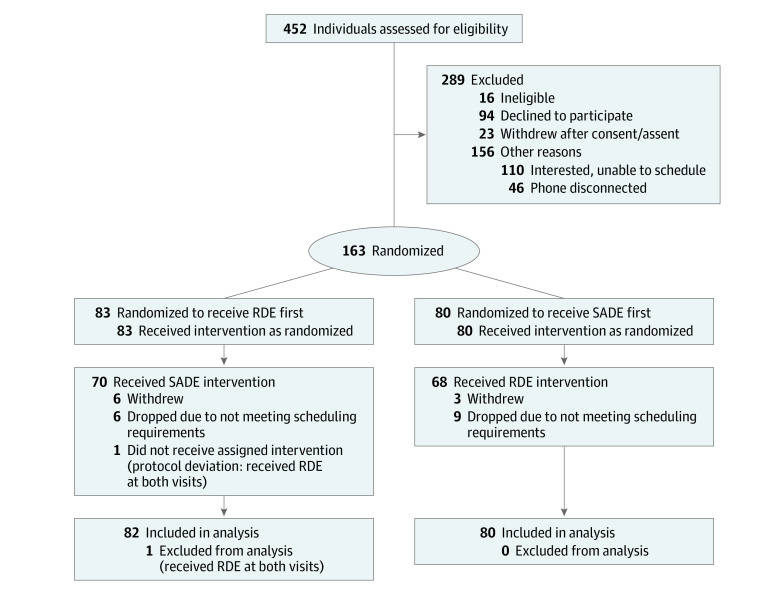
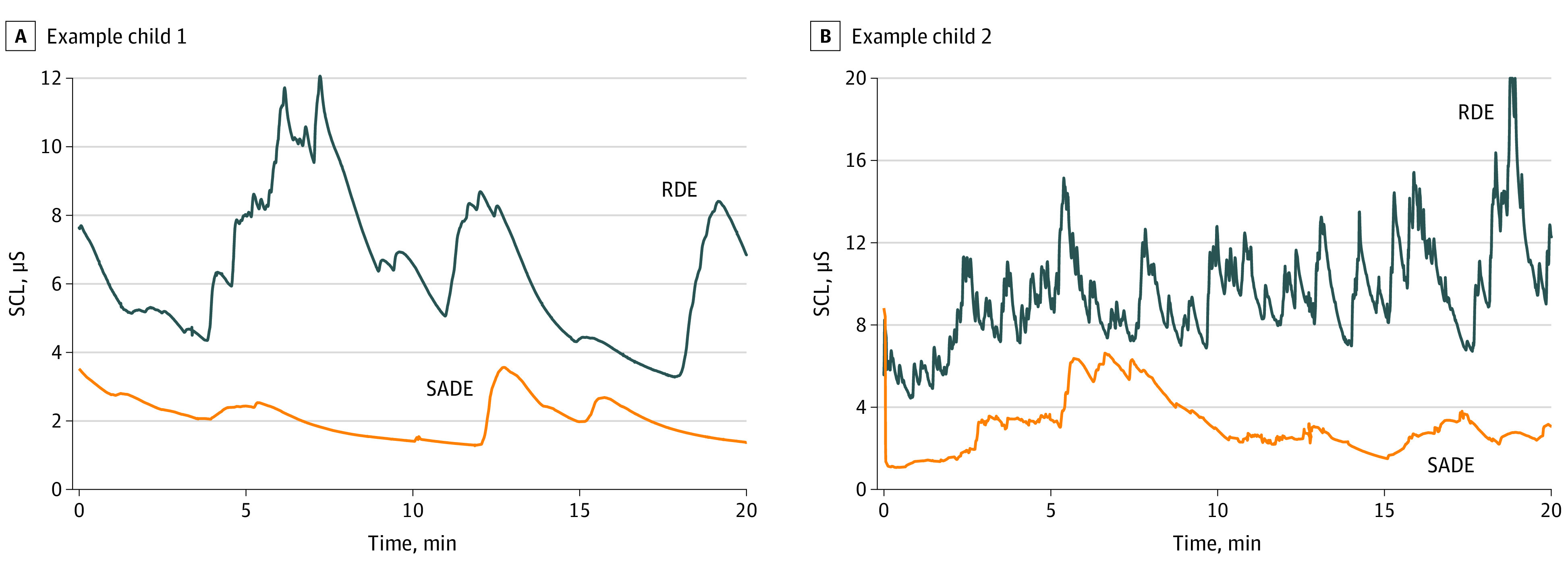
Among 452 families invited to participate, 220 children were enrolled, and 162 children (mean [SD] age, 9.16 [1.99] years; 136 [84.0%] male) with confirmed autism were randomized, with 83 children receiving RDE first and 80 children receiving SADE first. Most children (94 children [58.0%]) had moderate autism severity. Children had significantly lower physiological stress during dental care in SADE compared with RDE (mean difference in skin conductance level, -1.22 [95% CI, -2.17 to -0.27] μS), suggesting decreased sympathetic activity and increased relaxation during SADE dental care. No significant differences were found in nonspecific skin conductance responses (mean difference, -0.30 [95% CI, -0.86 to 0.25] per min). Video-coded frequency and duration of behavioral distress (but not questionnaire) measures were significantly lower in SADE vs RDE (Cohen d = -0.84 to -1.19). Physiological stress was associated with behavioral distress during the dental cleaning (eg, nonspecific skin conductance responses associated with the Frankl Scale: β = -0.29; 95% CI, -0.39 to -0.19); age, IQ, and expressive communication moderated the intervention's success. No participants withdrew due to adverse effects.
In this randomized crossover trial of autistic children, using SADE was safe and efficacious in decreasing physiological and behavioral distress during dental care. This is important because enhancing oral care is critical for autistic children; this intervention may also be beneficial for populations beyond autism.
ClinicalTrials.gov Identifier: NCT02430051.
自闭症儿童的口腔健康状况较差,口腔护理挑战较大,这通常与感觉过度反应有关,与神经典型同龄人相比。为了让牙医能够成功地为这一人群实施标准的临床操作,确定创新的解决方案非常重要。
与常规口腔环境(RDE)相比,确定感觉适应口腔环境(SADE)是否能减少自闭症儿童在接受口腔清洁时的生理和行为困扰。
设计、地点和参与者:这是一项在一家大型城市儿童医院的儿科牙医诊所进行的随机交叉试验,于 2016 年 5 月至 2022 年 4 月进行。生理测量的编码人员对研究条件进行了盲法处理,但行为测量则不然。确定 6 至 12 岁的自闭症儿童并邀请他们参加。有兴趣的家庭连续入组;在确认自闭症诊断后,对儿童进行随机分组。这项基于方案的研究分析于 2022 年 4 月至 10 月进行。
每个孩子都接受了 1 次 RDE 和 1 次 SADE 牙齿清洁,大约 6 个月后以随机和平衡的方式进行。SADE 包括改良的视觉、听觉和触觉刺激。
主要结果是通过皮肤电活动评估的生理应激。次要结果是从视频记录中测量的行为困扰。
在邀请参与的 452 个家庭中,有 220 个家庭的孩子入组,162 个(平均年龄 9.16 [1.99] 岁;136 [84.0%] 为男性)被确诊为自闭症的儿童被随机分组,83 名儿童先接受 RDE,80 名儿童先接受 SADE。大多数儿童(94 名儿童 [58.0%])有中度自闭症严重程度。与 RDE 相比,SADE 中儿童在口腔护理期间的生理应激显著降低(皮肤电导率水平的平均差异,-1.22 [95%CI,-2.17 至 -0.27] μS),这表明在 SADE 口腔护理期间交感神经活动减少,放松度增加。在非特异性皮肤电导率反应方面没有发现显著差异(平均差异,-0.30 [95%CI,-0.86 至 0.25] 每分)。与 RDE 相比,SADE 中视频编码的行为困扰频率和持续时间(但不是问卷)明显更低(Cohen d=-0.84 至-1.19)。在牙齿清洁期间,生理应激与行为困扰相关(例如,与 Frankl 量表相关的非特异性皮肤电导率反应:β=-0.29;95%CI,-0.39 至-0.19);年龄、智商和表达性沟通能力调节了干预的效果。没有参与者因不良反应而退出。
在这项针对自闭症儿童的随机交叉试验中,使用 SADE 安全有效,可减少口腔护理期间的生理和行为困扰。这很重要,因为增强口腔护理对自闭症儿童至关重要;这种干预也可能对自闭症以外的人群有益。
ClinicalTrials.gov 标识符:NCT02430051。