The Christie NHS Foundation Trust, Manchester, UK; Division of Cancer Sciences, University of Manchester, Manchester, UK.
Cancer Research UK Manchester Institute, Cancer Biomarker Centre, University of Manchester, Manchester, UK.
ESMO Open. 2022 Jun;7(3):100430. doi: 10.1016/j.esmoop.2022.100430. Epub 2022 Apr 27.
Antibiotic (ABX) use can reduce the efficacy of immune checkpoint inhibitors and chemotherapeutics. The effect for patients treated with targeted therapies, namely, small-molecule tyrosine kinase inhibitors (TKIs), is less known.
Retrospective data were analysed for TKI-treated patients with advanced melanoma and non-small-cell lung cancer (NSCLC) between January 2015 and April 2017 at The Christie NHS Foundation Trust. Data on demographics, disease burden, lactate dehydrogenase (LDH) level, presence of brain metastases, ECOG performance status (PS) and ABX use were collected. Progression-free survival (PFS) and overall survival (OS) were compared between the ABX+ group (ABX within 2 weeks of TKI initiation-6 weeks after) and the ABX- group (no ABX during the same period).
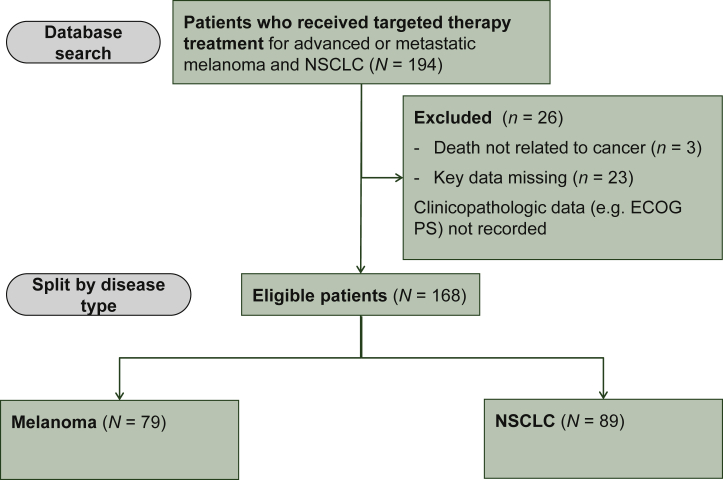
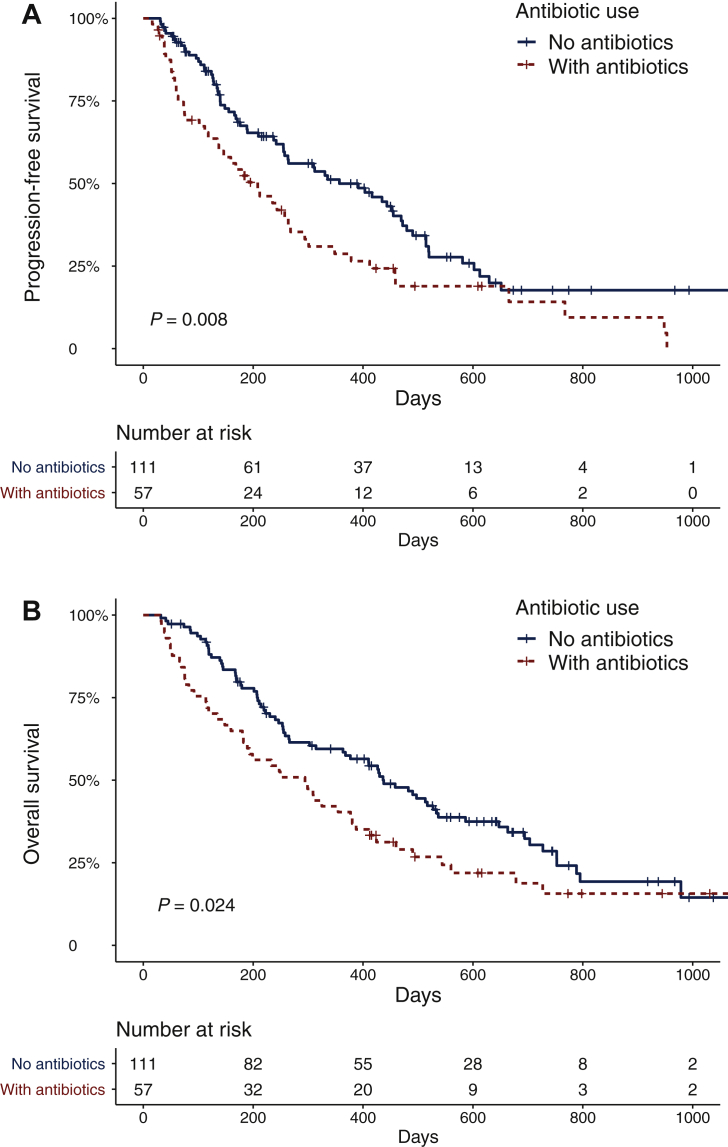
A total of 168 patients were included; 89 (53%) with NSCLC and 79 (47%) with melanoma. 55- (33%) patients received ABX. On univariable analysis, ABX+ patients demonstrated shorter PFS (208 versus 357 days; P = 0.008) and OS (294 versus 438 days; P = 0.024). Increased age, poorer PS and higher LDH were associated with shorter PFS and OS. On multivariable analysis, ABX use was independently associated with shorter PFS [hazard ratio (HR) 1.57, 95% confidence interval (CI) 1.05-2.34, P = 0.028] and OS (HR 2.19, 95% CI 1.44-3.32, P = 0.0002). The negative impact of ABX on OS was particularly pronounced for patients with PS of ≥2 (HR 3.82, 95% CI 1.18-12.36, P = 0.025).
For patients treated with TKIs, ABX use is independently associated with reduced PFS and OS and judicious use is warranted, particularly in patients with poorer PS.
抗生素(ABX)的使用会降低免疫检查点抑制剂和化疗药物的疗效。但靶向治疗药物(即小分子酪氨酸激酶抑制剂(TKI))的疗效则知之甚少。
回顾性分析了 2015 年 1 月至 2017 年 4 月在克里斯蒂 NHS 基金会信托基金接受 TKI 治疗的晚期黑色素瘤和非小细胞肺癌(NSCLC)患者的数据。收集了人口统计学、疾病负担、乳酸脱氢酶(LDH)水平、脑转移存在情况、ECOG 表现状态(PS)和 ABX 使用情况的数据。将 ABX+组(TKI 起始后 2 周内-6 周内使用 ABX)和 ABX-组(同期内未使用 ABX)的无进展生存期(PFS)和总生存期(OS)进行比较。
共纳入 168 例患者,其中 NSCLC 89 例(53%),黑色素瘤 79 例(47%)。55 例(33%)患者使用了 ABX。单变量分析显示,ABX+患者的 PFS 更短(208 天与 357 天;P=0.008),OS 更短(294 天与 438 天;P=0.024)。年龄较大、PS 较差和 LDH 较高与 PFS 和 OS 较短相关。多变量分析显示,ABX 使用与 PFS 更短[风险比(HR)1.57,95%置信区间(CI)1.05-2.34,P=0.028]和 OS 更短(HR 2.19,95%CI 1.44-3.32,P=0.0002)独立相关。ABX 对 OS 的负面影响在 PS≥2 的患者中尤为明显(HR 3.82,95%CI 1.18-12.36,P=0.025)。
对于接受 TKI 治疗的患者,ABX 的使用与 PFS 和 OS 降低独立相关,需要谨慎使用,特别是在 PS 较差的患者中。