Kuczma Michal P, Ding Zhi-Chun, Li Tao, Habtetsion Tsadik, Chen Tingting, Hao Zhonglin, Bryan Locke, Singh Nagendra, Kochenderfer James N, Zhou Gang
Georgia Cancer Center, Augusta University, Augusta, Georgia, USA.
Current/Present address: Institute for Biomedical Sciences, Georgia State University, Atlanta, Georgia, USA.
Oncotarget. 2017 Dec 5;8(67):111931-111942. doi: 10.18632/oncotarget.22953. eCollection 2017 Dec 19.
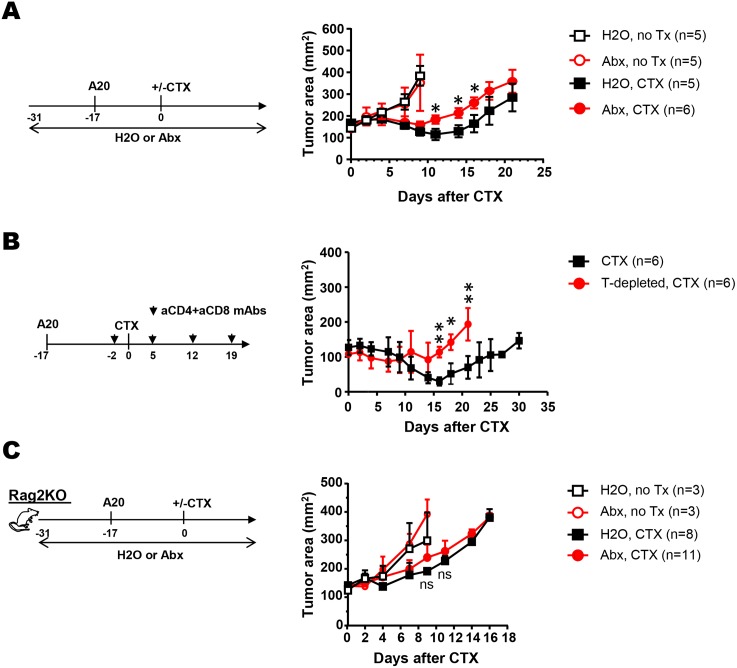
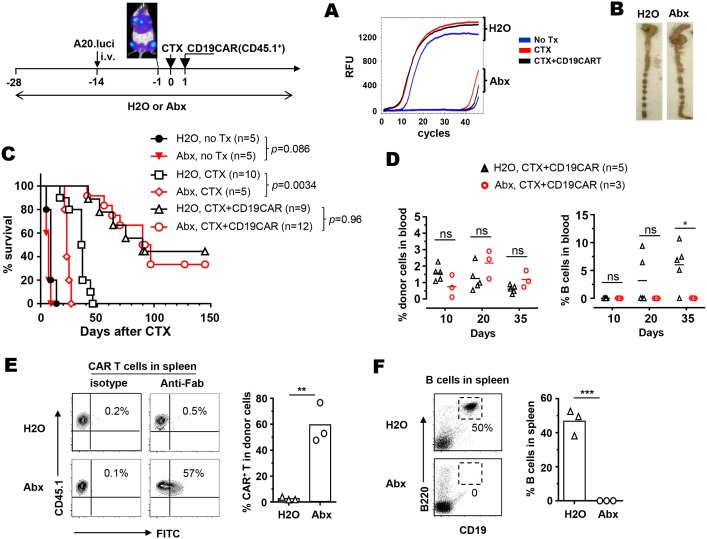
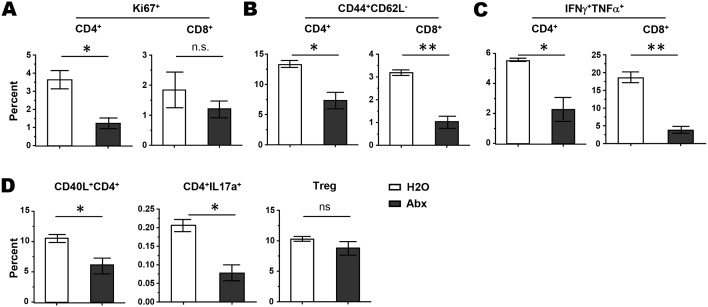
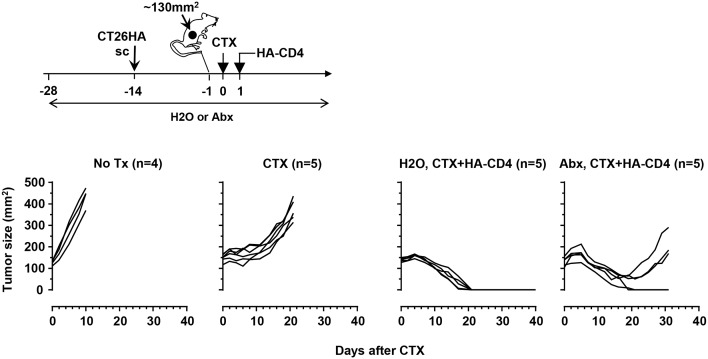
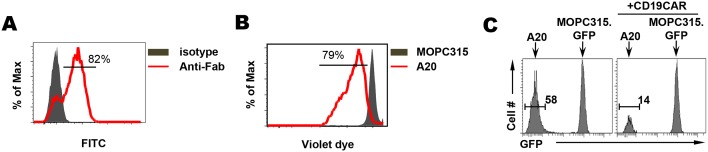
In recent years the combined use of chemotherapy and immunotherapy, collectively termed chemoimmunotherapy, has emerged as a promising treatment option for patients with cancer. Antibiotics are commonly used to reduce infection-related complications in patients undergoing chemotherapy. Intriguingly, accumulating evidence has implicated gut microbiota as a critical determinant of host antitumor immune responses, raising the question as to whether the use of broad-spectrum antibiotics would invariably diminish tumor response to chemoimmunotherapies. We investigated the impact of antibiotics on the therapeutic outcomes of cyclophosphamide (CTX) chemotherapy and adoptive T-cell therapy (ACT) where CTX was used as the host-conditioning regimen in mice. We show that antibiotic prophylaxis dampened the endogenous T cell responses elicited by CTX, and reduced the efficacy of CTX against B-cell lymphoma. In the ACT setting, antibiotics administration impaired the therapeutic effects of adoptively transferred tumor-specific CD4+ T cells in mice with implanted colorectal tumors. In contrast, long-term antibiotic exposure did not affect the efficacy of ACT using CD19-targeting chimeric antigen receptor (CAR) T cells in mice with systemic B-cell lymphoma, although it correlated with prolonged CAR expression and sustained B-cell aplasia. Our study demonstrates that chemoimmunotherapies may have variable reliance on intestinal microbiota for T cell activation and function, and thus have different sensitivities to antibiotic prophylaxis. These findings may have implications for the judicial use of antibiotics in cancer patients receiving chemoimmunotherapies.
近年来,化疗与免疫疗法的联合应用,统称为化学免疫疗法,已成为癌症患者一种有前景的治疗选择。抗生素常用于降低接受化疗患者的感染相关并发症。有趣的是,越来越多的证据表明肠道微生物群是宿主抗肿瘤免疫反应的关键决定因素,这就引发了一个问题,即使用广谱抗生素是否会不可避免地降低肿瘤对化学免疫疗法的反应。我们研究了抗生素对环磷酰胺(CTX)化疗和过继性T细胞疗法(ACT)治疗效果的影响,其中在小鼠中将CTX用作宿主预处理方案。我们发现抗生素预防抑制了CTX引发的内源性T细胞反应,并降低了CTX对B细胞淋巴瘤的疗效。在ACT环境中,抗生素给药损害了植入结直肠癌小鼠中过继转移的肿瘤特异性CD4 + T细胞的治疗效果。相比之下,长期接触抗生素并不影响在患有全身性B细胞淋巴瘤的小鼠中使用靶向CD19的嵌合抗原受体(CAR)T细胞进行ACT的疗效,尽管这与CAR表达延长和持续的B细胞发育不全相关。我们的研究表明,化学免疫疗法对肠道微生物群进行T细胞激活和功能的依赖可能各不相同,因此对抗生素预防具有不同的敏感性。这些发现可能对接受化学免疫疗法的癌症患者合理使用抗生素具有启示意义。