UK Centre for Ecology & Hydrology, Environment Centre Wales, Bangor, UK.
UK Centre for Ecology & Hydrology, Library Ave, Bailrigg, Lancaster, UK.
Sci Rep. 2022 Apr 30;12(1):7085. doi: 10.1038/s41598-022-11099-7.
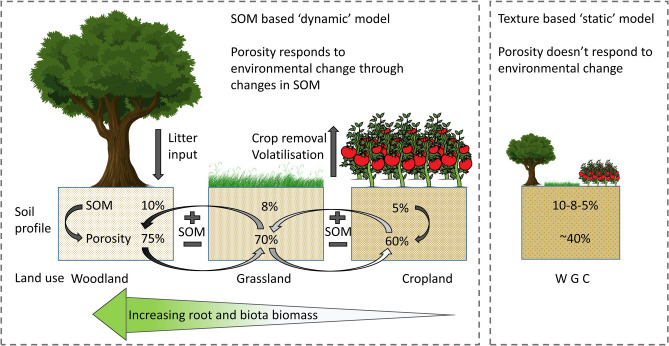
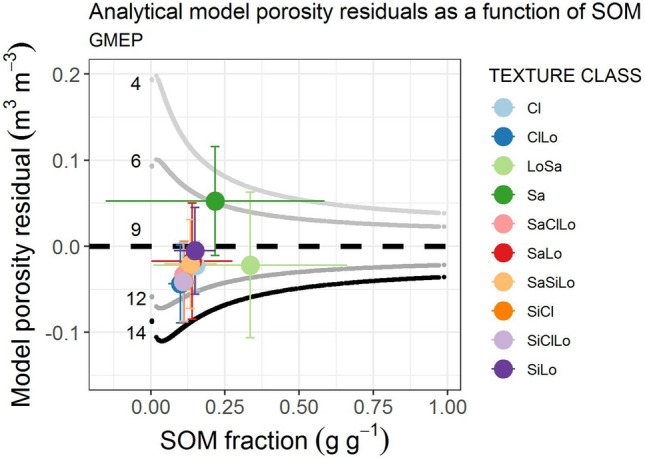
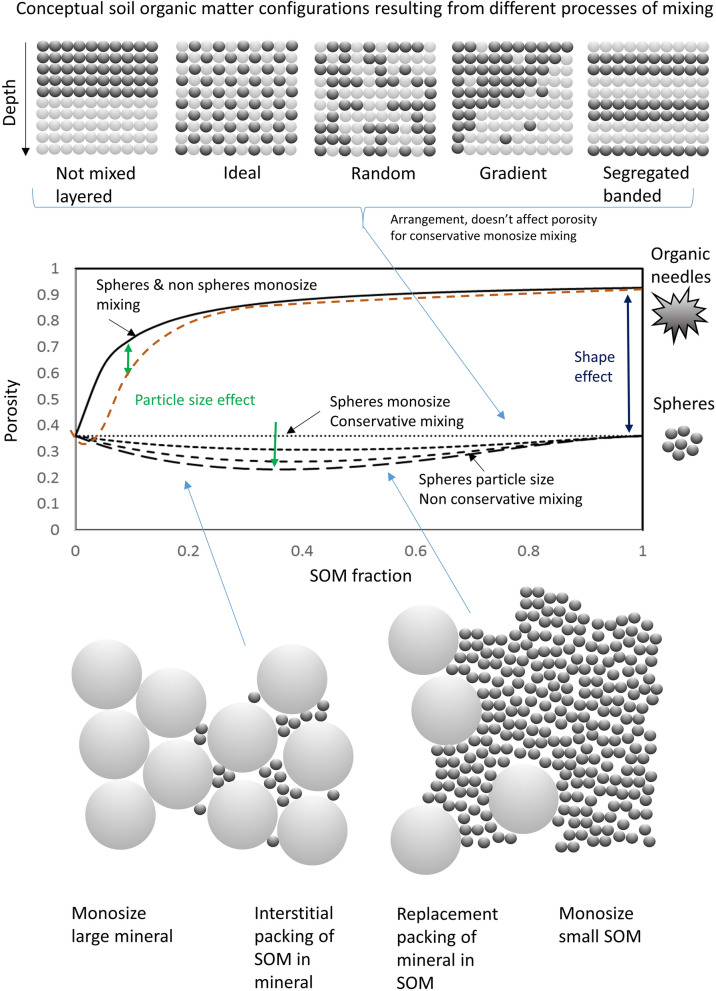
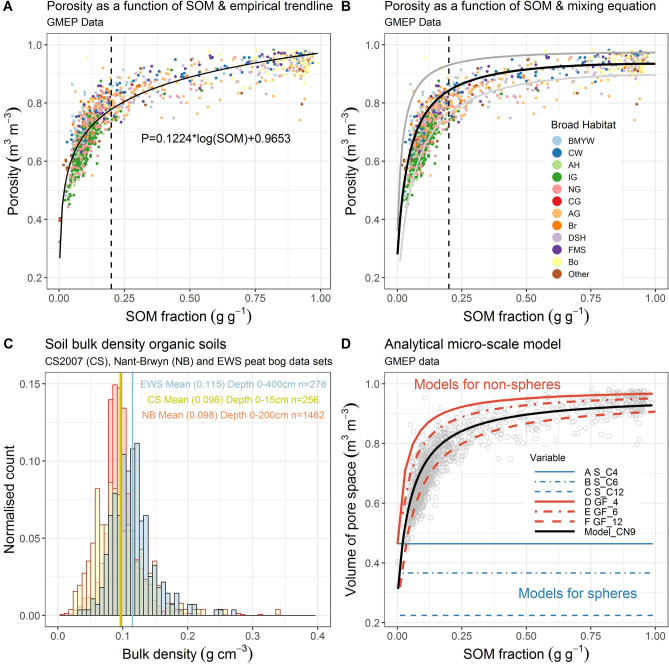
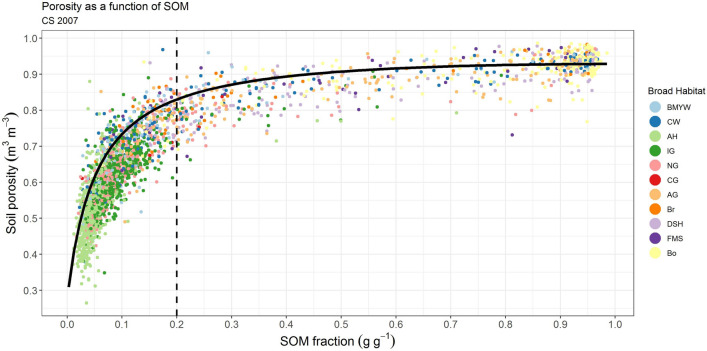
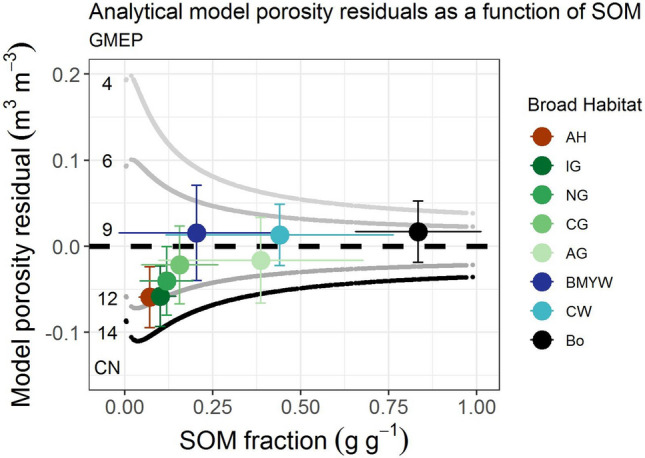
The thin layer of soil at the earth's surface supports life, storing water and nutrients for plant uptake. These processes occur in the soil pore space, often half the soil volume, but our understanding of how this volume responds to environmental change is poor. Convention, has been to predict soil porosity, or its reciprocal bulk density (BD), from soil texture using pedotransfer functions (PTFs). A texture based approach, invariant to environmental change, prevents feedback from land use or climate change to soil porosity. Moreover, PTFs are often limited to mineral soils with < 20% soil organic matter (SOM) content. Here, we develop an analytical model to predict soil porosity, or BD, as a function of SOM. We test it on two comprehensive, methodologically consistent, temperate national-scale topsoil data sets (0-15 cm) (Wales, n = 1385; Great Britain, n = 2570). The purpose of the approach is to generate an analytical function suitable for predicting soil porosity change with SOM content, while providing insight into the main grain-scale factors determining the porosity emergence. The newly developed function covering the entire SOM gradient allows for impacts of land use, management or climate change to feedback on soil porosity or bulk density through decadal dynamic changes in SOM.
土壤表层的薄土层为生命提供支持,储存水分和养分以供植物吸收。这些过程发生在土壤孔隙空间中,通常占土壤体积的一半,但我们对这一体积如何响应环境变化的了解还很有限。传统上,一直使用土壤转移函数 (PTF) 从土壤质地预测土壤孔隙率或其倒数体积密度 (BD)。基于质地的方法对环境变化具有不变性,可以防止土地利用或气候变化对土壤孔隙率的反馈。此外,PTF 通常仅限于矿物质土壤,其土壤有机物质 (SOM) 含量小于 20%。在这里,我们开发了一种分析模型,以 SOM 为函数预测土壤孔隙率或 BD。我们在两个全面的、方法上一致的、温带的全国性表层土壤数据集(0-15 厘米)(威尔士,n=1385;英国,n=2570)上对其进行了测试。该方法的目的是生成一个适合预测土壤孔隙率随 SOM 含量变化的分析函数,同时深入了解决定孔隙率出现的主要颗粒尺度因素。新开发的函数涵盖了整个 SOM 梯度,允许通过 SOM 的数十年动态变化,通过土地利用、管理或气候变化的影响反馈到土壤孔隙率或体积密度上。