Rodriguez-Sevilla Juan Jose, Güerri-Fernádez Roberto, Bertran Recasens Bernat
Hematology Department, Hospital del Mar, Barcelona, Spain.
Infectious Diseases Department, Hospital del Mar Institute of Medical Research (IMIM), Barcelona, Spain.
Front Med (Lausanne). 2022 Apr 12;9:852998. doi: 10.3389/fmed.2022.852998. eCollection 2022.
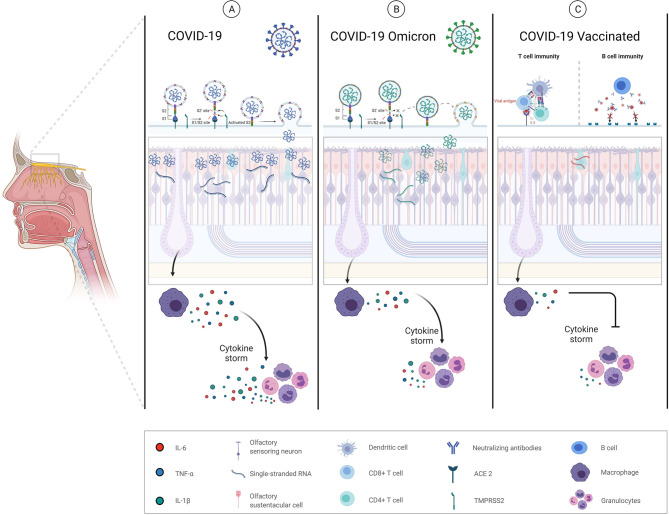
The ongoing pandemic Coronavirus Disease 2019 (COVID-19) caused by the severe acute respiratory syndrome coronavirus 2 (SARS-CoV-2) is a matter of global concern in terms of public health Within the symptoms secondary to SARS-CoV-2 infection, hyposmia and anosmia have emerged as characteristic symptoms during the onset of the pandemic. Although many researchers have investigated the etiopathogenesis of this phenomenon, the main cause is not clear. The appearance of the new variant of concern Omicron has meant a breakthrough in the chronology of this pandemic, presenting greater transmissibility and less severity, according to the first reports. We have been impressed by the decrease in anosmia reported with this new variant and in patients reinfected or who had received vaccination before becoming infected. Based on the literature published to date, this review proposes different hypotheses to explain this possible lesser affectation of smell. On the one hand, modifications in the SARS-CoV-2 spike protein could produce changes in cell tropism and interaction with proteins that promote virus uptake (ACE-2, TMPRSS2, and TMEM16F). These proteins can be found in the sustentacular cells and glandular cells of the olfactory epithelium. Second, due to the characteristics of the virus or previous immunity (infection or vaccination), there could be less systemic or local inflammation that would generate less cell damage in the olfactory epithelium and/or in the central nervous system.
由严重急性呼吸综合征冠状病毒2(SARS-CoV-2)引起的2019年冠状病毒病(COVID-19)疫情是全球公共卫生关注的问题。在SARS-CoV-2感染的继发症状中,嗅觉减退和嗅觉丧失已成为疫情暴发初期的特征性症状。尽管许多研究人员对这一现象的发病机制进行了调查,但其主要原因尚不清楚。根据初步报告,值得关注的新型变异株奥密克戎的出现意味着这场疫情的时间线出现了突破,其传播性更强,严重性更低。我们对这种新变异株以及再次感染或在感染前接种过疫苗的患者中嗅觉丧失情况的减少印象深刻。基于迄今为止发表的文献,本综述提出了不同的假设来解释嗅觉可能受影响较小的原因。一方面,SARS-CoV-2刺突蛋白的修饰可能会导致细胞嗜性的改变以及与促进病毒摄取的蛋白质(血管紧张素转换酶2、跨膜丝氨酸蛋白酶2和跨膜蛋白16F)的相互作用发生变化。这些蛋白质可在嗅觉上皮的支持细胞和腺细胞中发现。其次,由于病毒的特性或先前的免疫力(感染或接种疫苗),可能会有较少的全身或局部炎症,从而在嗅觉上皮和/或中枢神经系统中产生较少的细胞损伤。