Adams Olivia A, Zhang Yangfan, Gilbert Matthew H, Lawrence Craig S, Snow Michael, Farrell Anthony P
Department of Zoology, The University of British Columbia, Vancouver, British Columbia, Canada.
Faculty of Land and Food Systems, The University of British Columbia, Vancouver, British Columbia, Canada.
Conserv Physiol. 2022 Jan 15;10(1):coab101. doi: 10.1093/conphys/coab101. eCollection 2022.
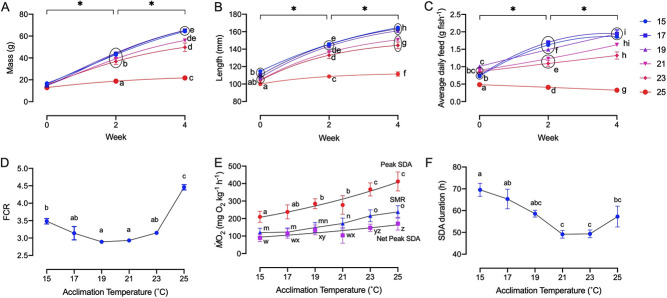
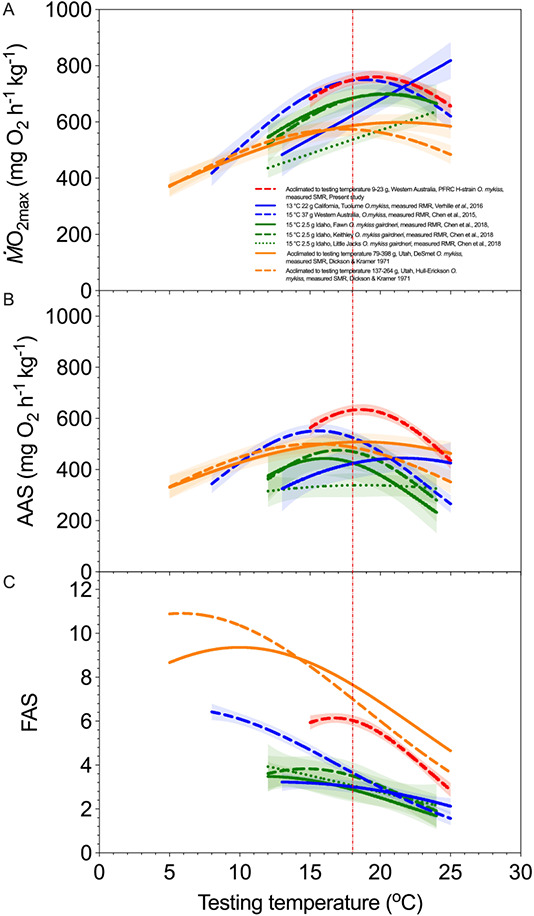
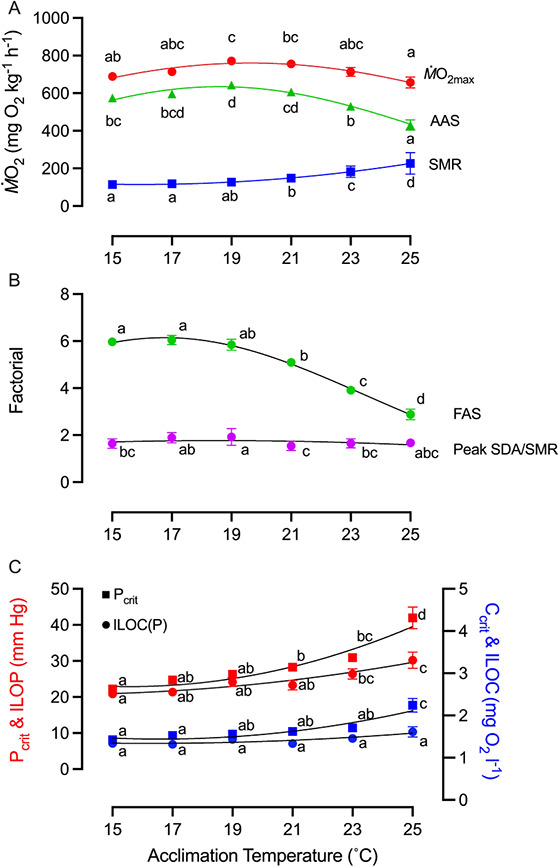
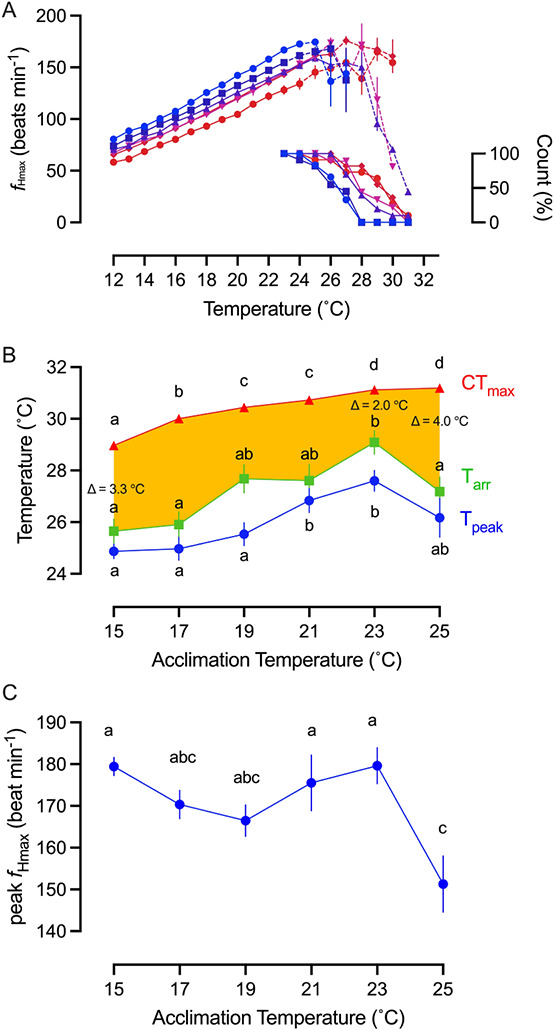
Thermal acclimation, a compensatory physiological response, is central to species survival especially during the current era of global warming. By providing the most comprehensive assessment to date for the cardiorespiratory phenotype of rainbow trout () at six acclimation temperatures from 15°C to 25°C, we tested the hypothesis that, compared with other strains of rainbow trout, an Australian H-strain of rainbow trout has been selectively inbred to have an unusually high and broad thermal acclimation potential. Using a field setting at the breeding hatchery in Western Australia, thermal performance curves were generated for a warm-adapted H-strain by measuring growth, feed conversion efficiency, specific dynamic action, whole-animal oxygen uptake (O) during normoxia and hypoxia, the critical maximum temperature and the electrocardiographic response to acute warming. Appreciable growth and aerobic capacity were possible up to 23°C. However, growth fell off drastically at 25°C in concert with increases in the time required to digest a meal, its total oxygen cost and its peak O. The upper thermal tipping points for appetite and food conversion efficiency corresponded with a decrease in the ability to increase heart rate during warming and an increase in the cost to digest a meal. Also, comparison of upper thermal tipping points provides compelling evidence that limitations to increasing heart rate during acute warming occurred well below the critical thermal maximum (CT) and that the faltering ability of the heart to deliver oxygen at different acclimation temperatures is not reliably predicted by CT for the H-strain of rainbow trout. We, therefore, reasoned the remarkably high thermal acclimation potential revealed here for the Australian H-strain of rainbow trout reflected the existing genetic variation within the founder Californian population, which was then subjected to selective inbreeding in association with severe heat challenges. This is an encouraging discovery for those with conservation concerns for rainbow trout and other fish species. Indeed, those trying to predict the impact of global warming should more fully consider the possibility that the standing intra-specific genetic variation within a fish species could provide a high thermal acclimation potential, similar to that shown here for rainbow trout.
热适应是一种补偿性生理反应,对物种生存至关重要,尤其是在当前全球变暖的时代。通过对虹鳟在15°C至25°C的六个适应温度下的心肺表型进行迄今为止最全面的评估,我们检验了这样一个假设:与其他虹鳟品系相比,澳大利亚H品系的虹鳟经过选择性近亲繁殖,具有异常高且广泛的热适应潜力。在西澳大利亚州的繁殖孵化场的实地环境中,通过测量生长、饲料转化效率、特殊动力作用、常氧和低氧期间的全动物氧摄取量(O)、临界最高温度以及对急性升温的心电图反应,为适应温暖环境的H品系绘制了热性能曲线。在高达23°C时,可观的生长和有氧能力是可能的。然而,在25°C时生长急剧下降,同时消化一餐所需的时间、其总氧成本及其峰值O增加。食欲和食物转化效率的热上限转折点与升温期间心率增加能力的下降以及消化一餐成本的增加相对应。此外,热上限转折点的比较提供了令人信服的证据,即急性升温期间心率增加的限制发生在远低于临界热最大值(CT)的温度下,并且对于虹鳟H品系,心脏在不同适应温度下输送氧气的能力下降不能通过CT可靠预测。因此,我们推断,这里揭示的澳大利亚虹鳟H品系极高的热适应潜力反映了创始加利福尼亚种群内现有的遗传变异,然后在面临严重热挑战的情况下进行了选择性近亲繁殖。对于那些关注虹鳟和其他鱼类保护的人来说,这是一个令人鼓舞的发现。事实上,那些试图预测全球变暖影响的人应该更充分地考虑鱼类物种内现有的种内遗传变异可能提供高热适应潜力的可能性,就像这里虹鳟所显示的那样。