Department of Ecology, Evolution and Marine Biology, University of California, Santa Barbara, CA, 93106, USA.
Sci Rep. 2023 Oct 19;13(1):17900. doi: 10.1038/s41598-023-44574-w.
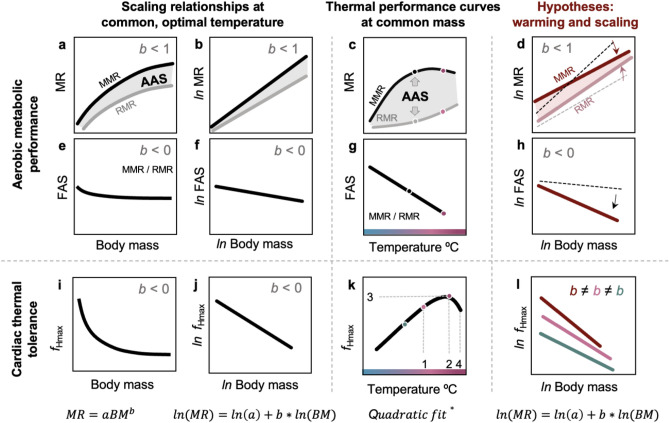
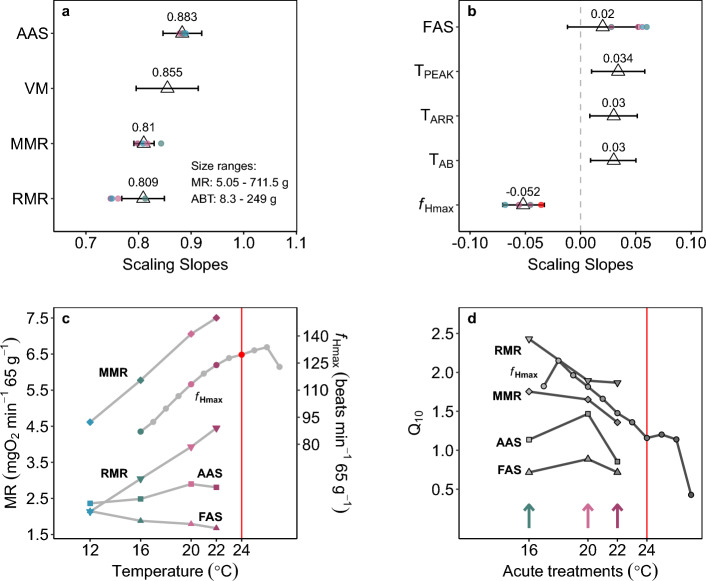
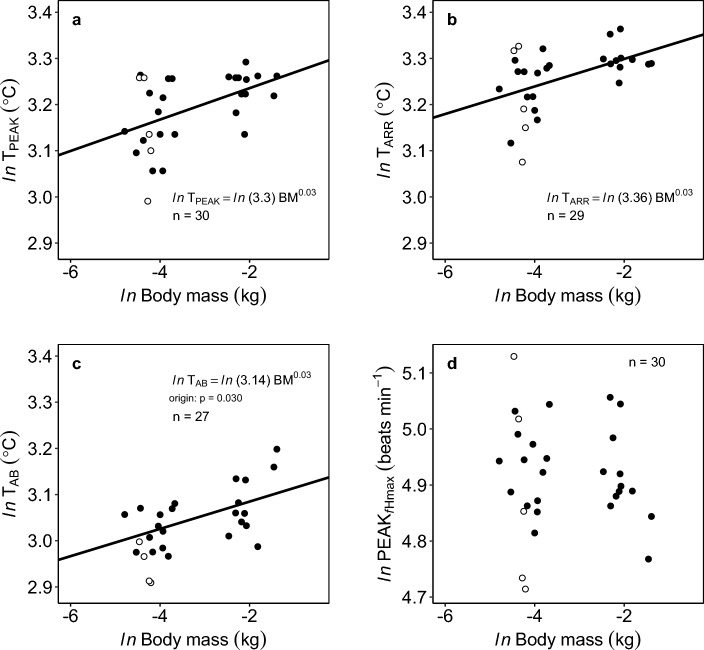
Environmental warming is associated with reductions in ectotherm body sizes, suggesting that larger individuals may be more vulnerable to climate change. The mechanisms driving size-specific vulnerability to temperature are unknown but are required to finetune predictions of fisheries productivity and size-structure community responses to climate change. We explored the potential metabolic and cardiac mechanisms underlying these body size vulnerability trends in a eurythermal fish, barred surfperch. We acutely exposed surfperch across a large size range (5-700 g) to four ecologically relevant temperatures (16 °C, 12 °C, 20 °C, and 22 °C) and subsequently, measured their metabolic capacity (absolute and factorial aerobic scopes, maximum and resting metabolic rates; AAS, FAS, MMR, RMR). Additionally, we estimated the fish's cardiac thermal tolerance by measuring their maximum heart rates (f) across acutely increasing temperatures. Barred surfperch had parallel hypoallometric scaling of MMR and RMR (exponent 0.81) and a weaker hypoallometric scaling of f (exponent - 0.05) across all test temperatures. In contrast to our predictions, the fish's aerobic capacity was maintained across sizes and acute temperatures, and larger fish had greater cardiac thermal tolerance than smaller fish. These results demonstrate that thermal performance may be limited by different physiological constraints depending on the size of the animal and species of interest.
环境变暖与变温动物体型缩小有关,这表明较大的个体可能更容易受到气候变化的影响。导致对温度的特定体型脆弱性的机制尚不清楚,但需要对渔业生产力和大小结构社区对气候变化的反应进行微调预测。我们在一种广温性鱼类,条纹鲈中探索了这些体型脆弱性趋势背后潜在的代谢和心脏机制。我们在一个较大的体型范围内(5-700 克)急性暴露于四种生态相关温度(16°C、12°C、20°C 和 22°C),随后测量了它们的代谢能力(绝对和因子有氧范围、最大和静息代谢率;AAS、FAS、MMR、RMR)。此外,我们通过测量鱼在急性升温过程中的最大心率(f)来估计其心脏的热耐受能力。条纹鲈在所有测试温度下,MMR 和 RMR 的超比例缩小(指数 0.81),f 的超比例缩小较弱(指数-0.05)。与我们的预测相反,鱼类的有氧能力在体型和急性温度范围内保持不变,较大的鱼比较小的鱼具有更大的心脏热耐受能力。这些结果表明,热性能可能受到不同生理限制的限制,具体取决于动物的大小和感兴趣的物种。