Pfeffer Martina, von Gall Charlotte, Wicht Helmut, Korf Horst-Werner
Institute of Anatomy II, Medical Faculty, Heinrich Heine University, Düsseldorf, Germany.
Dr. Senckenbergische Anatomie II, Fachbereich Medizin der Goethe-Universität, Frankfurt am Main, Germany.
Front Physiol. 2022 Apr 12;13:883637. doi: 10.3389/fphys.2022.883637. eCollection 2022.
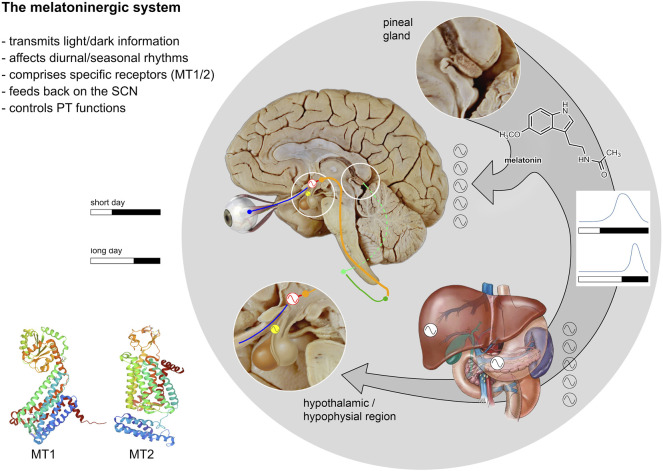
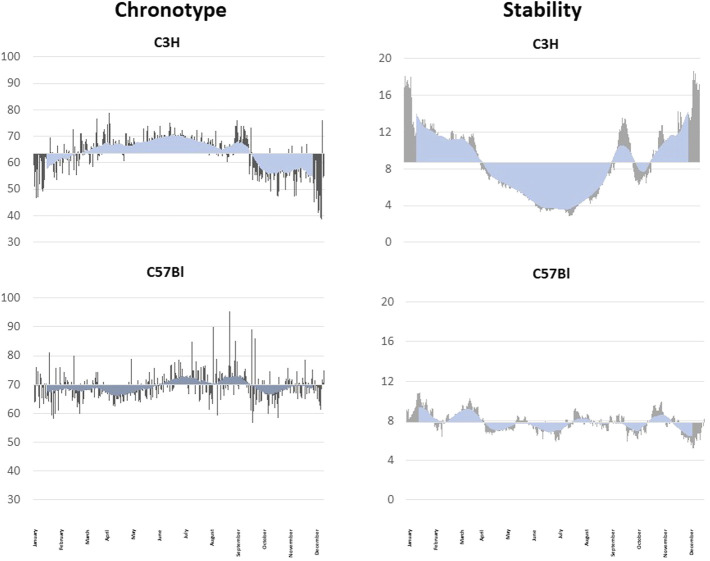
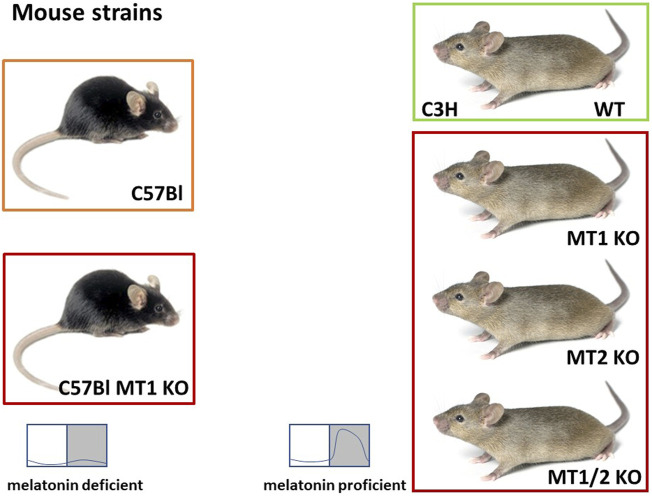
The melatoninergic system comprises the neurohormone melatonin and its molecular targets. The major source of melatonin is the pineal organ where melatonin is rhythmically produced during darkness. In mammals, melatonin biosynthesis is controlled by the central circadian rhythm generator in the suprachiasmatic nucleus (SCN) and photoreceptors in the retina. Melatonin elicits its function principally through two specific receptors called MT1 and MT2. MT1 is highly expressed in the SCN and the hypophysial pars tuberalis (PT), an important interface for control of seasonal functions. The expression of the MT2 is more widespread. The role of the melatoninergic system in the control of seasonal functions, such as reproduction, has been known for more than 4 decades, but investigations on its impact on the circadian system under normal (entrained) conditions started 2 decades later by comparing mouse strains with a fully functional melatoninergic system with mouse strains which either produce insufficient amounts of melatonin or lack the melatonin receptors MT1 and MT2. These studies revealed that an intact melatoninergic system is not required for the generation or maintenance of rhythmic behavior under physiological entrained conditions. As shown by jet lag experiments, the melatoninergic system facilitated faster re-entrainment of locomotor activity accompanied by a more rapid adaptation of the molecular clock work in the SCN. This action depended on MT2. Further studies indicated that the endogenous melatoninergic system stabilizes the locomotor activity under entrained conditions. Notably, these effects of the endogenous melatoninergic system are subtle, suggesting that other signals such as corticosterone or temperature contribute to the synchronization of locomotor activity. Outdoor experiments lasting for a whole year indicate a seasonal plasticity of the chronotype which depends on the melatoninergic system. The comparison between mice with an intact or a compromised melatoninergic system also points toward an impact of this system on sleep, memory and metabolism.
褪黑素能系统由神经激素褪黑素及其分子靶点组成。褪黑素的主要来源是松果体,在黑暗期间松果体有节律地分泌褪黑素。在哺乳动物中,褪黑素的生物合成受视交叉上核(SCN)中的中枢昼夜节律发生器和视网膜中的光感受器控制。褪黑素主要通过两种特定的受体MT1和MT2发挥其功能。MT1在SCN和垂体结节部(PT)中高度表达,垂体结节部是控制季节性功能的重要界面。MT2的表达更为广泛。褪黑素能系统在控制季节性功能(如繁殖)中的作用已为人所知超过40年,但对其在正常(同步化)条件下对昼夜节律系统影响的研究在20年后才开始,通过比较具有功能完整的褪黑素能系统的小鼠品系与褪黑素分泌不足或缺乏褪黑素受体MT1和MT2的小鼠品系。这些研究表明,在生理同步化条件下,完整的褪黑素能系统对于节律性行为的产生或维持并非必需。如时差实验所示,褪黑素能系统促进了运动活动更快地重新同步化,同时伴随着SCN中分子时钟工作的更快适应。这种作用依赖于MT2。进一步的研究表明,内源性褪黑素能系统在同步化条件下稳定运动活动。值得注意的是,内源性褪黑素能系统的这些作用很微妙,表明其他信号如皮质酮或温度有助于运动活动的同步化。持续一整年的户外实验表明,昼夜节律类型具有季节性可塑性,这取决于褪黑素能系统。具有完整或受损褪黑素能系统的小鼠之间的比较也表明该系统对睡眠、记忆和代谢有影响。