Crawford Colin L, Antoniou Christina, Komarek Lina, Schultz Verena, Donald Claire L, Montague Paul, Barnett Susan C, Linington Christopher, Willison Hugh J, Kohl Alain, Coleman Michael P, Edgar Julia M
Institute of Infection, Immunity and Inflammation, College of Medical, Veterinary and Life Sciences, University of Glasgow, Glasgow, United Kingdom.
John van Geest Centre for Brain Repair, Cambridge, United Kingdom.
Front Mol Neurosci. 2022 Apr 13;15:860410. doi: 10.3389/fnmol.2022.860410. eCollection 2022.
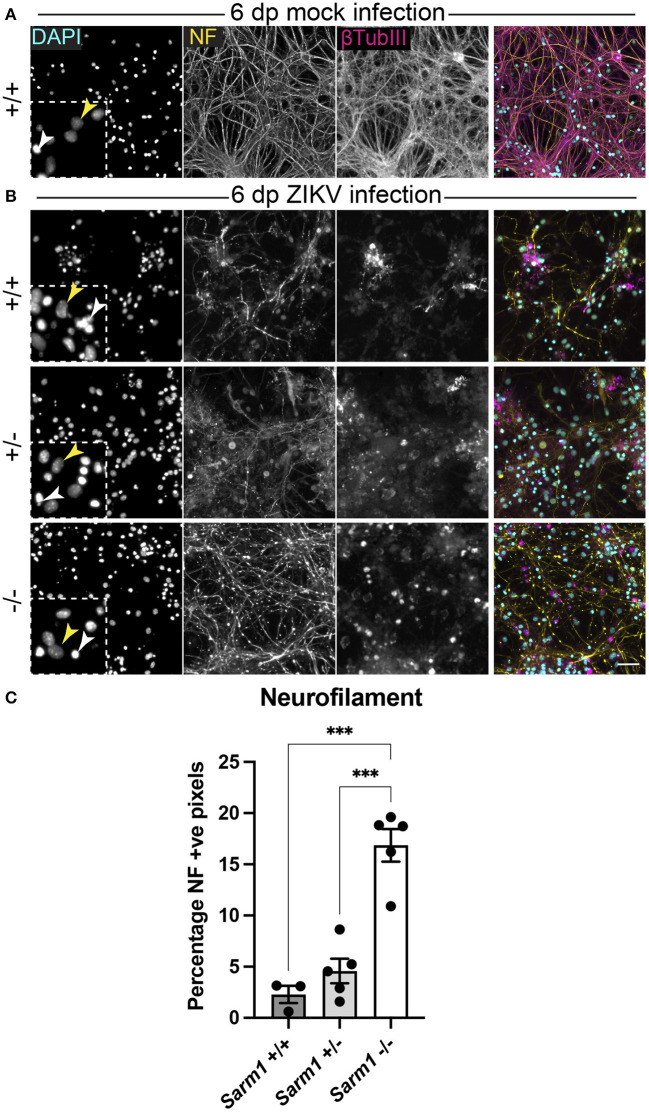
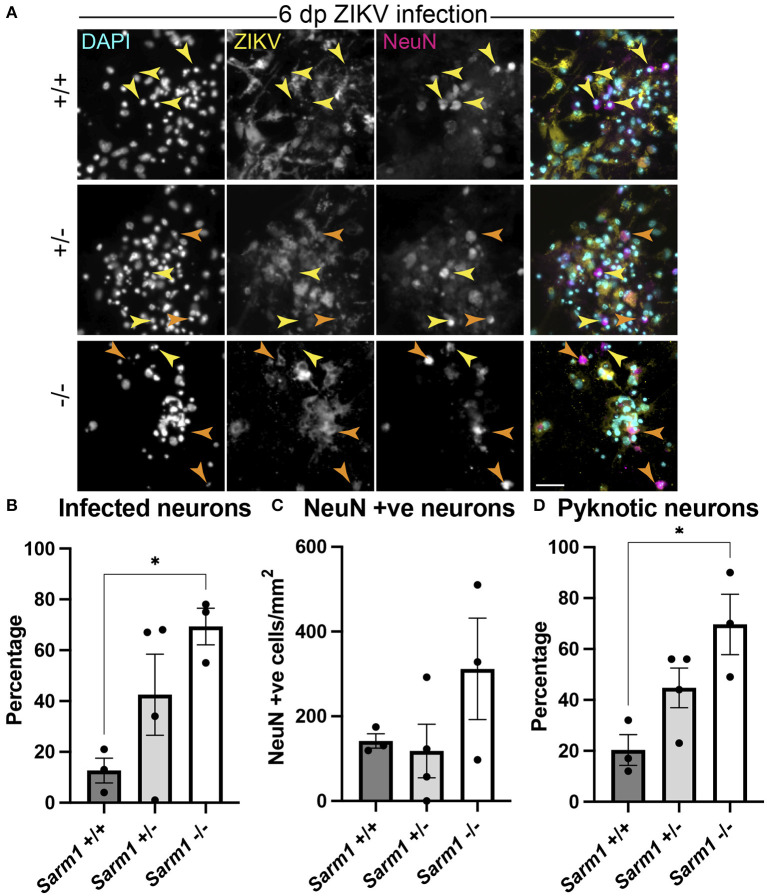
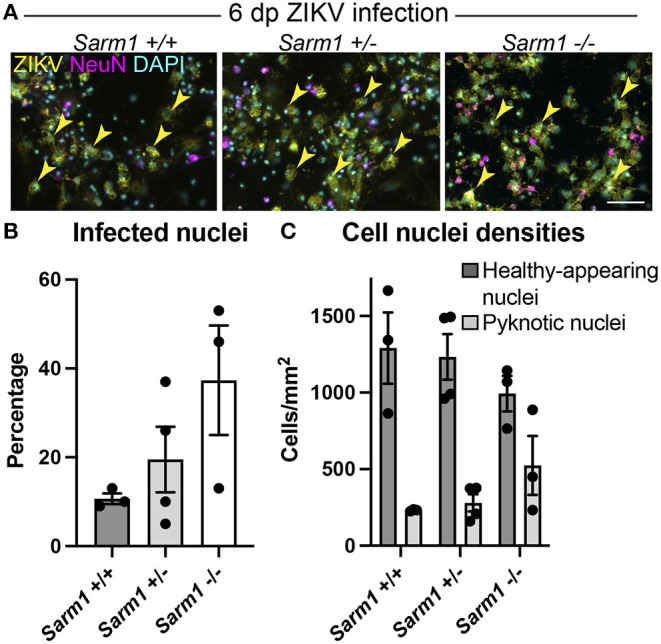
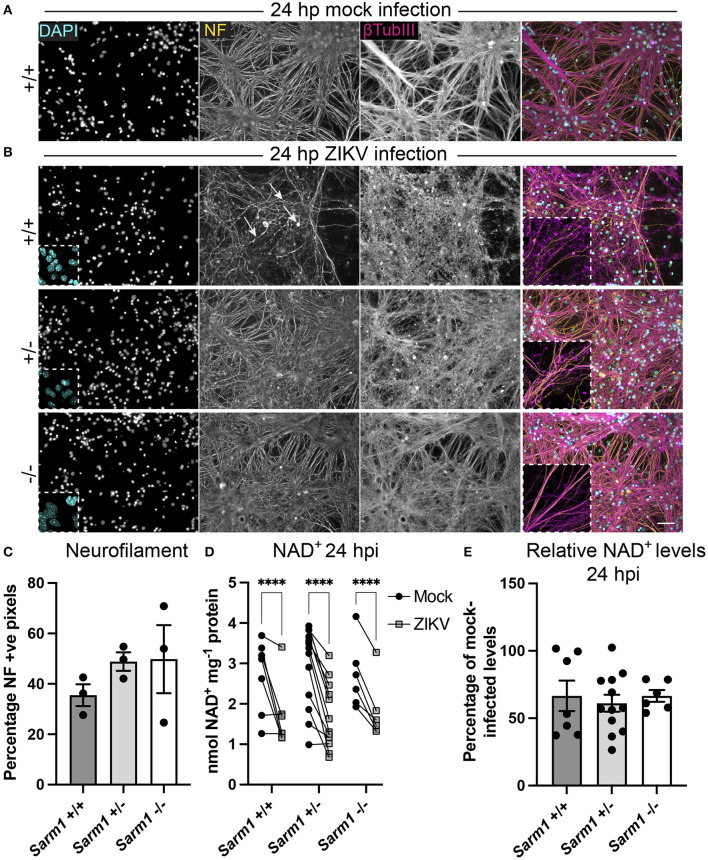
Zika virus (ZIKV) is a neurotropic flavivirus recently linked to congenital ZIKV syndrome in children and encephalitis and Guillain-Barré syndrome in adults. Neurotropic viruses often use axons to traffic to neuronal or glial cell somas where they either remain latent or replicate and proceed to infect new cells. Consequently, it has been suggested that axon degeneration could represent an evolutionarily conserved mechanism to limit viral spread. Whilst it is not known if ZIKV transits in axons, we previously reported that ZIKV infection of glial cells in a murine spinal cord-derived cell culture model of the CNS is associated with a profound loss of neuronal cell processes. This, despite that postmitotic neurons are relatively refractory to infection and death. Here, we tested the hypothesis that ZIKV-associated degeneration of neuronal processes is dependent on activation of Sterile alpha and armadillo motif-containing protein 1 (SARM1), an NADase that acts as a central executioner in a conserved axon degeneration pathway. To test this, we infected wild type and homozygous or heterozygous null cell cultures with ZIKV and examined NAD levels as well as the survival of neurons and their processes. Unexpectedly, ZIKV infection led to a rapid SARM1-independent reduction in NAD. Nonetheless, the subsequent profound loss of neuronal cell processes was SARM1-dependent and was preceded by early changes in the appearance of β-tubulin III staining. Together, these data identify a role for SARM1 in the pathogenesis of ZIKV infection, which may reflect SARM1's conserved prodegenerative function, independent of its NADase activity.
寨卡病毒(ZIKV)是一种嗜神经黄病毒,最近被发现与儿童先天性寨卡病毒综合征以及成人脑炎和吉兰 - 巴雷综合征有关。嗜神经病毒通常利用轴突运输到神经元或神经胶质细胞的胞体,在那里它们要么保持潜伏状态,要么进行复制并继续感染新的细胞。因此,有人提出轴突退化可能是一种进化上保守的限制病毒传播的机制。虽然尚不清楚寨卡病毒是否通过轴突传播,但我们之前报道过,在中枢神经系统的小鼠脊髓衍生细胞培养模型中,神经胶质细胞感染寨卡病毒与神经元细胞突起的大量丧失有关。尽管有丝分裂后的神经元对感染和死亡相对不敏感。在这里,我们测试了这样一个假设,即寨卡病毒相关的神经元突起退化依赖于含无菌α和犰狳基序蛋白1(SARM1)的激活,SARM1是一种NAD酶,在保守的轴突退化途径中起核心刽子手的作用。为了验证这一点,我们用寨卡病毒感染野生型以及纯合或杂合缺失的细胞培养物,并检测NAD水平以及神经元及其突起的存活情况。出乎意料的是,寨卡病毒感染导致NAD迅速减少,且不依赖于SARM1。然而,随后神经元细胞突起的大量丧失是依赖于SARM1的,并且在β - 微管蛋白III染色外观出现早期变化之前就已发生。总之,这些数据确定了SARM1在寨卡病毒感染发病机制中的作用,这可能反映了SARM1保守的促退化功能,与其NAD酶活性无关。