Uchimaru Tadafumi, Yamane Shogo, Mizukado Junji, Tsuzuki Seiji
Research Institute for Sustainable Chemistry, National Institute of Advanced Industrial Science and Technology Higashi, 1-1-1 Tsukuba Ibaraki 305-8565 Japan
Research Center for Computational Design of Advanced Functional Materials, National Institute of Advanced Industrial Science and Technology Umezono, 1-1-1 Tsukuba Ibaraki 305-8568 Japan.
RSC Adv. 2020 Apr 22;10(27):15955-15965. doi: 10.1039/d0ra02463e. eCollection 2020 Apr 21.
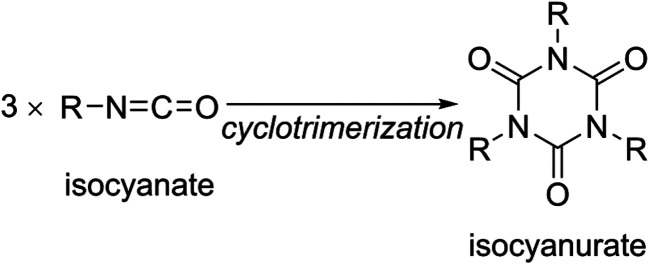
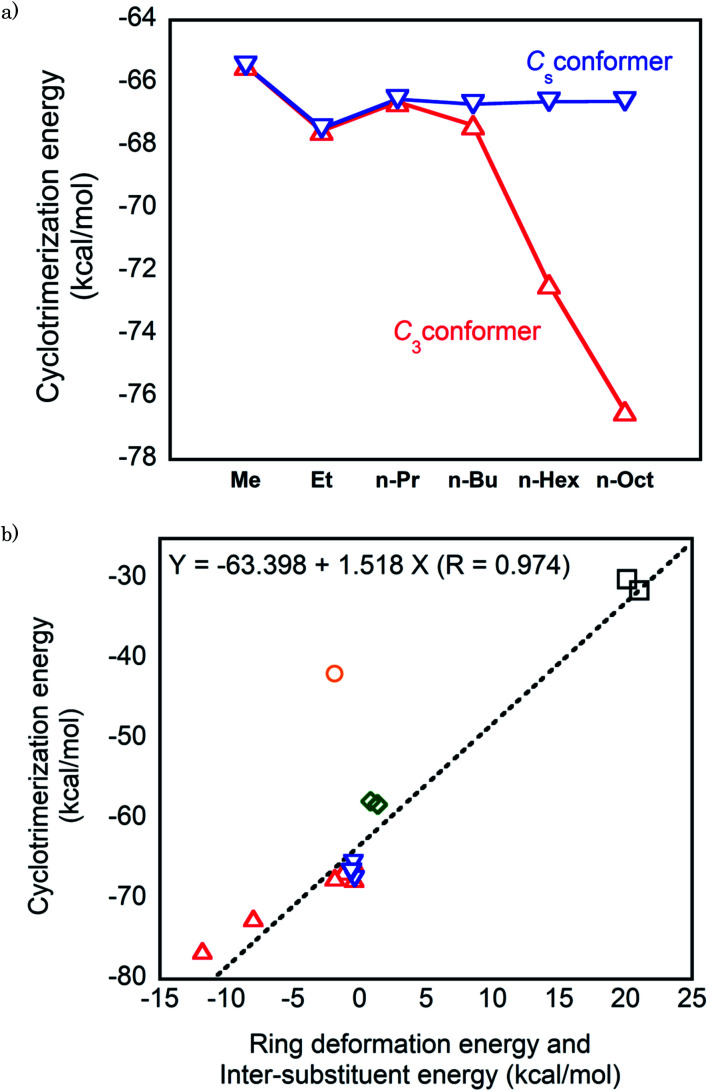
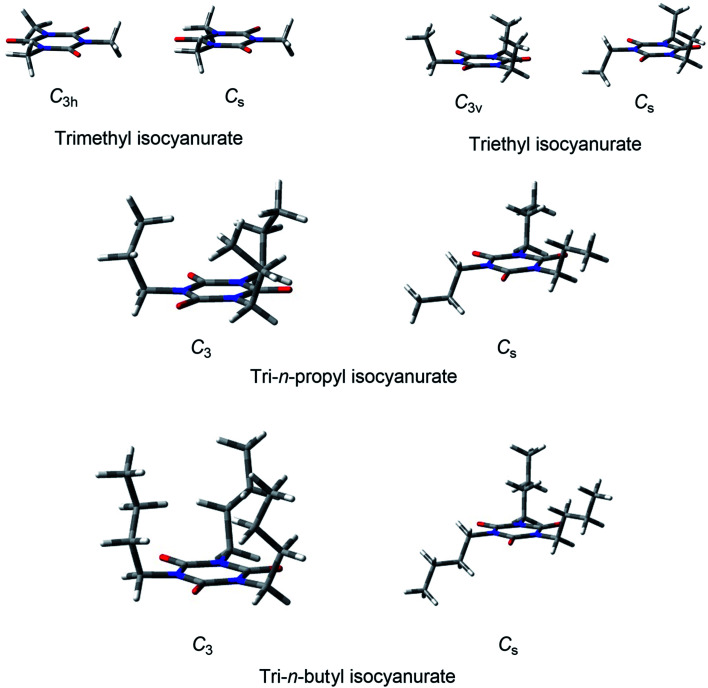
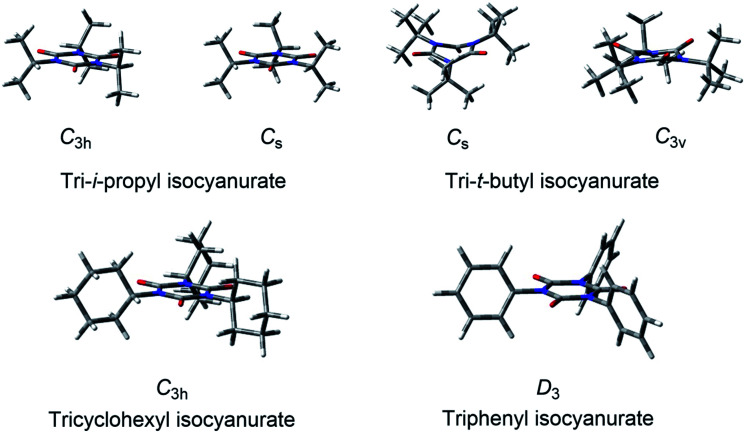
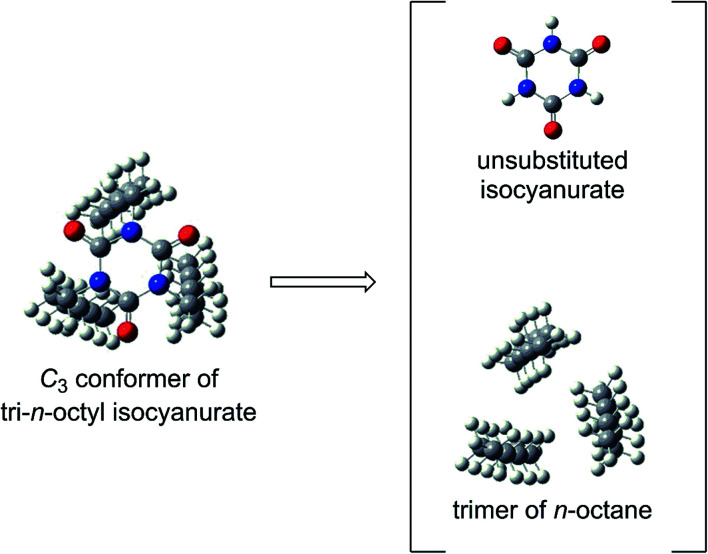
Isocyanurates are cyclic trimers of isocyanate molecules. They are generally known as highly thermostable compounds. However, it is interesting how the thermal stabilities of the isocyanurate molecules will be altered depending on the substituents of their three nitrogen atoms. We performed computational investigations on the thermochemical behaviors of isocyanurate molecules with various alkyl and phenyl substituents. The cyclotrimerization processes of isocyanates are highly exothermic. Our best estimate of the enthalpy change for the cyclotrimerization of methyl isocyanate into trimethyl isocyanurate was -66.4 kcal mol. Additional negative cyclotrimerization enthalpy changes were observed for -alkyl-substituted isocyanates. This trend was enhanced with an extension of -alkyl chains. Conversely, low negative cyclotrimerization enthalpy changes were shown for secondary and tertiary alkyl-substituted isocyanates. The -alkyl-substituted isocyanurates were shown to be stabilized due to attractive dispersion interactions between the substituents. Meanwhile, the branched alkyl-substituted isocyanurates were destabilized due to the deformation of their isocyanurate rings. For various alkyl-substituted isocyanates, the sum of the deformation energy of the isocyanurate ring and the intramolecular inter-substituent nonbonding interaction energies was found to be linearly correlated with their cyclotrimerization energies. The cyclotrimerization energy for phenyl isocyanate was shown to have significantly deviated from the linear relationship observed for the alkyl-substituted isocyanurates. This is probably attributable to a remarkable change in the orbital resonance interactions during the cyclotrimerization of phenyl isocyanate to triphenyl isocyanurate.
异氰尿酸酯是异氰酸酯分子的环状三聚体。它们通常被认为是高度热稳定的化合物。然而,有趣的是,异氰尿酸酯分子的热稳定性如何根据其三个氮原子的取代基而改变。我们对具有各种烷基和苯基取代基的异氰尿酸酯分子的热化学行为进行了计算研究。异氰酸酯的环三聚化过程是高度放热的。我们对甲基异氰酸酯环三聚化为三甲基异氰尿酸酯的焓变的最佳估计值为-66.4千卡/摩尔。对于烷基取代的异氰酸酯,观察到了额外的负环三聚化焓变。随着烷基链的延长,这种趋势增强。相反,仲烷基和叔烷基取代的异氰酸酯显示出较低的负环三聚化焓变。烷基取代的异氰尿酸酯由于取代基之间有吸引力的色散相互作用而被稳定。同时,支链烷基取代的异氰尿酸酯由于其异氰尿酸酯环的变形而不稳定。对于各种烷基取代的异氰酸酯,发现异氰尿酸酯环的变形能和分子内取代基间非键相互作用能的总和与它们的环三聚化能呈线性相关。苯基异氰酸酯的环三聚化能明显偏离了烷基取代异氰尿酸酯所观察到的线性关系。这可能归因于苯基异氰酸酯环三聚化为三苯基异氰尿酸酯过程中轨道共振相互作用的显著变化。