Fallahi Nafiseh, Hafezalkotob Ashkan, Raissi Sadigh, Ghezavati Vahidreza
Tehran, Iran College of Industrial Engineering, Islamic Azad University, South Tehran Branch.
Environ Dev Sustain. 2023;25(6):5597-5633. doi: 10.1007/s10668-022-02282-x. Epub 2022 Apr 26.
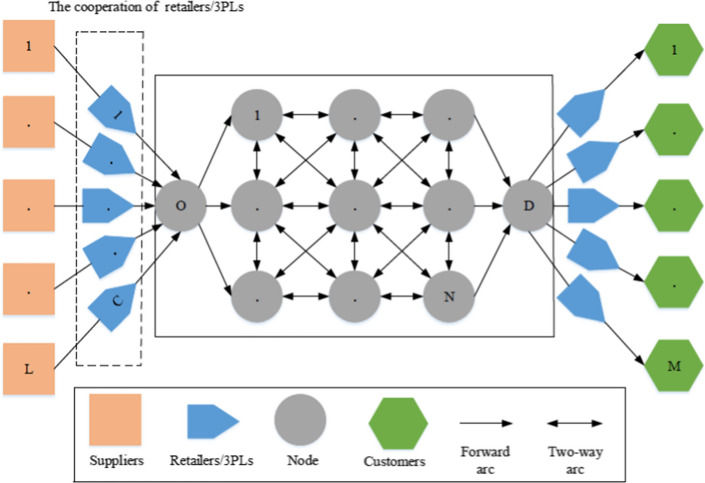
Optimal profits for third-party logistics providers (3PLs) can be analyzed using the networks model to determine decision-making processes within transshipment and logistics, distribution networks, etc. Increasing academic attention is currently being focused upon fields examining 3PLs' operations within logistics networks. This paper studies cooperative game theory (CGT) of retailers-3PLs that make an alliance with each other with a specified demand function. The logistics network involves several suppliers and retailers-3PLs alliances, a distribution graph consisting of several nodes and arcs as well as multiple customers. Retailers-3PLs purchase the same goods from suppliers and sell to customers after shipping via the network; they also consider environmental issues to reduce pollutants and emissions fines. The proposed nonlinear programming (NLP) model aims to find the best flow and price of goods under cooperation conditions among retailers-3PLs by analyzing their risk levels. Controlling uncertainty in the models is accomplished by Mulvey's robust approach. In a general coalition, fair profit distribution methods are applied to share the profits among retailers-3PLs under different risk situations. We conduct a numerical analysis to present the application of our proposed model and find whether coalitions and cooperation between retailers-3PLs reduce costs and increase profits. Finally, we report the sensitivity analysis results regarding the penalties imposed for pollutant emissions, along with suggestions for future research. The results reveal that since their profit is greater in the coalition mode, they tend to cooperate with each other, whatever the amount of pollution fines be.
第三方物流供应商(3PLs)的最优利润可以通过网络模型进行分析,以确定转运和物流、分销网络等中的决策过程。目前,学术界越来越关注研究第三方物流供应商在物流网络中的运营领域。本文研究了具有特定需求函数的零售商 - 第三方物流供应商之间相互结盟的合作博弈理论(CGT)。物流网络涉及多个供应商和零售商 - 第三方物流供应商联盟、一个由多个节点和弧组成的分销图以及多个客户。零售商 - 第三方物流供应商从供应商处采购相同的商品,并在通过网络运输后销售给客户;他们还考虑环境问题以减少污染物和排放罚款。所提出的非线性规划(NLP)模型旨在通过分析零售商 - 第三方物流供应商之间的风险水平,找到合作条件下商品的最佳流量和价格。模型中的不确定性控制通过马尔维的稳健方法来实现。在一般联盟中,应用公平利润分配方法在不同风险情况下的零售商 - 第三方物流供应商之间分享利润。我们进行了数值分析,以展示所提出模型的应用,并研究零售商 - 第三方物流供应商之间的联盟与合作是否能降低成本并增加利润。最后,我们报告了关于污染物排放处罚的敏感性分析结果以及对未来研究的建议。结果表明,由于在联盟模式下他们的利润更高,无论污染罚款金额如何,他们都倾向于相互合作。