Pandya Vaibhav Kumar, Sonwane Babasaheb, Rathore Rajeshwari, Unnikrishnan A G, Kumaran Sangaralingam, Kulkarni Mahesh J
Proteomics Facility, Biochemical Sciences Division, CSIR-National Chemical Laboratory Pune-411008 India
Academy of Scientific and Innovative Research (AcSIR) Ghaziabad India.
RSC Adv. 2020 Jan 2;10(2):763-769. doi: 10.1039/c9ra08532g.
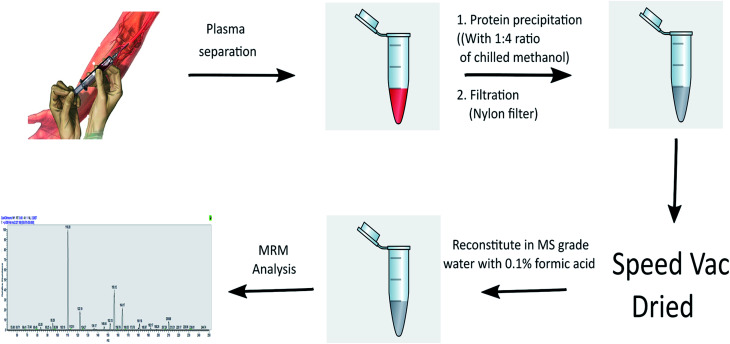
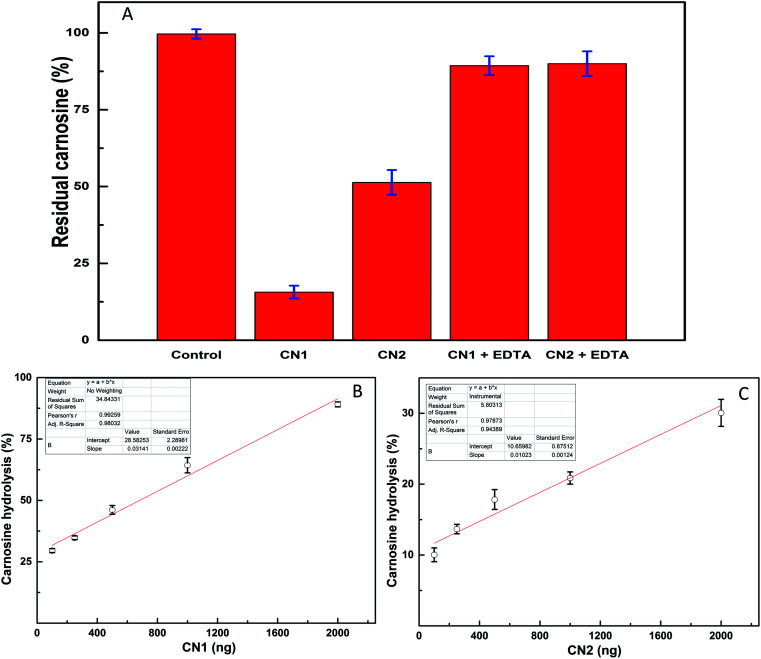
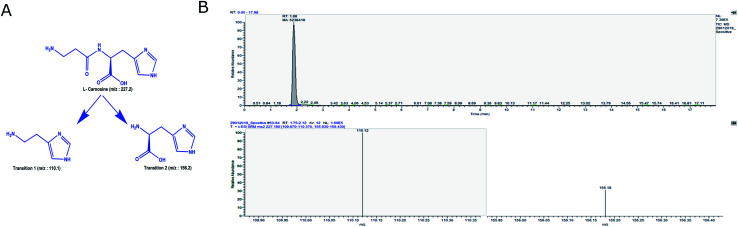
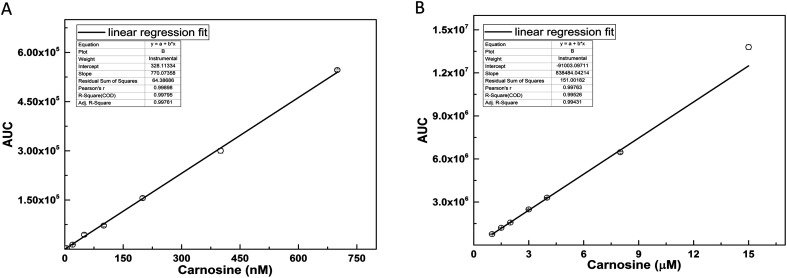
Carnosine, a histidine containing dipeptide, exerts beneficial effects by scavenging reactive carbonyl compounds (RCCs) that are implicated in pathogenesis of diabetes. However, the reduced carnosine levels may aggravate the severity of diabetes. The precise quantification of carnosine levels may serve as an indicator of pathophysiological state of diabetes. Therefore, we have developed a highly sensitive targeted multiple reaction monitoring (MRM) method for quantification of carnosine in human plasma samples. Various mass spectrometry parameters such as ionization of precursor, fragment abundance and stability, collision energy, tube lens offset voltage were optimized to develop a sensitive and robust assay. Using the optimized MRM assay, the lower limit of detection (LOD) and limit of quantification (LOQ) for carnosine were found to be 0.4 nM and 1.0 nM respectively. Standard curves were constructed ranging from 1.0 nM to 15.0 μM and the levels of carnosine in mice and human plasma were determined. Further, the MRM assay was extended to study carnosine hydrolyzing activity of human carnosinases, the serum carnosinase (CN1) and the cytosolic carnosinase (CN2). CN1 showed three folds higher activity than CN2. The MRM assay developed in this study is highly sensitive and can be used for basal plasma carnosine quantification, which can be developed as a novel marker for scavenging of RCCs in diabetes.
肌肽是一种含组氨酸的二肽,通过清除与糖尿病发病机制有关的活性羰基化合物(RCCs)发挥有益作用。然而,肌肽水平降低可能会加重糖尿病的严重程度。肌肽水平的精确量化可作为糖尿病病理生理状态的指标。因此,我们开发了一种高灵敏度的靶向多反应监测(MRM)方法,用于定量检测人血浆样本中的肌肽。优化了各种质谱参数,如前体离子化、碎片丰度和稳定性、碰撞能量、管透镜偏移电压,以建立一种灵敏且稳健的检测方法。使用优化后的MRM检测方法,发现肌肽的检测下限(LOD)和定量下限(LOQ)分别为0.4 nM和1.0 nM。构建了范围从1.0 nM到15.0 μM的标准曲线,并测定了小鼠和人血浆中的肌肽水平。此外,将MRM检测扩展到研究人肌肽酶(血清肌肽酶(CN1)和胞质肌肽酶(CN2))的肌肽水解活性。CN1的活性比CN2高两倍。本研究开发的MRM检测方法高度灵敏,可用于基础血浆肌肽定量,有望成为糖尿病中RCCs清除的新型标志物。