Vogeleer Philippe, Létisse Fabien
INSA, UPS, Toulouse Biotechnology Institute, Université de Toulouse, Toulouse, France.
Front Microbiol. 2022 Apr 14;13:872749. doi: 10.3389/fmicb.2022.872749. eCollection 2022.
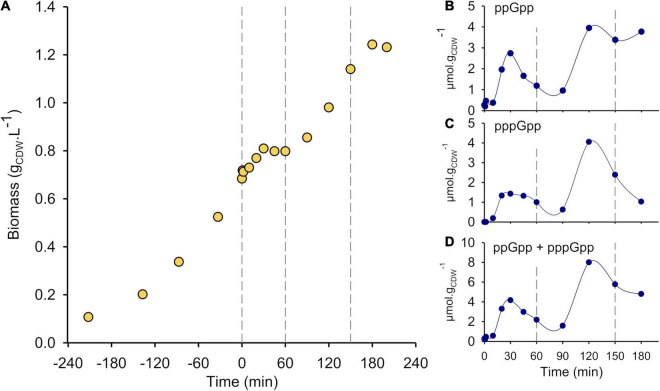
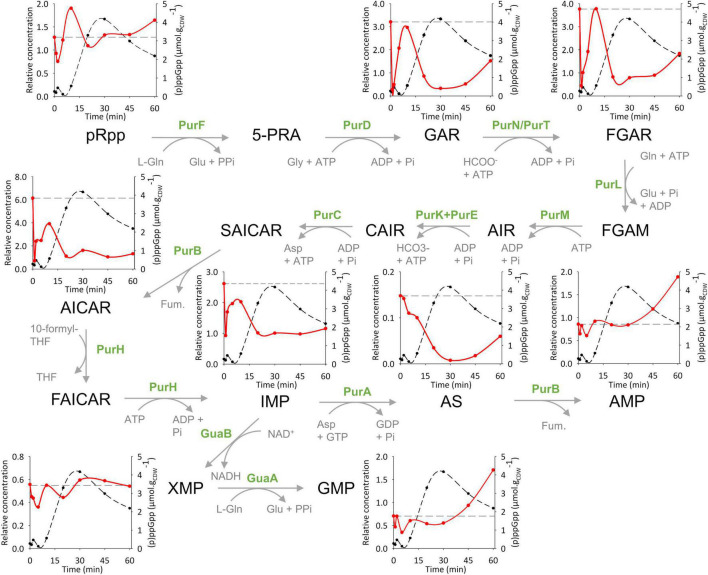
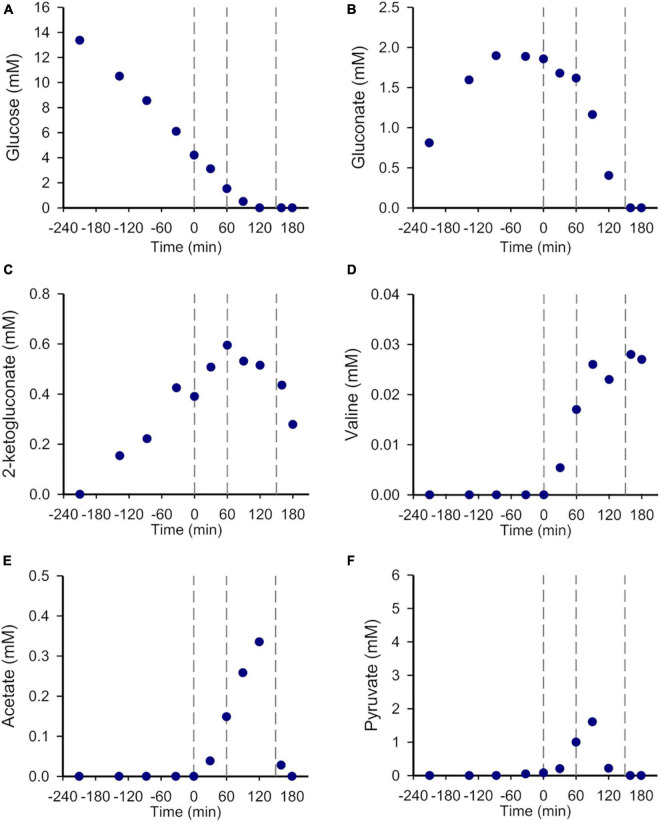
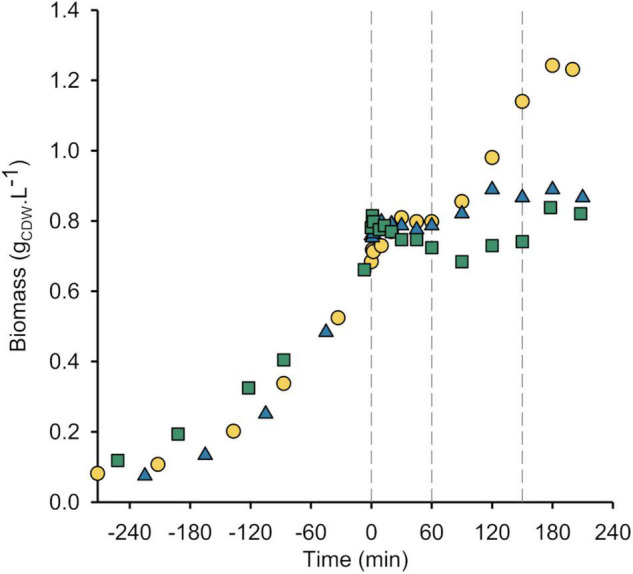
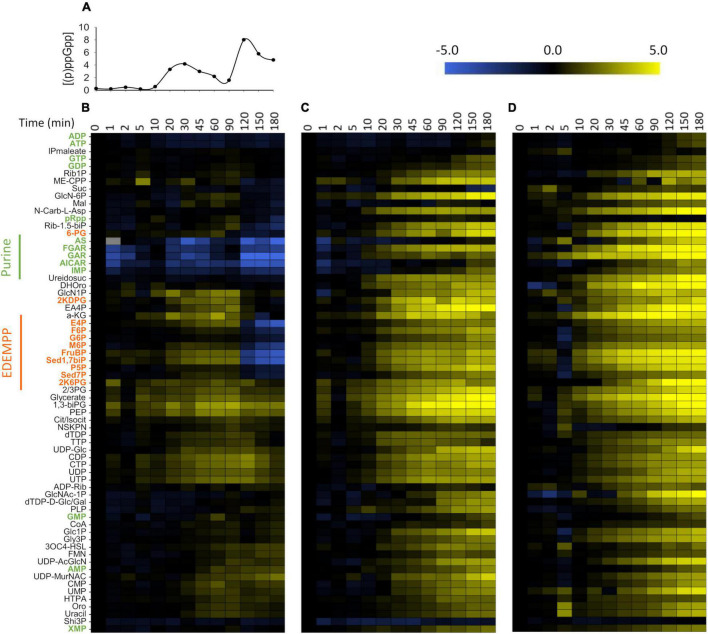
The stringent response is a ubiquitous bacterial reaction triggered by nutrient deprivation and mediated by the intracellular concentrations of ppGpp and pppGpp. These alarmones, jointly referred to as (p)ppGpp, control gene transcription, mRNA translation and protein activity to adjust the metabolism and growth rate to environmental changes. While the ability of (p)ppGpp to mediate cell growth slowdown and metabolism adaptation has been demonstrated in , it's role in remains unclear. The aims of this study were therefore to determine which forms of (p)ppGpp are synthetized in response to severe growth inhibition in , and to decipher the mechanisms of (p)ppGpp-mediated metabolic regulation in this bacterium. We exposed exponentially growing cells of to serine hydroxamate (SHX), a serine analog known to trigger the stringent response, and tracked the dynamics of intra- and extracellular metabolites using untargeted quantitative MS and NMR-based metabolomics, respectively. We found that SHX promotes ppGpp and pppGpp accumulation few minutes after exposure and arrests bacterial growth. Meanwhile, central carbon metabolites increase in concentration while purine pathway intermediates drop sharply. Importantly, in a Δ mutant and a ppGpp strain in which (p)ppGpp synthesis genes were deleted, SHX exposure inhibited cell growth but led to an accumulation of purine pathway metabolites instead of a decrease, suggesting that as observed in other bacteria, (p)ppGpp downregulates the purine pathway in . Extracellular accumulations of pyruvate and acetate were observed as a specific metabolic consequence of the stringent response. Overall, our results show that (p)ppGpp rapidly remodels the central carbon metabolism and the purine biosynthesis pathway in . These data represent a hypothesis-generating resource for future studies on the stringent response.
严谨反应是一种普遍存在的细菌反应,由营养剥夺触发,并由细胞内的ppGpp和pppGpp浓度介导。这些警报素统称为(p)ppGpp,它们控制基因转录、mRNA翻译和蛋白质活性,以根据环境变化调整新陈代谢和生长速率。虽然(p)ppGpp介导细胞生长减缓及代谢适应的能力已在[具体研究对象]中得到证实,但其在[具体情况]中的作用仍不清楚。因此,本研究的目的是确定在[具体研究对象]中,哪些形式的(p)ppGpp是在严重生长抑制时合成的,并破译(p)ppGpp介导的该细菌代谢调控机制。我们将指数生长期的[具体研究对象]细胞暴露于丝氨酸羟肟酸(SHX)中,SHX是一种已知能触发严谨反应的丝氨酸类似物,并分别使用非靶向定量质谱和基于核磁共振的代谢组学技术追踪细胞内和细胞外代谢物的动态变化。我们发现,SHX在暴露后几分钟内促进ppGpp和pppGpp积累,并使细菌生长停滞。与此同时,中心碳代谢物浓度增加,而嘌呤途径中间体急剧下降。重要的是,在一个Δ突变体和一个缺失(p)ppGpp合成基因的ppGpp菌株中,SHX暴露抑制细胞生长,但导致嘌呤途径代谢物积累而非减少,这表明正如在其他细菌中观察到的那样,(p)ppGpp在[具体研究对象]中下调嘌呤途径。丙酮酸和乙酸的细胞外积累被观察到是严谨反应的一种特定代谢后果。总体而言,我们的结果表明,(p)ppGpp在[具体研究对象]中迅速重塑中心碳代谢和嘌呤生物合成途径。这些数据为未来关于严谨反应的研究提供了一个产生假设的资源。