Cui Jieqiong, Li Meng, Wei Yuanyuan, Li Huayan, He Xiying, Yang Qi, Li Zhengkun, Duan Jinfeng, Wu Zhao, Chen Qian, Chen Bojun, Li Gang, Ming Xi, Xiong Lei, Qin Dongdong
School of Basic Medical Sciences, Yunnan University of Chinese Medicine, Kunming, China.
Department of TCM Pediatrics, Yunnan Provincial Hospital of Traditional Chinese Medicine, Kunming, China.
Front Pharmacol. 2022 Apr 12;13:860043. doi: 10.3389/fphar.2022.860043. eCollection 2022.
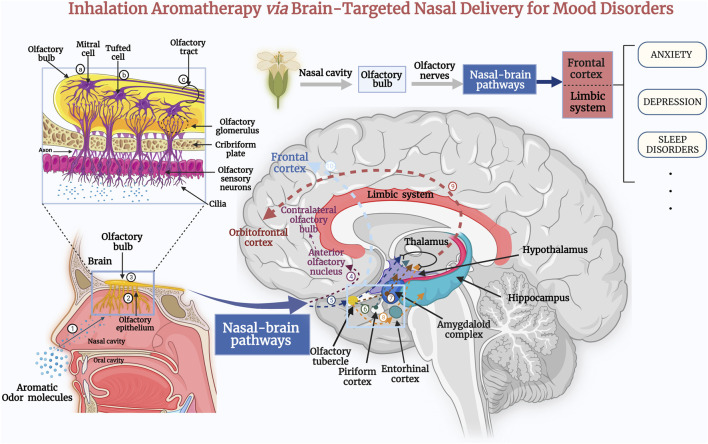
Mood disorders, also often referred to as affective disorders, are a group of psychiatric illnesses that severely impact mood and its related functions. The high medical expenditures have placed a significant financial burden on patients and their families. Aromatherapy is an alternative and complementary treatment that utilizes essential oils (EOs) or volatile oils (VOs) to achieve major therapeutic goals. In general, EOs are volatile chemicals that enter the body primarily through skin absorption and/or nasal inhalation. In addition, they can work through oral administration. Inhalation aromatherapy has shown unique advantages for treating mood disorders, especially depression, anxiety and mental disorders such as sleep disorder, which have been validated over the last decade through clinical and animal studies. Accumulating evidence has shown that EOs or VOs can bypass the blood-brain barrier to target brain tissue through the nasal-brain pathway. Subsequently, they act on the cerebral cortex, thalamus, and limbic system in the brain to improve symptoms of anxiety, depression and improve sleep quality. Here, we review the natural aromatic plants' volatiles or essential oils used commonly as adjuncts to manage mood disorders and illustrate the mechanisms of inhalation aromatherapy, and mainly summarized the application of transnasal inhalation aromatherapy in depression, anxiety, and sleep disorders. We conclude that aromatherapy does not cause side-effects, which is vastly different from commonly used psychotropic drugs. Inhalation aromatherapy brain-targeted nasal delivery offers potentially efficacious treatment for mental disorders and merits further study.
情绪障碍,也常被称为情感障碍,是一组严重影响情绪及其相关功能的精神疾病。高昂的医疗费用给患者及其家庭带来了沉重的经济负担。芳香疗法是一种替代和补充疗法,它利用精油(EOs)或挥发油(VOs)来实现主要治疗目标。一般来说,精油是挥发性化学物质,主要通过皮肤吸收和/或鼻腔吸入进入人体。此外,它们也可以通过口服起作用。吸入式芳香疗法在治疗情绪障碍方面显示出独特优势,尤其是抑郁症、焦虑症以及睡眠障碍等精神障碍,在过去十年中已通过临床和动物研究得到验证。越来越多的证据表明,精油或挥发油可以通过鼻脑途径绕过血脑屏障靶向脑组织。随后,它们作用于大脑中的大脑皮层、丘脑和边缘系统,以改善焦虑、抑郁症状并提高睡眠质量。在此,我们综述了常用于辅助治疗情绪障碍的天然芳香植物挥发物或精油,并阐述了吸入式芳香疗法的作用机制,主要总结了经鼻吸入式芳香疗法在抑郁症、焦虑症和睡眠障碍中的应用。我们得出结论,芳香疗法不会引起副作用,这与常用的精神药物有很大不同。吸入式芳香疗法通过鼻腔靶向给药为精神障碍提供了潜在有效的治疗方法,值得进一步研究。