Chen Hui, Fu Tian, Dan Lintao, Chen Xuejie, Sun Yuhao, Chen Jie, Wang Xiaoyan, Hesketh Therese
School of Public Health, Zhejiang University School of Medicine, Hangzhou, China.
Department of Gastroenterology, The Third Xiangya Hospital of Central South University, Changsha, China.
EClinicalMedicine. 2022 Apr 21;47:101406. doi: 10.1016/j.eclinm.2022.101406. eCollection 2022 May.
Whether meat consumption is related to risk of mortality in patients with inflammatory bowel disease (IBD) remains poorly understood.
In the UK Biobank, 5763 patients with IBD were recruited from 2007 to 2010 and finished a brief food frequency questionnaire at baseline. We followed them until March 13, 2021 to document all-cause death events. Cox proportional hazard models were used to estimate hazard ratios (HRs) for all-cause mortality associated with consumptions of fish, unprocessed poultry, unprocessed red meat, and processed meat among the patients.
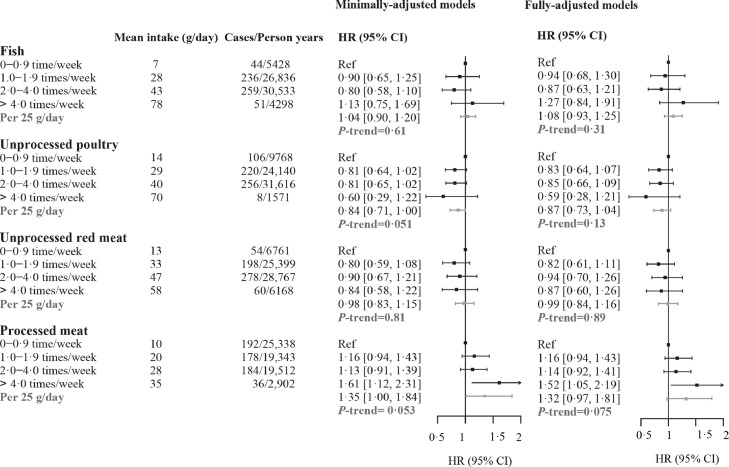
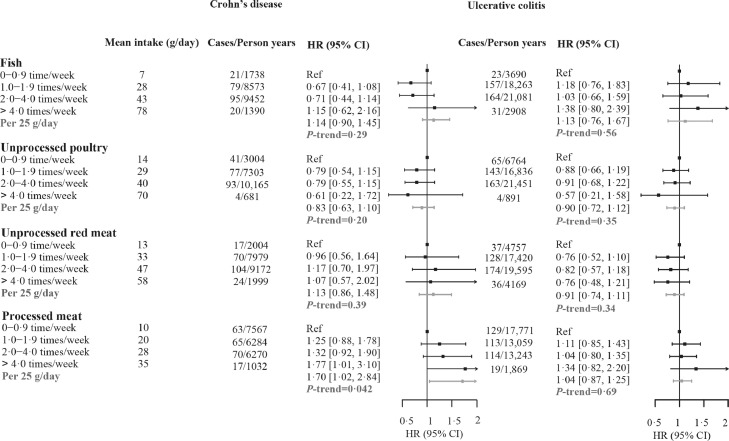
During 67,095 person-years (mean follow-up 11·7 years, mean age 57·3, 52·5% female), we documented 590 death events. Higher consumption of processed meat was associated with an increased risk of all-cause mortality in patients with IBD (HR comparing >4·0 with 0-0·9 time/week=1·52, 95% confidence interval (CI) 1·05-2·19), but the -trend for each 25 g increment was 0·075. This association remained significant in patients with Crohn's disease (HR 1·77, 95% CI 1·01-3·10) but not in patients with ulcerative colitis (HR 1·34, 95% CI 0·82-2·20). Consumptions of fish (HR 1·27, 95% CI 0·84-1·91), unprocessed poultry (HR 0·59, 95% CI 0·28-1·21), or unprocessed red meat (HR 0·87, 95% CI 0·60-1·26) were not significantly associated with the mortality of patients with IBD.
More frequent consumption of processed meat was associated with an increased risk of mortality in patients with IBD, while no associations were observed for consumption of other types of meat. Our exploratory and speculative findings should be cautiously interpreted and need further replication in other cohorts.
The National Natural Science Foundation of China (81,970,494); Key Project of Research and Development Plan of Hunan Province (2019SK2041).
肉类消费与炎症性肠病(IBD)患者的死亡风险之间的关系仍知之甚少。
在英国生物银行中,2007年至2010年招募了5763例IBD患者,并在基线时完成了一份简短的食物频率问卷。我们对他们进行随访直至2021年3月13日,记录全因死亡事件。使用Cox比例风险模型估计患者中与鱼类、未加工家禽、未加工红肉和加工肉类消费相关的全因死亡率的风险比(HRs)。
在67095人年期间(平均随访11.7年,平均年龄57.3岁,52.5%为女性),我们记录了590例死亡事件。IBD患者中,加工肉类的较高消费量与全因死亡率风险增加相关(每周食用量>4.0次与0 - 0.9次相比,HR = 1.52,95%置信区间(CI)1.05 - 2.19),但每增加25克的趋势为0.075。这种关联在克罗恩病患者中仍然显著(HR 1.77,95% CI 1.01 - 3.10),但在溃疡性结肠炎患者中不显著(HR 1.34,95% CI 0.82 - 2.20)。鱼类(HR 1.27,95% CI 0.84 - 1.91)、未加工家禽(HR 0.59,95% CI 0.28 - 1.21)或未加工红肉(HR 0.87,95% CI 0.60 - 1.26)的消费与IBD患者的死亡率无显著关联。
IBD患者中更频繁地食用加工肉类与死亡率风险增加相关,而其他类型肉类的消费未观察到关联。我们的探索性和推测性发现应谨慎解读,需要在其他队列中进一步验证。
中国国家自然科学基金(81970494);湖南省研发计划重点项目(2019SK2041)。