Karim Mohammad R, Alam M M, Aijaz M O, Asiri Abdullah M, AlMubaddel F S, Rahman Mohammed M
Center of Excellence for Research in Engineering Materials (CEREM), King Saud University Riyadh 11421 Saudi Arabia.
K.A.CARE Energy Research and Innovation Center Riyadh 11451 Saudi Arabia.
RSC Adv. 2020 Apr 9;10(21):12224-12233. doi: 10.1039/c9ra09315j. eCollection 2020 Mar 24.
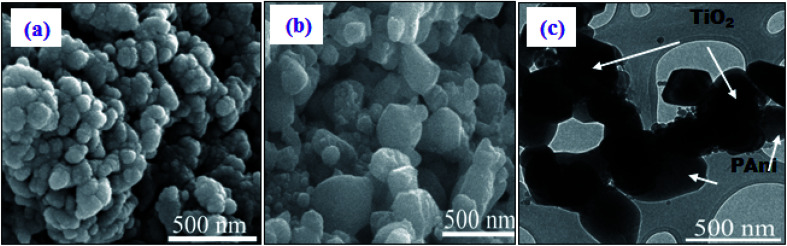
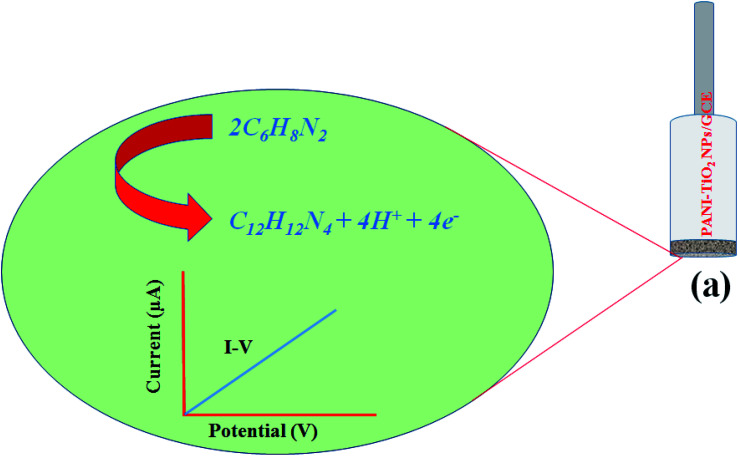
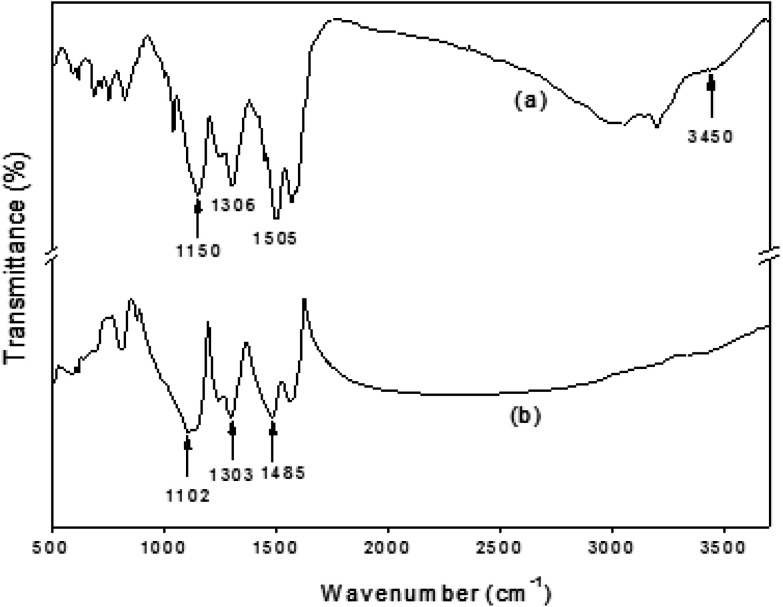
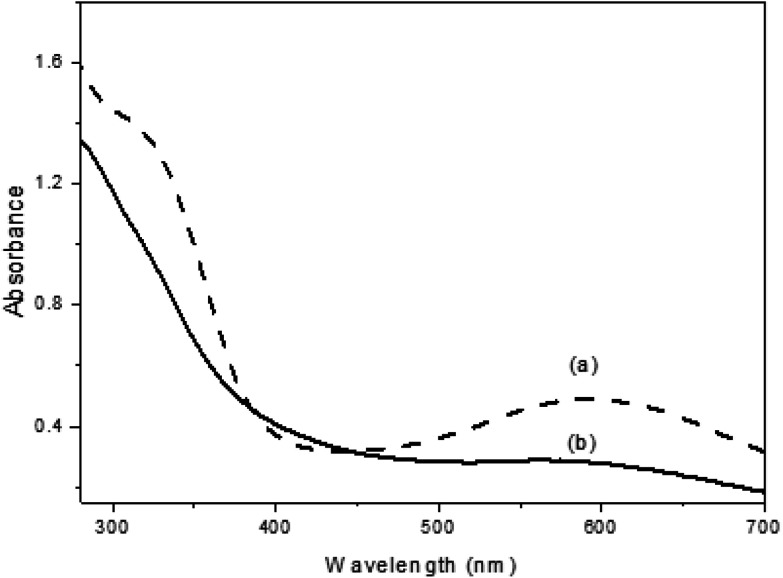
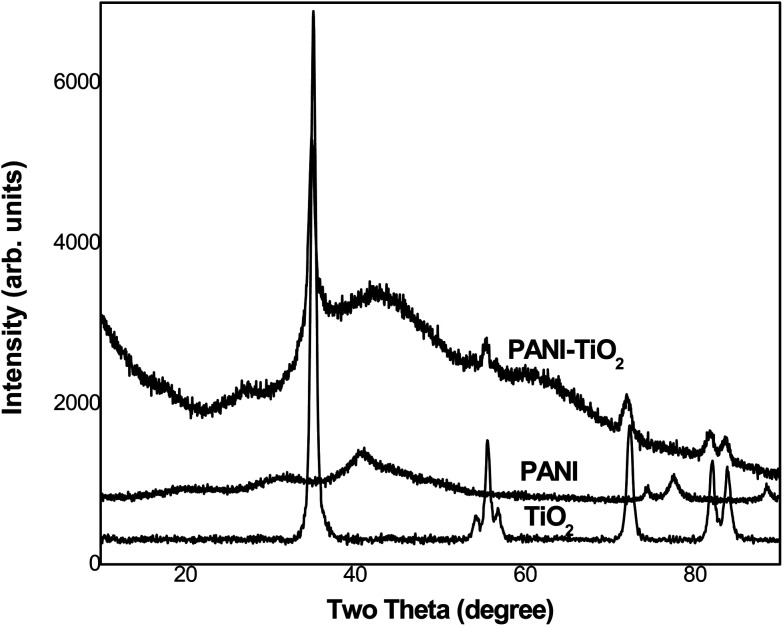
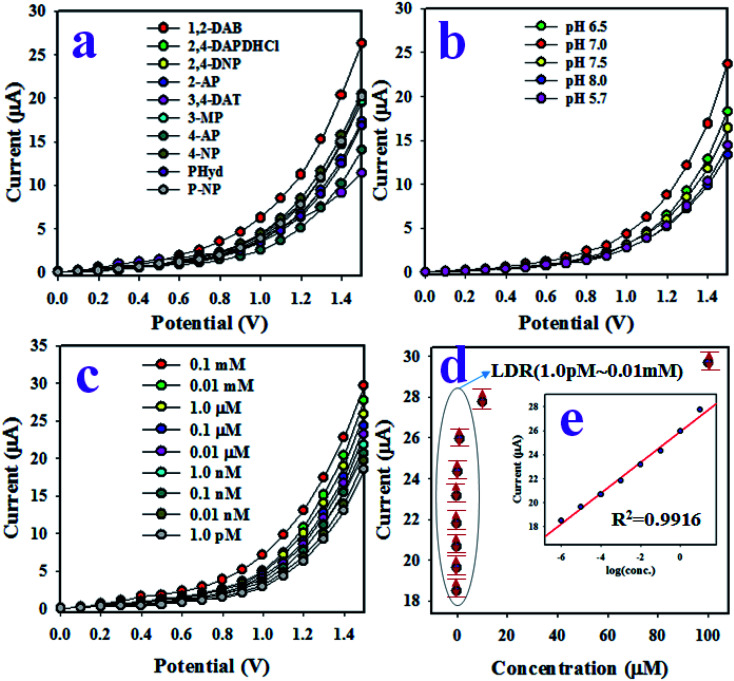
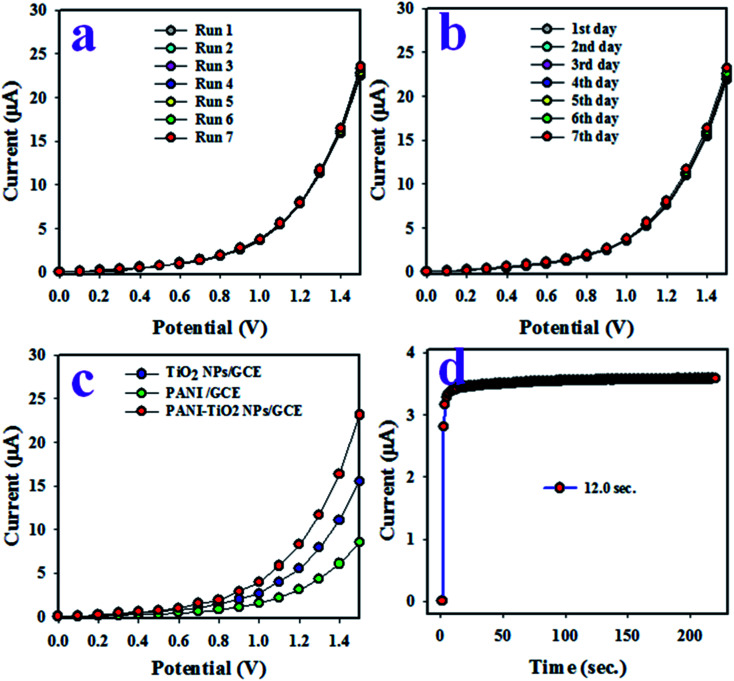
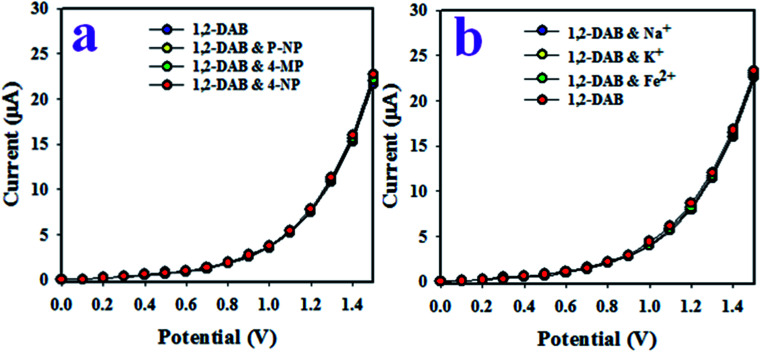
In this study, conjugated conducting polyaniline was fabricated onto titania nanoparticles (PANI-TiO NPs) using a microwave-accelerated reaction system. The synthesized nanoparticles were characterized using the techniques of electron microscopy (, FE-SEM and TEM), X-ray diffraction (XRD), Fourier-transform infrared spectroscopy (FT-IR), and ultraviolet-visible (UV-Vis) spectrometry. An ultrasensitive sensor using the electrochemical (-) approach was fabricated using a thin film of PANI-TiO NPs on a glassy carbon electrode (GCE), and it was found to be selective towards 1,2-diaminobenzene (1,2-DAB) in a buffer phase. From current concentration studies, the calibration curve was plotted to estimate the sensor's analytical parameters. The highest sensitivity (19.8165 μA μM cm) and lowest detection limit (0.93 ± 0.05 pM) were obtained from the electrochemical assessment by applying a signal-to-noise ratio of 3. A linear calibration plot was attained over a large range of concentration (LDR: 1.0 pM to 0.01 mM). The selective 1,2-DAB sensor was found to be efficient and reproducible in performance, yielding significant results with a fast response time (12.0 s). Therefore, the overall results of the 1,2-DAB chemical sensor suggest that this detection approach might be an easy way to develop an efficient electrochemical sensor for the protection of the environment as well as for use in the healthcare field on a broad scale.
在本研究中,使用微波加速反应系统将共轭导电聚苯胺制备在二氧化钛纳米颗粒(PANI-TiO NPs)上。采用电子显微镜技术(场发射扫描电子显微镜和透射电子显微镜)、X射线衍射(XRD)、傅里叶变换红外光谱(FT-IR)和紫外可见(UV-Vis)光谱对合成的纳米颗粒进行了表征。利用玻碳电极(GCE)上的PANI-TiO NPs薄膜制备了一种采用电化学(-)方法的超灵敏传感器,发现其在缓冲相中对1,2-二氨基苯(1,2-DAB)具有选择性。通过电流-浓度研究绘制校准曲线,以估算传感器的分析参数。通过应用3的信噪比进行电化学评估,获得了最高灵敏度(19.8165 μA μM cm)和最低检测限(0.93±0.05 pM)。在较大浓度范围内(线性动态范围:1.0 pM至0.01 mM)获得了线性校准图。发现选择性1,2-DAB传感器性能高效且可重复,响应时间快(12.0 s),产生了显著结果。因此,1,2-DAB化学传感器的总体结果表明,这种检测方法可能是开发一种高效电化学传感器的简便方法,可用于环境保护以及广泛应用于医疗保健领域。