Dkhili Marwa, Lucarelli Giulia, De Rossi Francesca, Taheri Babak, Hammedi Khadija, Ezzaouia Hatem, Brunetti Francesca, Brown Thomas M
CHOSE (Centre for Hybrid and Organic Solar Energy), Department of Electronic Engineering, University of Rome Tor Vergata, Via del Politecnico 1, 00133 Rome, Italy.
Laboratory of Semiconductors, Nanostructures and Advanced Technology (LSNTA), Research and Technology Centre of Energy (CRTEn), BP 95, 2050 Hammam-Lif, Tunisia.
ACS Appl Energy Mater. 2022 Apr 25;5(4):4096-4107. doi: 10.1021/acsaem.1c03311. Epub 2022 Apr 6.
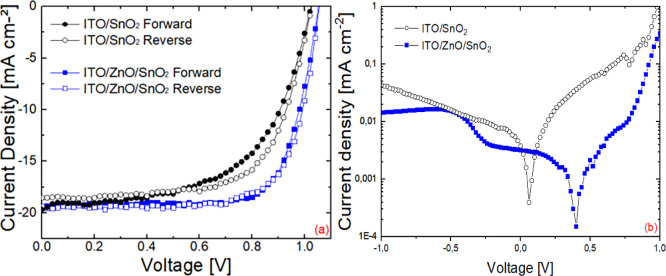
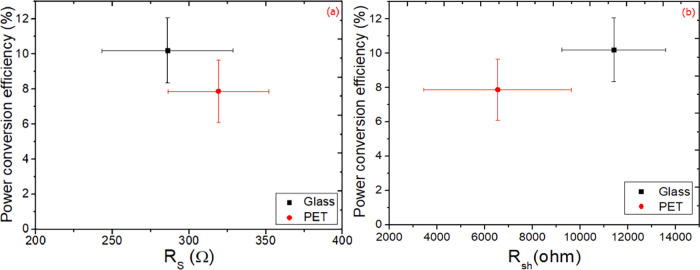
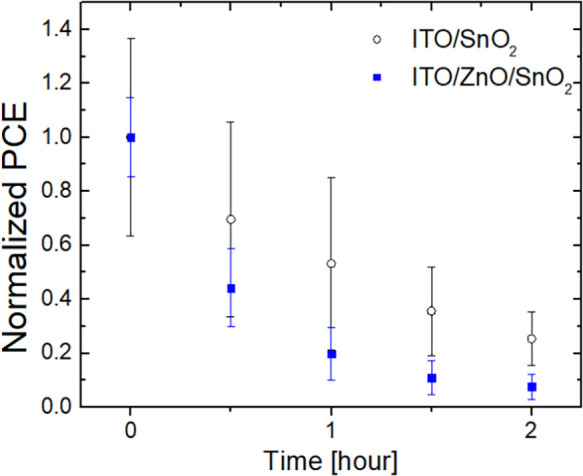
Electron transport layers (ETLs) play a fundamental role in perovskite solar cells (PSCs) through charge extraction. Here, we developed flexible PSCs on 12 different kinds of ETLs based on SnO. We show that ETLs need to be specifically developed for plastic substrates in order to attain 15% efficient flexible cells. Recipes developed for glass substrates do not typically transfer directly. Among all the ETLs, ZnO/SnO double layers delivered the highest average power conversion efficiency of 14.6% (best cell 14.8%), 39% higher than that of flexible cells of the same batch based on SnO-only ETLs. However, the cells with a single ETL made of SnO nanoparticles were found to be more stable as well as more efficient and reproducible than SnO formed from a liquid precursor (SnO-LP). We aimed at increasing the understanding of what makes a good ETL on polyethylene terephthalate (PET) substrates. More so than ensuring electron transport (as seen from on-current and series resistance analysis), delivering high shunt resistances ( ) and lower recombination currents ( ) is key to obtain high efficiency. In fact, of PSCs fabricated on glass was twice as large, and was 76% lower in relative terms, on average, than those on PET, indicating considerably better blocking behavior of ETLs on glass, which to a large extent explains the differences in average PCE (+29% in relative terms for glass vs PET) between these two types of devices. Importantly, we also found a clear trend for all ETLs and for different substrates between the wetting behavior of each surface and the final performance of the device, with efficiencies increasing with lower contact angles (ranging between ∼50 and 80°). Better wetting, with average contact angles being lower by 25% on glass versus PET, was conducive to delivering higher-quality layers and interfaces. This cognizance can help further optimize flexible devices and close the efficiency gap that still exists with their glass counterparts.
电子传输层(ETL)通过电荷提取在钙钛矿太阳能电池(PSC)中发挥着重要作用。在此,我们基于SnO在12种不同的ETL上制备了柔性PSC。我们发现,为了实现效率达15%的柔性电池,需要专门为塑料基板开发ETL。为玻璃基板开发的配方通常不能直接照搬。在所有的ETL中,ZnO/SnO双层结构的平均功率转换效率最高,为14.6%(最佳电池效率为14.8%),比同一批次基于单一SnO ETL的柔性电池高出39%。然而,人们发现,由SnO纳米颗粒制成的单一ETL的电池比由液体前驱体制成的SnO(SnO-LP)更稳定、更高效且可重复性更好。我们旨在加深对在聚对苯二甲酸乙二醇酯(PET)基板上制备优质ETL的理解。与确保电子传输(从正向电流和串联电阻分析来看)相比,提供高并联电阻( )和更低的复合电流( )对于获得高效率更为关键。事实上,在玻璃上制备的PSC的 平均是在PET上制备的PSC的两倍,而 相对而言平均低76%,这表明ETL在玻璃上具有明显更好的阻挡性能,这在很大程度上解释了这两种器件之间平均功率转换效率的差异(玻璃相对于PET,相对提高了29%)。重要的是,我们还发现,对于所有ETL以及不同基板,每个表面的润湿行为与器件最终性能之间存在明显趋势,效率随着接触角降低(范围在约50至80°之间)而提高。玻璃表面的平均接触角比PET低25%,更好的润湿性有利于形成更高质量的层和界面。这种认识有助于进一步优化柔性器件,并缩小其与玻璃同类器件之间仍然存在的效率差距。