Nokkaew Weerapun, Intarapuk Apiradee, Sakulthai Apichaya, Wajjwalku Worawidh, Thongtip Nikorn
Graduate Program in Bio-Veterinary Science, Faculty of Veterinary Medicine, Kasetsart University, Chatuchak, Bangkok 10900, Thailand.
Wildlife Clinic, Faculty of Veterinary Medicine, Mahanakorn University of Technology, Nong Chok, Bangkok 10530, Thailand.
Vet World. 2022 Mar;15(3):647-654. doi: 10.14202/vetworld.2022.647-654. Epub 2022 Mar 23.
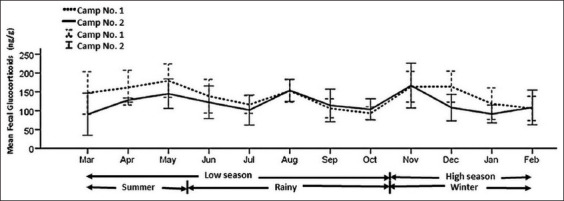
Over the past two decades, the number of elephant camps in Thailand has increased considerably, and captive elephants have become more popular within the tourism industry. Tourist activities involving elephant exhibitions and trekking potentially affect animal health and welfare. This study aimed to investigate the relationships between a novel stress biomarker, fecal glucocorticoid metabolites (fGCM), and various factors (sex, age, weather season, tourist season, and elephant usage patterns), monitoring the fGCM concentration during and after trekking activities ceased.
Fecal samples of 20 captive Asian elephants from two camps in Kanchanaburi Province were collected monthly for 1 year. The fGCM concentrations were measured using enzyme immunoassay and evaluated relative to individual demography, season, and tourist trekking activity. The mean differences of fGCMs concentrations were compared by analysis of variance and t-test statistics according to data types with p<0.5.
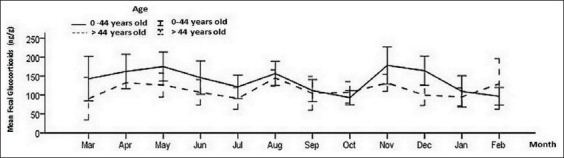
Significant differences in mean fGCM concentrations were found between age categories (p=0.001), trekking and non-trekking animals (p=0.039), and during and after trekking (p=0.023). The mean fGCM concentration of elephants aged during 0-44 years (136.7 ng/g) was significantly higher than for animals over 44 years old (107.7 ng/g), and the elephant trekking group (144.9 ng/g) was significantly higher than the other group (124.7 ng/g). Within the trekking group, the mean fGCM concentrations gradually declined to 129.13 ng/g within 8 months of trekking cessation.
Elephant's ages and activities co-influenced the variance of fGCM concentrations. In addition, permanent tourist activity, especially trekking, can increase elephant stress. This study's findings can be applied to the health status monitoring of captive elephants and result in improved animal welfare.
在过去二十年中,泰国大象营地的数量显著增加,圈养大象在旅游业中越来越受欢迎。涉及大象展览和徒步旅行的旅游活动可能会影响动物的健康和福利。本研究旨在调查一种新型应激生物标志物——粪便糖皮质激素代谢物(fGCM)与各种因素(性别、年龄、季节、旅游季节和大象使用模式)之间的关系,并在徒步旅行活动停止期间及之后监测fGCM浓度。
从北碧府两个营地的20头圈养亚洲象中每月采集粪便样本,持续1年。使用酶免疫测定法测量fGCM浓度,并根据个体人口统计学、季节和旅游徒步活动进行评估。根据数据类型,采用方差分析和t检验统计比较fGCM浓度的平均差异,p<0.5。
不同年龄组(p=0.001)、徒步和非徒步大象(p=0.039)以及徒步期间和之后(p=0.023)的fGCM平均浓度存在显著差异。0至44岁大象的fGCM平均浓度(136.7 ng/g)显著高于44岁以上的大象(107.7 ng/g),徒步大象组(144.9 ng/g)显著高于另一组(124.7 ng/g)。在徒步组中,徒步停止8个月内,fGCM平均浓度逐渐降至129.13 ng/g。
大象的年龄和活动共同影响fGCM浓度的变化。此外,长期的旅游活动,尤其是徒步旅行,会增加大象的压力。本研究结果可应用于圈养大象的健康状况监测,从而改善动物福利。