Thondapu Vikas, Shishikura Daisuke, Dijkstra Jouke, Zhu Shuang J, Revalor Eve, Serruys Patrick W, van Gaal William J, Poon Eric K W, Ooi Andrew, Barlis Peter
Department of Medicine, Faculty of Medicine, Melbourne Medical School, Dentistry and Health Sciences, University of Melbourne, Parkville, VIC, Australia.
Department of Mechanical Engineering, Melbourne School of Engineering, University of Melbourne, Parkville, VIC, Australia.
Front Cardiovasc Med. 2022 Apr 14;9:835270. doi: 10.3389/fcvm.2022.835270. eCollection 2022.
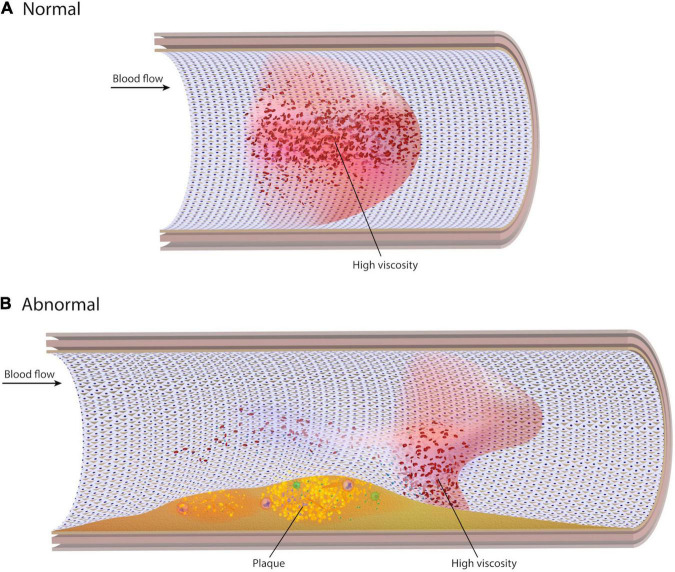
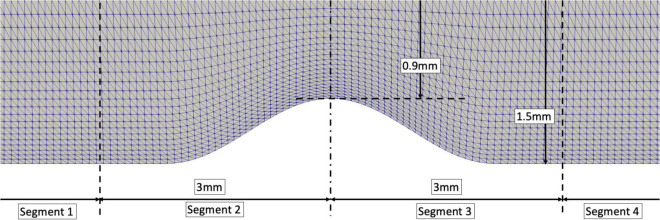
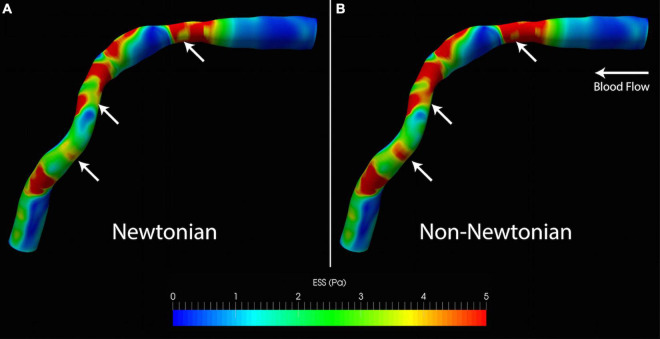
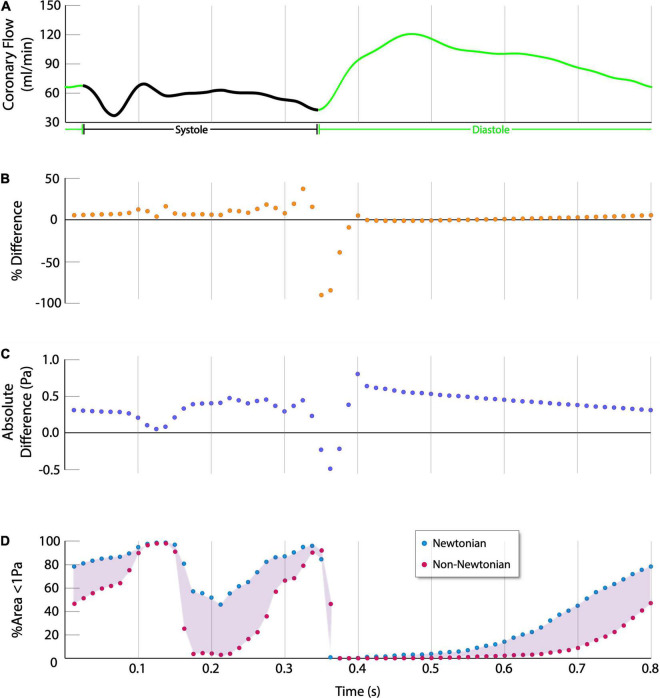
Patient-specific coronary endothelial shear stress (ESS) calculations using Newtonian and non-Newtonian rheological models were performed to assess whether the common assumption of Newtonian blood behavior offers similar results to a more realistic but computationally expensive non-Newtonian model. 16 coronary arteries (from 16 patients) were reconstructed from optical coherence tomographic (OCT) imaging. Pulsatile CFD simulations using Newtonian and the Quemada non-Newtonian model were performed. Endothelial shear stress (ESS) and other indices were compared. Exploratory indices including local blood viscosity (LBV) were calculated from non-Newtonian simulation data. Compared to the Newtonian results, the non-Newtonian model estimates significantly higher time-averaged ESS (1.69 (IQR 1.36)Pa versus 1.28 (1.16)Pa, < 0.001) and ESS gradient (0.90 (1.20)Pa/mm versus 0.74 (1.03)Pa/mm, < 0.001) throughout the cardiac cycle, under-estimating the low ESS (<1Pa) area (37.20 ± 13.57% versus 50.43 ± 14.16%, 95% CI 11.28-15.18, < 0.001). Similar results were also found in the idealized artery simulations with non-Newtonian median ESS being higher than the Newtonian median ESS (healthy segments: 0.8238Pa versus 0.6618Pa, < 0.001 proximal; 0.8179Pa versus 0.6610Pa, < 0.001 distal; stenotic segments: 0.8196Pa versus 0.6611Pa, < 0.001 proximal; 0.2546Pa versus 0.2245Pa, < 0.001 distal) On average, the non-Newtonian model has a LBV of 1.45 times above the Newtonian model with an average peak LBV of 40-fold. Non-Newtonian blood model estimates higher quantitative ESS values than the Newtonian model. Incorporation of non-Newtonian blood behavior may improve the accuracy of ESS measurements. The non-Newtonian model also allows calculation of exploratory viscosity-based hemodynamic indices, such as local blood viscosity, which may offer additional information to detect underlying atherosclerosis.
使用牛顿和非牛顿流变学模型进行患者特异性冠状动脉内皮剪切应力(ESS)计算,以评估牛顿血液行为的常见假设是否能产生与更符合实际但计算成本更高的非牛顿模型相似的结果。从光学相干断层扫描(OCT)成像中重建了16条冠状动脉(来自16名患者)。使用牛顿和Quemada非牛顿模型进行了脉动CFD模拟。比较了内皮剪切应力(ESS)和其他指标。从非牛顿模拟数据中计算了包括局部血液粘度(LBV)在内的探索性指标。与牛顿模型结果相比,非牛顿模型在整个心动周期中估计的时间平均ESS显著更高(1.69(IQR 1.36)Pa对1.28(1.16)Pa,<0.001)和ESS梯度(0.90(1.20)Pa/mm对0.74(1.03)Pa/mm,<0.001),低估了低ESS(<1Pa)区域(37.20±13.57%对50.43±14.16%,95%CI 11.28 - 15.18,<0.001)。在理想化动脉模拟中也发现了类似结果,非牛顿模型的ESS中位数高于牛顿模型(健康节段:近端0.8238Pa对0.6618Pa,<0.001;远端0.8179Pa对0.6610Pa,<0.001;狭窄节段:近端0.8196Pa对0.6611Pa,<0.001;远端0.2546Pa对0.2245Pa,<0.001)。平均而言,非牛顿模型的LBV比牛顿模型高1.45倍,平均峰值LBV高40倍。非牛顿血液模型估计的定量ESS值高于牛顿模型。纳入非牛顿血液行为可能会提高ESS测量的准确性。非牛顿模型还允许计算基于粘度的探索性血流动力学指标,如局部血液粘度,这可能为检测潜在的动脉粥样硬化提供额外信息。