Department of Public Health, Graduate School, Yonsei University, Seoul, Republic of Korea; Institute of Health Services Research, Yonsei University, Seoul, Republic of Korea.
Institute of Health Services Research, Yonsei University, Seoul, Republic of Korea; Department of Preventive Medicine, Yonsei University College of Medicine, Seoul, Republic of Korea.
J Affect Disord. 2022 Jul 15;309:411-417. doi: 10.1016/j.jad.2022.04.154. Epub 2022 Apr 30.
COVID-19 has had a worldwide economic impact. A decline in family financial level can adversely affect adolescents' mental health. This study examined the association between perceived family financial decline due to COVID-19 and generalized anxiety disorder (GAD) among South Korean adolescents.
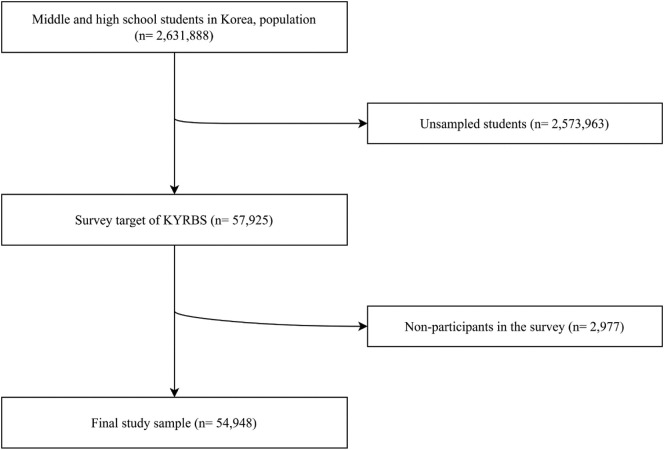
Data from 54,948 middle and high school students from the 2020 Korea Youth Risk Behavior Survey were collected in this cross-sectional study. The effect of the perceived family financial decline due to COVID-19 related to GAD was analyzed using binary and multinomial logistic regression.
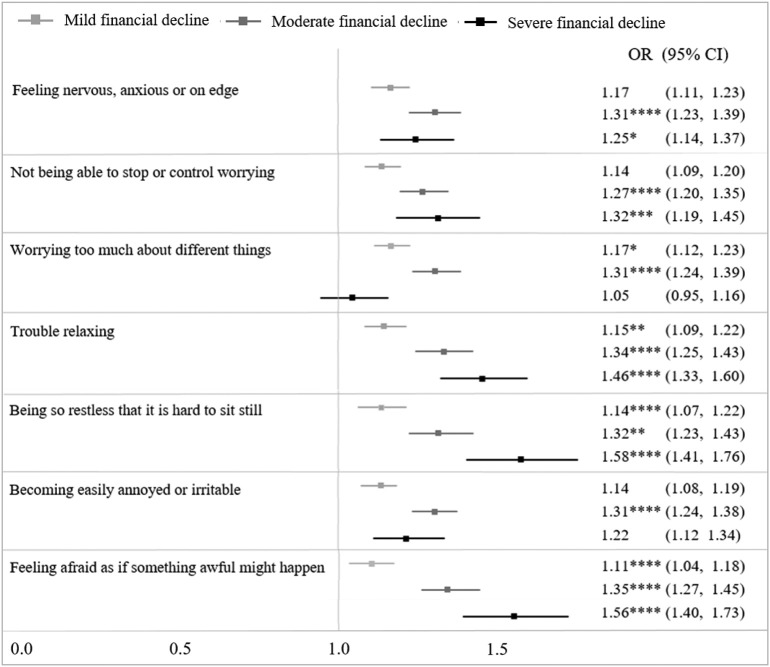
The relationship between perceived family financial decline due to COVID-19 and GAD was linear with increasing odds ratios and confidence intervals (the possibility of GAD, no financial decline: OR 1.00, mild: OR 1.11, CI 1.05-1.17, moderate: OR 1.30, CI 1.22-1.39, severe: OR 1.48, CI 1.34-1.63). Girls, low-income class, and living with family were vulnerable to GAD. GAD levels of mild, moderate, and severe were most likely to occur in each case of mild, moderate, and severe financial decline, respectively.
As this is a cross-sectional study, causality is unknown. Because this study data was self-reported by adolescents, they may have been overestimated or underestimated.
GAD in adolescents is closely related to perceived decreased family finances due to COVID-19. The dose-response of GAD according to financial decline became gradually severe. Anxious adolescents were afraid of uncertain and adverse outcomes affecting them or their families. Therefore, there is a vital need to care for financially affected adolescents.
COVID-19 对全球经济造成了影响。家庭经济水平下降会对青少年的心理健康产生不利影响。本研究调查了因 COVID-19 导致的感知家庭经济衰退与韩国青少年广泛性焦虑障碍(GAD)之间的关联。
本横断面研究收集了来自 2020 年韩国青少年风险行为调查的 54948 名中学生和高中生的数据。使用二项和多项逻辑回归分析了因 COVID-19 导致的感知家庭经济衰退与 GAD 之间的关系。
因 COVID-19 导致的感知家庭经济衰退与 GAD 之间呈线性关系,比值比和置信区间(GAD 的可能性,无经济衰退:OR=1.00,轻度:OR=1.11,CI=1.05-1.17,中度:OR=1.30,CI=1.22-1.39,重度:OR=1.48,CI=1.34-1.63)增加。女孩、低收入阶层和与家人同住的人更容易患 GAD。在每种轻度、中度和重度经济衰退的情况下,最有可能出现轻度、中度和重度 GAD。
由于这是一项横断面研究,因此因果关系尚不清楚。由于本研究的数据是由青少年自我报告的,他们可能会被高估或低估。
青少年的 GAD 与因 COVID-19 导致的感知家庭经济衰退密切相关。根据经济衰退,GAD 的剂量反应逐渐变得严重。焦虑的青少年担心影响他们或他们家庭的不确定和不利结果。因此,迫切需要关爱受经济影响的青少年。