Ewha Womans University College of Medicine, Seoul, Korea.
Department of Environmental Medicine, Ewha Womans University College of Medicine, Seoul, Korea.
J Prev Med Public Health. 2024 Jan;57(1):18-27. doi: 10.3961/jpmph.23.306. Epub 2023 Nov 11.
This study investigated the association between exacerbated economic hardship during the coronavirus disease 2019 (COVID-19) pandemic and changes in the health behaviors of Korean adolescents.
We analyzed data from the 2021 Korea Youth Risk Behavior Survey and included 44 908 students (22 823 boys and 22 085 girls) as study subjects. The dependent variables included changes in health behaviors (breakfast habits, physical activity, and alcohol use) that occurred during the COVID-19 pandemic. The aggravation of economic hardship by COVID-19 and the subjective economic status of the family were used as exposure variables. Multiple logistic regression analysis was utilized to calculate the prevalence odds ratios (PORs).
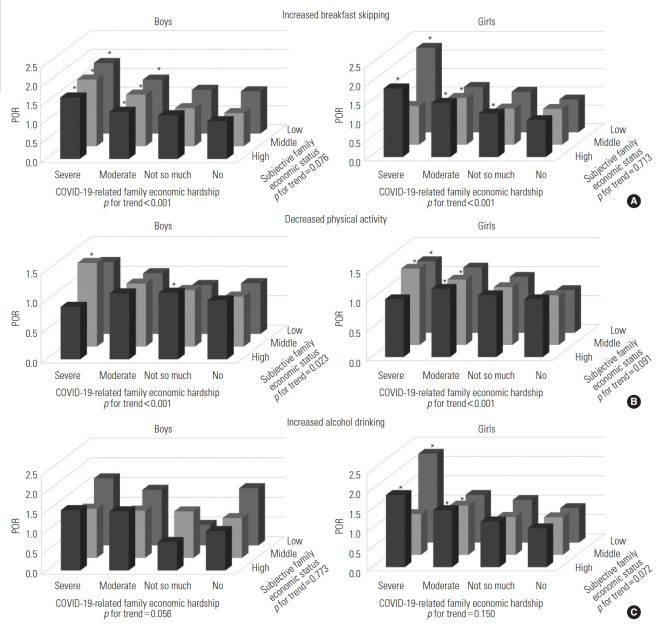
Severe exacerbation of a family's economic hardship due to COVID-19 was negatively associated with the health behaviors of adolescents, including increased breakfast skipping (POR, 1.85; 95% confidence interval [CI], 1.55 to 2.21 for boys and POR, 1.56; 95% CI, 1.27 to 1.92 for girls) and decreased physical activity (POR, 1.37; 95% CI, 1.19 to 1.57 for boys and POR, 1.38; 95% CI, 1.19 to 1.60 for girls). These negative changes in health behaviors were further amplified when combined with a low subjective family economic status.
The experience of worsening household hardship can lead to negative changes in health behavior among adolescents. It is crucial to implement measures that address the economic challenges that arise from stressful events such as COVID-19 and to strive to improve the lifestyles of adolescents under such circumstances.
本研究旨在探讨 2019 冠状病毒病(COVID-19)大流行期间经济困难加剧与韩国青少年健康行为变化之间的关系。
我们分析了 2021 年韩国青少年风险行为调查的数据,共纳入 44908 名学生(男生 22823 名,女生 22085 名)作为研究对象。因 COVID-19 而恶化的家庭经济困难和家庭的主观经济状况被用作暴露变量。采用多因素 logistic 回归分析计算患病率比值比(POR)。
COVID-19 导致家庭经济严重恶化与青少年的健康行为呈负相关,包括增加不吃早餐(男生 POR,1.85;95%可信区间[CI],1.55 至 2.21;女生 POR,1.56;95%CI,1.27 至 1.92)和减少体育活动(男生 POR,1.37;95%CI,1.19 至 1.57;女生 POR,1.38;95%CI,1.19 至 1.60)。当与低主观家庭经济状况结合时,这些健康行为的负面变化进一步放大。
家庭经济困难加剧会导致青少年健康行为的负面变化。有必要实施应对 COVID-19 等压力事件引起的经济挑战的措施,并努力改善青少年在这种情况下的生活方式。