Faculty of Economics, Ss. Cyril and Methodius University in Skopje, Skopje, North Macedonia.
Macedonian Academy of Sciences and Arts, Skopje, North Macedonia.
Sci Rep. 2022 May 2;12(1):7099. doi: 10.1038/s41598-022-10894-6.
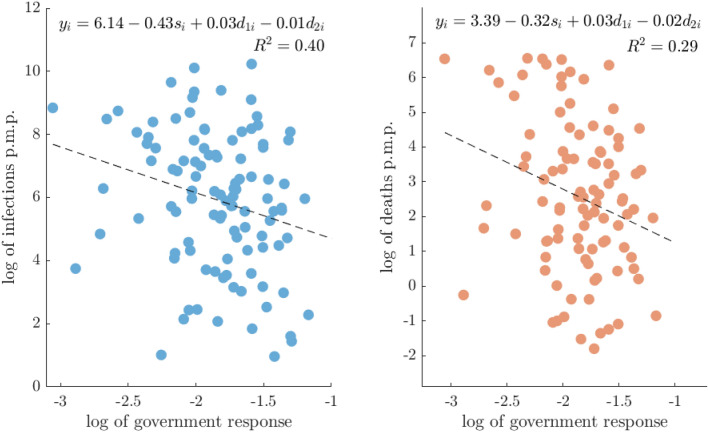
The COVID-19 pandemic resulted in great discrepancies in both infection and mortality rates between countries. Besides the biological and epidemiological factors, a multitude of social and economic criteria also influenced the extent to which these discrepancies appeared. Consequently, there is an active debate regarding the critical socio-economic and health factors that correlate with the infection and mortality rates outcome of the pandemic. Here, we leverage Bayesian model averaging techniques and country level data to investigate whether 28 variables, which describe a diverse set of health and socio-economic characteristics, correlate with the final number of infections and deaths during the first wave of the coronavirus pandemic. We show that only a few variables are able to robustly correlate with these outcomes. To understand the relationship between the potential correlates in explaining the infection and death rates, we create a Jointness Space. Using this space, we conclude that the extent to which each variable is able to provide a credible explanation for the COVID-19 infections/mortality outcome varies between countries because of their heterogeneous features.
新冠疫情在各国造成了感染率和死亡率的巨大差异。除了生物和流行病学因素外,还有许多社会和经济因素也影响了这些差异的出现程度。因此,对于与疫情感染率和死亡率结果相关的关键社会经济和健康因素存在着激烈的争论。在这里,我们利用贝叶斯模型平均技术和国家层面的数据,来研究 28 个变量是否与冠状病毒大流行第一波期间的最终感染人数和死亡人数相关,这些变量描述了一系列多样化的健康和社会经济特征。我们表明,只有少数变量能够与这些结果可靠地相关。为了了解潜在相关因素在解释感染和死亡率方面的关系,我们创建了一个联合空间。使用这个空间,我们得出结论,由于各国的特征不同,每个变量在多大程度上能够为 COVID-19 感染/死亡率结果提供可信的解释也有所不同。