Department of Radiology, Candiolo Cancer Institute, FPO-IRCCS, Candiolo, Italy.
Department of Surgical Sciences, University of Turin, Turin, Italy.
Eur Radiol Exp. 2022 May 3;6(1):19. doi: 10.1186/s41747-022-00272-2.
Pathological complete response after neoadjuvant chemoradiotherapy in locally advanced rectal cancer (LARC) is achieved in 15-30% of cases. Our aim was to implement and externally validate a magnetic resonance imaging (MRI)-based radiomics pipeline to predict response to treatment and to investigate the impact of manual and automatic segmentations on the radiomics models.
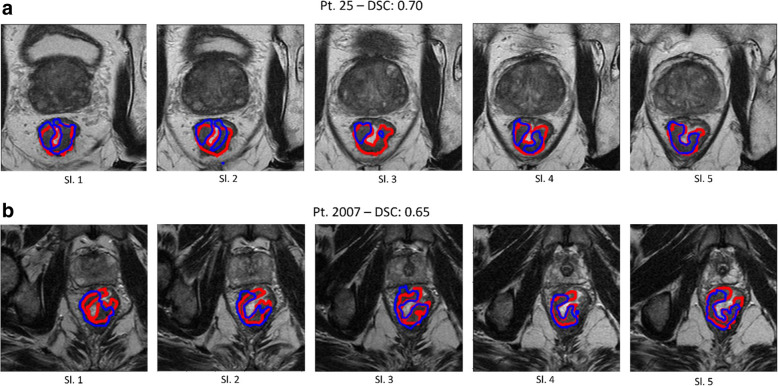
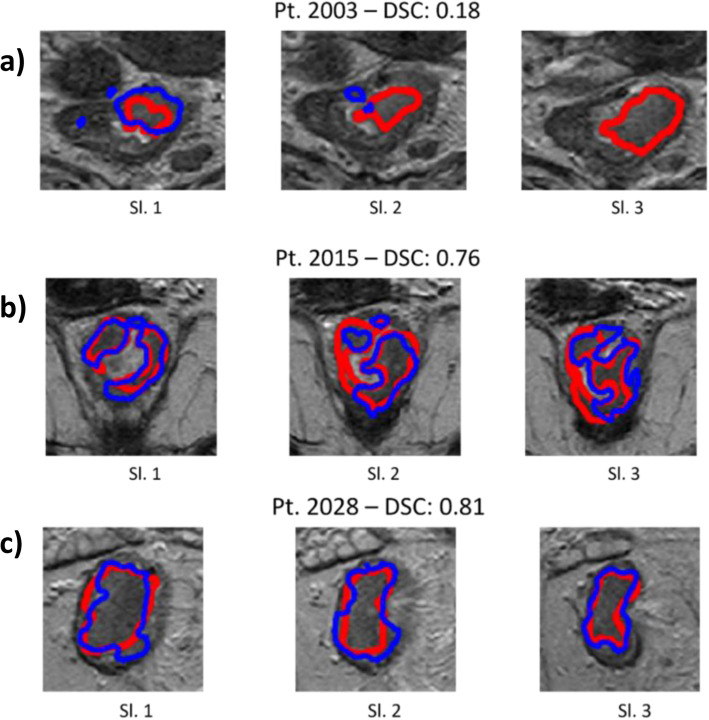
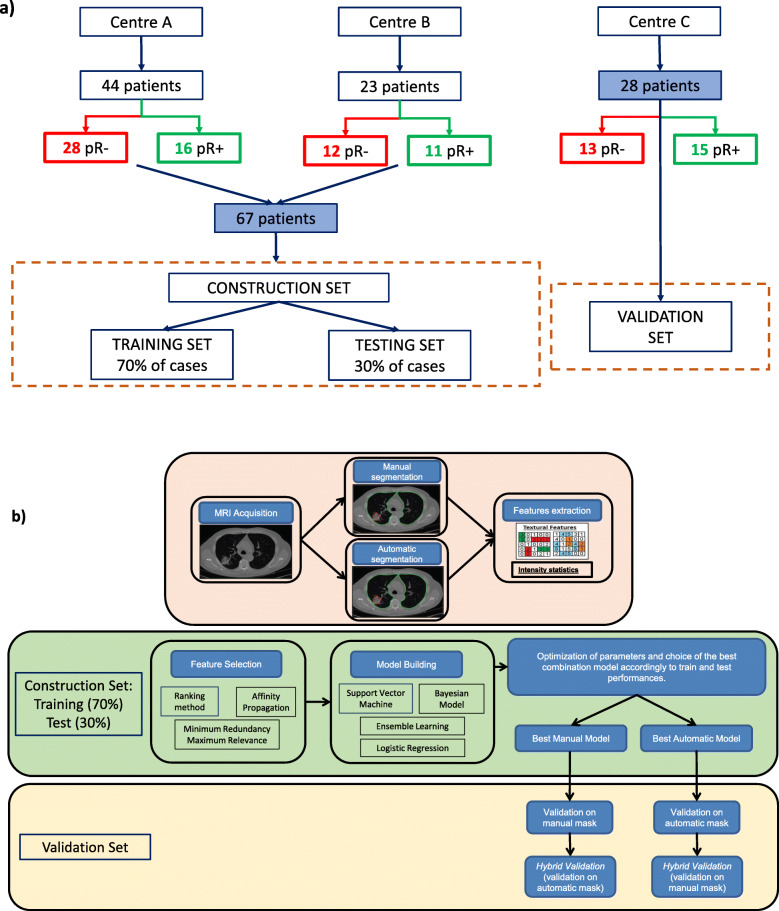
Ninety-five patients with stage II/III LARC who underwent multiparametric MRI before chemoradiotherapy and surgical treatment were enrolled from three institutions. Patients were classified as responders if tumour regression grade was 1 or 2 and nonresponders otherwise. Sixty-seven patients composed the construction dataset, while 28 the external validation. Tumour volumes were manually and automatically segmented using a U-net algorithm. Three approaches for feature selection were tested and combined with four machine learning classifiers.
Using manual segmentation, the best result reached an accuracy of 68% on the validation set, with sensitivity 60%, specificity 77%, negative predictive value (NPV) 63%, and positive predictive value (PPV) 75%. The automatic segmentation achieved an accuracy of 75% on the validation set, with sensitivity 80%, specificity 69%, and both NPV and PPV 75%. Sensitivity and NPV on the validation set were significantly higher (p = 0.047) for the automatic versus manual segmentation.
Our study showed that radiomics models can pave the way to help clinicians in the prediction of tumour response to chemoradiotherapy of LARC and to personalise per-patient treatment. The results from the external validation dataset are promising for further research into radiomics approaches using both manual and automatic segmentations.
新辅助放化疗后局部晚期直肠癌(LARC)的病理完全缓解率为 15-30%。我们的目的是实施并外部验证一种基于磁共振成像(MRI)的放射组学分析方法,以预测治疗反应,并研究手动和自动分割对放射组学模型的影响。
从三个机构招募了 95 名接受新辅助放化疗和手术治疗前多参数 MRI 的 II/III 期 LARC 患者。如果肿瘤消退分级为 1 或 2,则将患者分类为应答者,否则为无应答者。67 例患者组成了构建数据集,而 28 例患者组成了外部验证数据集。使用 U-net 算法对肿瘤体积进行手动和自动分割。测试了三种特征选择方法,并将其与四种机器学习分类器相结合。
使用手动分割,在验证集上最佳结果的准确率为 68%,敏感性为 60%,特异性为 77%,阴性预测值(NPV)为 63%,阳性预测值(PPV)为 75%。自动分割在验证集上的准确率为 75%,敏感性为 80%,特异性为 69%,NPV 和 PPV 均为 75%。自动分割与手动分割相比,验证集上的敏感性和 NPV 显著更高(p=0.047)。
本研究表明,放射组学模型可以为预测 LARC 患者对放化疗的肿瘤反应并为每位患者制定个体化治疗方案提供帮助。外部验证数据集的结果为进一步研究手动和自动分割的放射组学方法提供了有希望的结果。