Alice Lee Centre for Nursing Studies, Yong Loo Lin School of Medicine, National University of Singapore, Level 2, Clinical Research Centre, Block MD11 10 Medical Drive, Singapore, 117597, Singapore.
Woodlands Health Campus, Singapore, Singapore.
J Gen Intern Med. 2023 Jan;38(1):67-73. doi: 10.1007/s11606-022-07557-7. Epub 2022 May 2.
Simulation-based education can equip healthcare providers with the ability to respond to and manage stressors associated with rapidly deteriorating patient situations. However, little is known about the benefits of using virtual reality (VR) for this purpose.
To compare between desktop VR and face-to-face simulation in stress responses and performance outcomes of a team-based simulation training in managing clinical deterioration.
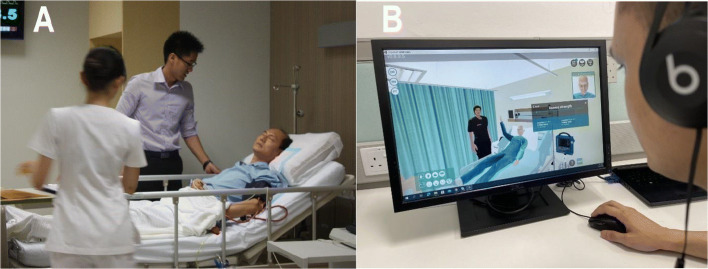
A randomised controlled study METHOD: The study was conducted on 120 medical and nursing students working in interprofessional teams. The teams were randomly assigned to participate in a 2-h simulation using either the desktop VR or face-to-face simulation with simulated patient (SP). Biophysiological stress response, psychological stress, and confidence levels were measured before and after the simulation. Performance outcomes were evaluated after the simulation using a deteriorating patient scenario.
The systolic blood pressure and psychological stress response were significantly increased among participants in VR and SP groups; however, no significant differences were found between the groups. There was also no significant difference in confidence and performance outcomes between participants in the VR and SP groups for both medical and nursing students. Although the psychological stress response was negatively correlated (r = -0.43; p < 0.01) with confidence levels, there was no association between stress response and performance score.
Despite being less immersive, the desktop VR was capable of inducing psychological and physiological stress responses by placing emotional, social, and cognitive demands on learners. Additionally, by ensuring close alignment between the simulation tasks and the clinical tasks (i.e. functional fidelity), the desktop VR may provide similar performance outcomes as conventional simulation training. This evidence is timely given the rise in the use of virtual learning platforms to facilitate training during the COVID-19 pandemic where face-to-face training may not be feasible.
The study was registered at ClinicalTrials.gov NCT04330924.
基于模拟的教育可以使医疗保健提供者具备应对和管理与患者病情迅速恶化相关的压力源的能力。然而,目前对于使用虚拟现实(VR)达到这一目的的好处知之甚少。
比较桌面 VR 和面对面模拟在管理临床恶化的团队模拟培训中的应激反应和绩效结果方面的差异。
随机对照研究。
该研究纳入了 120 名从事跨专业团队工作的医学和护理学生。这些团队被随机分配参加 2 小时的模拟训练,使用桌面 VR 或面对面模拟加模拟患者(SP)。在模拟前后测量生物生理应激反应、心理应激和信心水平。使用病情恶化的患者场景评估模拟后的绩效结果。
VR 和 SP 组的参与者的收缩压和心理应激反应均显著增加;但两组间无显著差异。VR 和 SP 组的医学生和护理学生的信心和绩效结果也无显著差异。虽然心理应激反应与信心水平呈负相关(r = -0.43;p < 0.01),但应激反应与绩效评分之间没有关联。
尽管桌面 VR 的沉浸感较低,但它通过对学习者施加情感、社会和认知方面的需求,能够引起心理和生理应激反应。此外,通过确保模拟任务与临床任务(即功能保真度)紧密一致,桌面 VR 可以提供与传统模拟训练相似的绩效结果。鉴于在 COVID-19 大流行期间,虚拟学习平台的使用增加,以促进培训,而面对面培训可能不可行,因此这项证据是及时的。
该研究在 ClinicalTrials.gov 注册,编号为 NCT04330924。