Department of Oncology and Department for Research and Innovation, Møre and Romsdal Hospital Trust, Åsehaugen 1, N-6026, Ålesund, Norway.
Department of Clinical and Molecular Medicine, Faculty of Medicine and Health Sciences, Norwegian University of Science and Technology, Trondheim, Norway.
BMC Palliat Care. 2022 May 2;21(1):61. doi: 10.1186/s12904-022-00952-1.
Spending time at home and dying at home is advocated to be a desirable outcome in palliative care (PC). In Norway, home deaths among cancer patients are rare compared to other European countries. Advance care planning (ACP) conversations enable patients to define goals and preferences, reflecting a person's wishes and current medical condition.
The study included 250 cancer patients in the Romsdal region with or without an ACP conversation in primary health care who died between September 2018 and August 2020. The patients were identified through their contact with the local hospital, cancer outpatient clinic or hospital-based PC team.
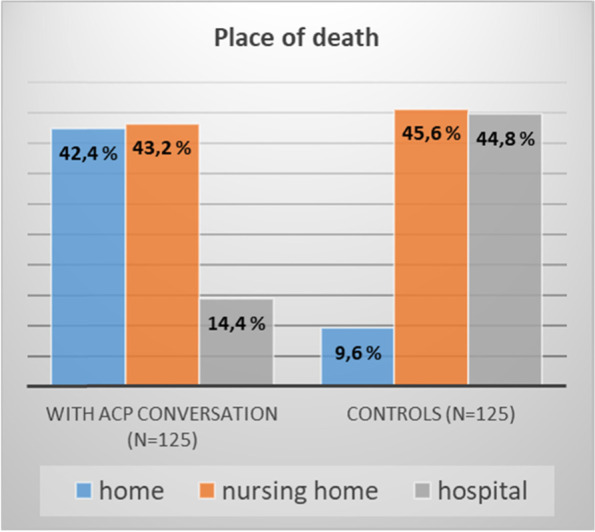
During the last 90 days of life, patients who had an ACP conversation in primary health care (N=125) were mean 9.8 more days at home, 4.5 less days in nursing home and 5.3 less days in hospital. Having an ACP conversation in primary health care, being male or having a lower age significantly predicted more days at home at the end of life (p< .001). Patients with an ACP conversation in primary health care where significantly more likely to die at home (p< .001) with a four times higher probability (RR=4.5). Contact with the hospital-based PC team was not associated with more days at home or death at home. Patients with contact with the hospital-based PC team were more likely to have an ACP conversation in primary health care.
Palliative cancer patients with an ACP conversation in primary health care spent more days at home and more frequently died at home. Data suggest it is important that ACP conversations are conducted in primary health care setting.
在姑息治疗(PC)中,提倡患者在家中度过时间并在家中去世,这是一种理想的结果。与其他欧洲国家相比,挪威癌症患者在家中死亡的情况很少见。预先医疗指示(ACP)对话使患者能够定义目标和偏好,反映出一个人的愿望和当前的医疗状况。
该研究包括罗姆斯达尔地区的 250 名癌症患者,这些患者在初级保健中心进行了或没有进行 ACP 对话,并于 2018 年 9 月至 2020 年 8 月期间去世。这些患者是通过与当地医院、癌症门诊或医院的姑息治疗团队联系而被确定的。
在生命的最后 90 天里,在初级保健中心进行 ACP 对话的患者(N=125)平均在家中多了 9.8 天,在疗养院少了 4.5 天,在医院少了 5.3 天。在初级保健中心进行 ACP 对话、为男性或年龄较低与生命末期在家中的天数增加显著相关(p<.001)。在初级保健中心进行 ACP 对话的患者更有可能在家中去世(p<.001),其可能性高出四倍(RR=4.5)。与医院姑息治疗团队的联系与在家中的天数或在家中死亡无关。与医院姑息治疗团队联系的患者更有可能在初级保健中心进行 ACP 对话。
在初级保健中心进行 ACP 对话的姑息治疗癌症患者在家中度过的时间更多,在家中去世的频率更高。数据表明,在初级保健环境中进行 ACP 对话非常重要。