Graduate Program in Rural Development, Universidad Austral de Chile, Valdivia, Los Ríos Region, Chile.
Laboratory of Territorial Studies LabT UACh, Institute of Environmental and Evolutionary Sciences, Universidad Austral de Chile, Valdivia, Los Ríos Region, Chile.
J Ethnobiol Ethnomed. 2022 May 3;18(1):36. doi: 10.1186/s13002-022-00534-8.
Traditional veterinary medicine (TVM) or ethnoveterinary medicine comprises knowledge, practices, and beliefs about farm animals. Its study serves to offer ecologically and culturally appropriate strategies for the management of animals and their health in a context marked by the increased use of synthetic pharmaceuticals, social-environmental degradation, pollution, and climate change. In this study, we examine the TVM that Mapuche and non-Mapuche campesinos in the southern Andes have about the management of animals and their health. In addition, we investigate the main factors influencing the current use of TVM.
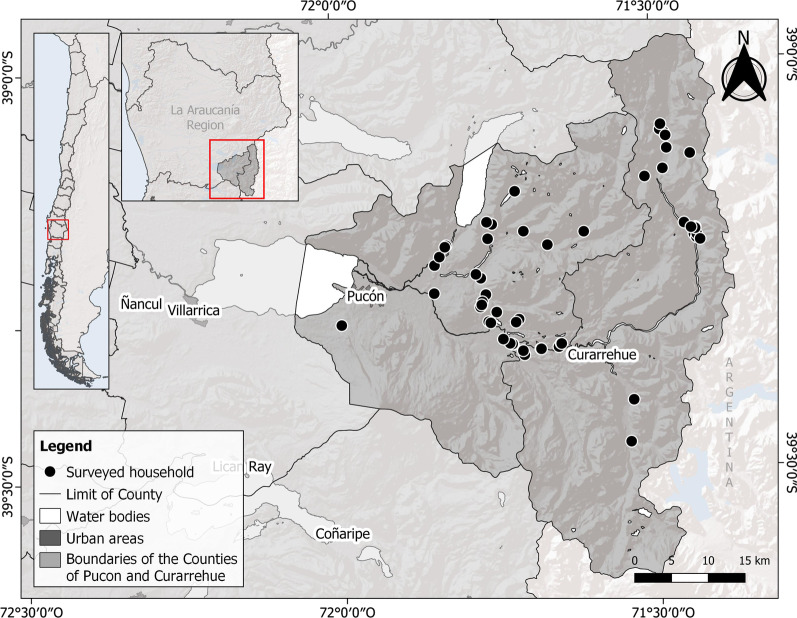
Between December 2020 and March 2021, we undertook participant observation and conducted 60 semi-structured and informal interviews with Mapuche and non-Mapuche campesinos from the Pucón and Curarrehue municipal districts in the southern Andes of Chile.
We identified a set of knowledge about cycles and manifestations of nature used in planning 14 animal management practices related to a Mapuche kosmos expressed in living with respect for and in dialogue with non-human elements. On health management, we recorded knowledge about 30 plant species, whose use for different categories of wounds and parasites has the highest informant consensus factors. The use of these plant species is governed by a kosmos associated with respect and reciprocity in their gathering. Nonetheless, 70% of the campesinos interviewed prefer to use synthetic pharmaceuticals. We found that the growing use of synthetic pharmaceuticals, the processes of reduction and change in the structure of land ownership, and climate change are perceived as the main factors behind processes of assimilation of new praxis and hybridization as well as the reduction and/or loss of the use of TVM.
Our results reveal the presence of ethnoveterinary knowledge, practices, and beliefs that are safeguarded by Mapuche and non-Mapuche campesinos in the southern Andes. However, in the context of different social-environmental changes, it is imperative to document, visibilize, and revitalize TVM since it provides new perspectives for bioculturally diverse and sustainable animal production.
传统兽医(TVM)或民族兽医包含了有关农场动物的知识、实践和信仰。对其进行研究旨在提供生态和文化上适宜的策略,以管理动物及其健康,这一策略在以下背景下具有重要意义:越来越多地使用合成药物、社会-环境退化、污染和气候变化。在这项研究中,我们研究了安第斯南部的马普切人和非马普切农民对动物管理和健康的传统兽医知识。此外,我们还调查了影响当前传统兽医使用的主要因素。
在 2020 年 12 月至 2021 年 3 月期间,我们进行了参与式观察,并对智利南部安第斯地区普孔和库里雷乌市的马普切人和非马普切农民进行了 60 次半结构化和非正式访谈。
我们确定了一套与马普切宇宙相关的自然周期和表现的知识,用于规划与尊重非人类元素和与非人类元素对话相关的 14 种动物管理实践。在健康管理方面,我们记录了 30 种植物物种的知识,这些植物物种在不同类别伤口和寄生虫方面的使用具有最高的信息共识因素。这些植物物种的使用受与尊重和互惠相关的宇宙的制约。尽管如此,70%的受访者更喜欢使用合成药物。我们发现,合成药物的使用不断增加、土地所有权结构的减少和变化以及气候变化被视为新实践同化和杂交以及传统兽医使用减少和/或丧失的主要因素。
我们的研究结果揭示了安第斯南部的马普切人和非马普切农民所拥有的传统兽医知识、实践和信仰。然而,在不同的社会-环境变化背景下,必须记录、凸显和振兴传统兽医知识,因为它为生物文化多样和可持续的动物生产提供了新的视角。