Zhang Huan, Sun Chen, Chen Yu, Yuan Yan, Xu Ke, Lu Peipei, Wang Jialin, Zhang Nan
Shandong First Medical University & Shandong Academy of Medical Sciences, Jinan 250021, China.
Centre for Health Management and Policy Research, School of Public Health, Cheeloo College of Medicine, Shandong University, Jinan 250012, China.
J Oncol. 2022 Apr 23;2022:2607829. doi: 10.1155/2022/2607829. eCollection 2022.
Health-related quality of life (HRQoL) is a key variable in the evaluation of health economics. We aimed to evaluate the HRQoL and utility scores of patients with gastric cancer and related precancerous lesions by assessing their quality of life using a single standardized health measurement instrument.
A cross-sectional study was conducted in six counties in Shangdong Province from November 2019 to March 2020. Subjects with precancerous lesions and gastric cancer (cardia and noncardia) were included and surveyed. Patients were divided into four groups: low-grade intraepithelial neoplasia (LGIN), high-grade intraepithelial neoplasia (HGIN), early gastric cancer (EGC), and advanced gastric cancer (AGC). All patients, except those with LGIN, received treatment. The five-level EQ-5D was used to assess HRQoL and generate utility scores using the Chinese-specific tariff published in 2017.
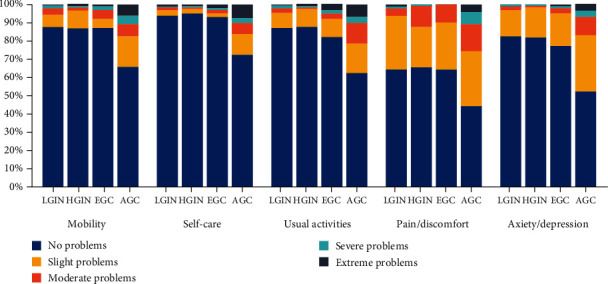
The study included 566 respondents. The average utility was 0.927 for precancerous lesions (LGIN: 0.930; HGIN: 0.926), 0.906 for early gastric cancer (EGC), and 0.756 for advanced gastric cancer (AGC). Visual analogue scale (VAS) means were 76.82 (LGIN: 78.08; HGIN: 74.81), 72.26, and 69.16 for precancerous lesions, EGC, and AGC, respectively. HRQoL was lower in women with AGC than in men (0.612 vs. 0.792, = 0.035). AGC patients were more likely to report problems across all five dimensions than patients in other stages. The proportion of patients reporting pain/discomfort problems was highest across all gastric cancer stages (LGIN, 35.6%; HGIN, 34.4%; EGC, 35.6%; and AGC, 55.7%), followed by anxiety/depression (LGIN, 17.5%; HGIN, 18%; EGC, 22.8%; and AGC, 47.7%).
HRQoL declined as cancer progressed, with the most dramatic decline observed in patients with AGC. A more advanced pathological stage was associated with a greater decrease in health utility. The obtained utilities for different pathological stages of gastric cancer were significant parameters for researchers to perform further cost-utility analysis. Pain/discomfort and anxiety/depression were problems that seriously affected the patients in all groups.
健康相关生活质量(HRQoL)是健康经济学评估中的关键变量。我们旨在通过使用单一标准化健康测量工具评估胃癌及相关癌前病变患者的生活质量,从而评估其HRQoL和效用得分。
2019年11月至2020年3月在山东省六个县进行了一项横断面研究。纳入并调查了患有癌前病变和胃癌(贲门癌和非贲门癌)的受试者。患者分为四组:低级别上皮内瘤变(LGIN)、高级别上皮内瘤变(HGIN)、早期胃癌(EGC)和进展期胃癌(AGC)。除LGIN患者外,所有患者均接受了治疗。使用五级EQ-5D评估HRQoL,并根据2017年发布的中国特定关税生成效用得分。
该研究纳入了566名受访者。癌前病变(LGIN:0.930;HGIN:0.926)的平均效用为0.927,早期胃癌(EGC)为0.906,进展期胃癌(AGC)为0.756。视觉模拟量表(VAS)平均值在癌前病变、EGC和AGC中分别为76.82(LGIN:78.08;HGIN:74.81), 72.26和69.16。AGC女性患者的HRQoL低于男性(0.612对0.792,P = 0.035)。与其他阶段的患者相比,AGC患者在所有五个维度上更有可能报告问题。在所有胃癌阶段中,报告疼痛/不适问题的患者比例最高(LGIN为35.6%;HGIN为34.4%;EGC为35.6%;AGC为55.7%),其次是焦虑/抑郁(LGIN为17.5%;HGIN为18%;EGC为22.8%;AGC为47.7%)。
随着癌症进展,HRQoL下降,在AGC患者中观察到最显著的下降。更晚期的病理阶段与健康效用的更大下降相关。胃癌不同病理阶段获得的效用是研究人员进行进一步成本-效用分析的重要参数。疼痛/不适和焦虑/抑郁是严重影响所有组患者的问题。