Department of Psychology, University of Michigan Ann Arbor, Ann Arbor, Michigan, United Started of America.
School of Medicine, University of Washington, Seattle, Washington, United States of America.
PLoS One. 2022 May 3;17(5):e0267345. doi: 10.1371/journal.pone.0267345. eCollection 2022.
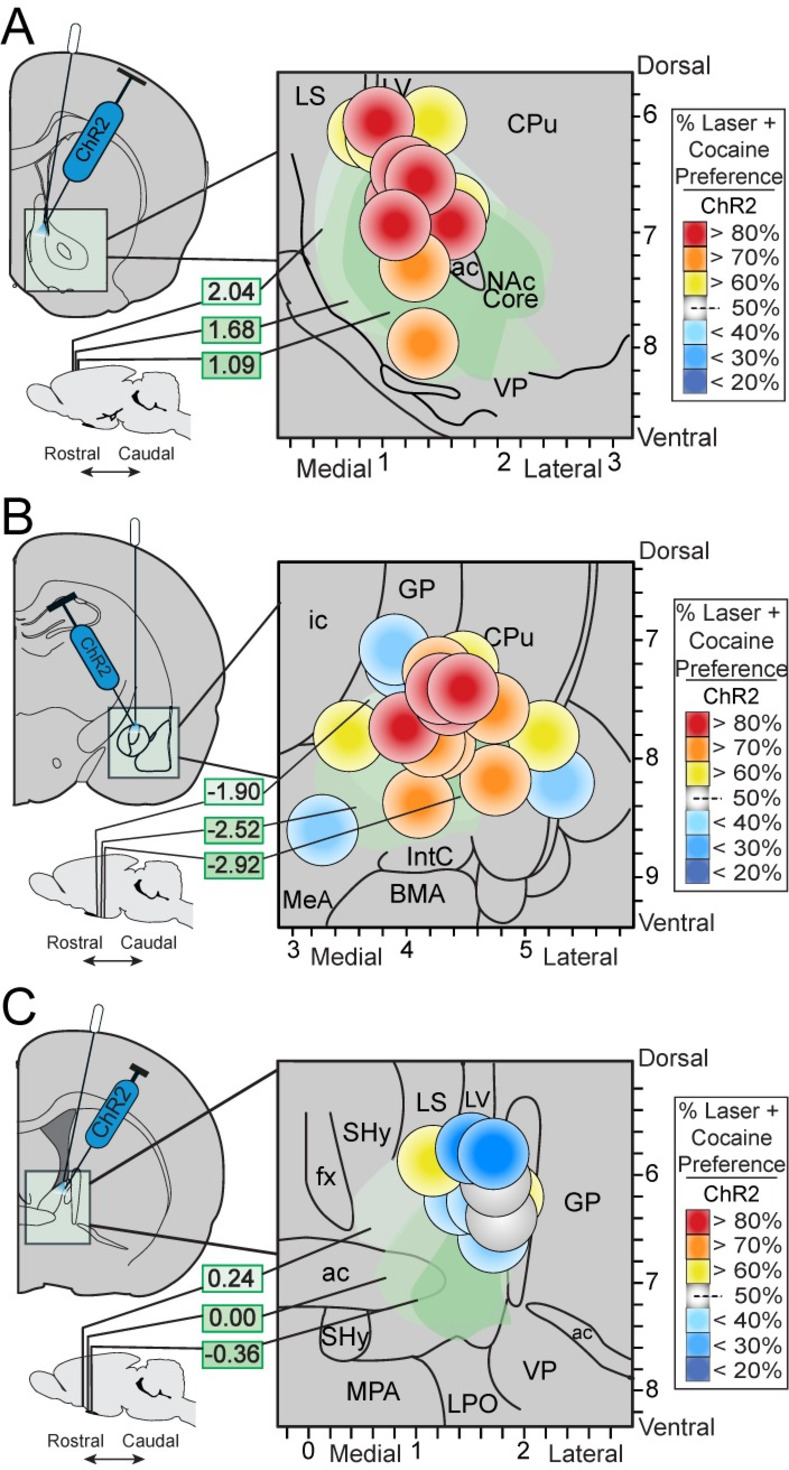
Corticotropin releasing factor (CRF) systems in limbic structures are posited to mediate stress-induced relapse in addiction, traditionally by generating distress states that spur drug consumption as attempts at hedonic self-medication. Yet evidence suggests that activating CRF-expressing neurons in the central amygdala (CeA) or nucleus accumbens (NAc) can magnify incentive motivation in absence of distress, at least for sucrose rewards. However, traditional CRF hypotheses in addiction neuroscience are primarily directed toward drug rewards. The question remains open whether CRF systems can similarly act via incentive motivation mechanisms to promote pursuit of drug rewards, such as cocaine. Here we tested whether optogenetic excitation of CRF-containing neurons in either NAc medial shell, lateral CeA, or dorsolateral BNST of transgenic Crh-Cre+ rats would spur preference and pursuit of a particular laser-paired cocaine reward over an alternative cocaine reward, and whether excitation served as a positively-valenced incentive itself, through laser self-stimulation tests. We report that excitation of CRF-containing neurons in either NAc or CeA recruited mesocorticolimbic circuitry to amplify incentive motivation to pursue the laser-paired cocaine: focusing preference on the laser-paired cocaine reward in a two-choice task, and spurred pursuit as doubled breakpoint in a progressive ratio task. Crucially indicating positive-valence, excitation of CRF neurons in NAc and CeA also was actively sought after by most rats in self-stimulation tasks. Conversely, CRF neuronal activation in BNST was never self-stimulated, but failed to enhance cocaine consumption. Collectively, we find that NAc and CeA CRF-containing neurons can amplify pursuit and consumption of cocaine by positively-valenced incentive mechanisms, without any aversive distress.
边缘结构中的促肾上腺皮质释放因子(CRF)系统被认为可以介导成瘾导致的应激性复发,传统上是通过产生痛苦状态来刺激药物消费,作为享乐自我药物治疗的尝试。然而,有证据表明,激活中杏仁核(CeA)或伏隔核(NAc)中的 CRF 表达神经元可以在没有痛苦的情况下放大激励动机,至少对于蔗糖奖励是如此。然而,成瘾神经科学中的传统 CRF 假设主要针对药物奖励。CRF 系统是否可以通过激励动机机制类似地促进对药物奖励(如可卡因)的追求,这个问题仍然没有答案。在这里,我们测试了是否可以通过转基因 Crh-Cre+大鼠的 NAc 内侧壳、外侧 CeA 或背外侧 BNST 中的 CRF 神经元的光遗传学刺激来刺激对特定激光配对可卡因奖励的偏好和追求,以及兴奋是否本身作为一种正价激励,通过激光自我刺激测试。我们报告说,无论是在 NAc 还是 CeA 中,CRF 神经元的兴奋都会募集中边缘皮质奖励回路,以放大对激光配对可卡因的激励动机:在双选择任务中,将偏好集中在激光配对可卡因奖励上,在渐进比率任务中,刺激追求的动力增加一倍。至关重要的是,表明正价的是,NAc 和 CeA 中的 CRF 神经元的兴奋也被大多数大鼠在自我刺激任务中积极寻求。相反,BNST 中的 CRF 神经元激活从未被自我刺激,但未能增强可卡因消费。总的来说,我们发现 NAc 和 CeA 中的 CRF 神经元可以通过正价激励机制放大可卡因的追求和消费,而不会产生任何痛苦。