Ingusci Emanuela, Signore Fulvio, Cortese Claudio Giovanni, Molino Monica, Pasca Paola, Ciavolino Enrico
Department of History, Society and Human Studies, University of Salento, Studium 2000 - Building 5 - Via di Valesio, 24 - Lecce (LE) Office 18, Ground Floor, Lecce, Italy.
Department of Psychology, University of Turin, Via Verdi 10, 10124 Torino, Italy.
Qual Quant. 2023;57(2):1159-1183. doi: 10.1007/s11135-022-01364-2. Epub 2022 Apr 29.
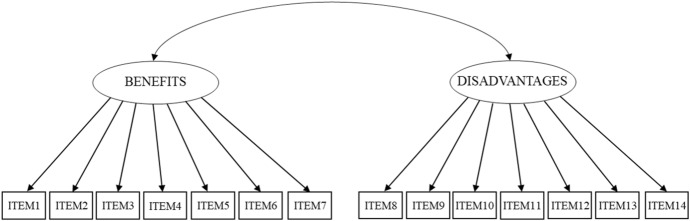
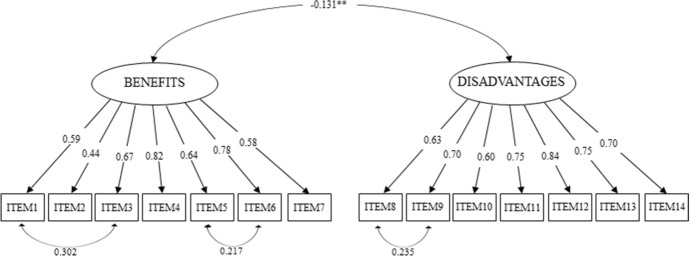
The changes that are constantly occurring in the labour sector have led organisations and companies to move towards digital transformation. This process was accelerated by the COVID-19 pandemic and conducted to a massive recourse to the practice of remote working, which in this study is understood as the term for the way of performing work outside the usual workplace and with the support of ICT. Currently, there are no flexible scales in the literature that allow measuring the benefits and disadvantages of remote working with a single instrument. Thus, the distinction between the positive and negative consequences of working remotely, substantiated by a solid literature, provides a framework for a systematical understanding of the issue. The aim of the present study is to develop and validate a scale on remote working benefits and disadvantages (RW-B&D scale). For this end, a preliminary Exploratory Factor Analysis (EFA) with 304 participants, a tailored EFA with a sample of 301 workers and a Confirmatory Factor Analysis (CFA) with 677 workers were conducted. Participants were all Italian employees who worked remotely during the period of the COVID-19 health emergency. Data were collected between October 2020 and April 2021. The psychometric robustness of the model was assessed through bootstrap validation (5000 resamples), fit indices testing and measurement of factorial invariance. The statistical analyses demonstrated the bifactorial nature of the scale, supporting the research hypothesis. The model showed good fit indices, bootstrap validation reported statistically significant saturations, good reliability indices, and convergent and discriminant validity. Measurement invariance was tested for gender and organisational sector. The results suggested that the novel scale facilitates the quantitative measurement of the benefits and disadvantages associated with remote working in empirical terms. For this reason, it could be a streamlined and psychometrically valid instrument to identify the potential difficulties arising from remote working and, at the same time, the positive aspects that can be implemented to improve organisational well-being.
劳动力部门持续发生的变化促使组织和公司走向数字化转型。新冠疫情加速了这一进程,并导致大量采用远程工作方式,在本研究中,远程工作被理解为在通常工作场所以外借助信息通信技术支持开展工作的方式。目前,文献中没有灵活的量表能够用单一工具衡量远程工作的利弊。因此,有坚实文献依据的远程工作正负后果之分,为系统理解该问题提供了一个框架。本研究的目的是开发并验证一个关于远程工作利弊的量表(RW-B&D量表)。为此,对304名参与者进行了初步探索性因素分析(EFA),对301名员工样本进行了定制EFA,并对677名员工进行了验证性因素分析(CFA)。参与者均为在新冠疫情健康紧急状态期间远程工作的意大利员工。数据收集于2020年10月至2021年4月之间。通过自助法验证(5000次重抽样)、拟合指数测试和因子不变性测量来评估模型的心理测量稳健性。统计分析证明了该量表的双因素性质,支持了研究假设。该模型显示出良好的拟合指数,自助法验证报告了具有统计学意义的饱和度、良好的信度指数以及收敛效度和区分效度。对性别和组织部门进行了测量不变性测试。结果表明,这个新量表有助于从实证角度对与远程工作相关的利弊进行量化测量。因此,它可能是一个精简且心理测量有效的工具,既能识别远程工作产生的潜在困难,又能同时找出可用于改善组织福祉的积极方面。