Pharmacy and Allied Health Sciences, Iqra University, Karachi 7580, Pakistan.
Department of Biochemistry, Clinical Biochemistry and Psychopharmacology Research Unit, University of Karachi, Karachi 75270, Pakistan.
Biosci Rep. 2022 May 27;42(5). doi: 10.1042/BSR20220426.
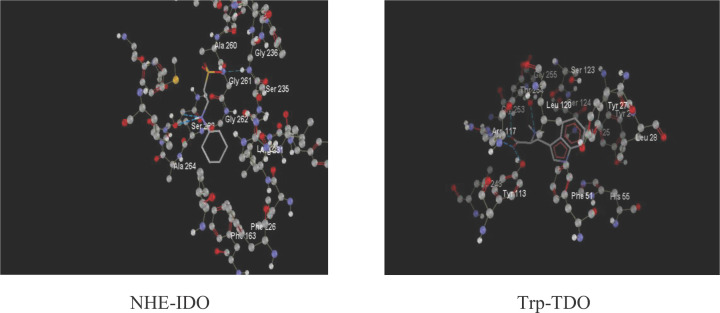
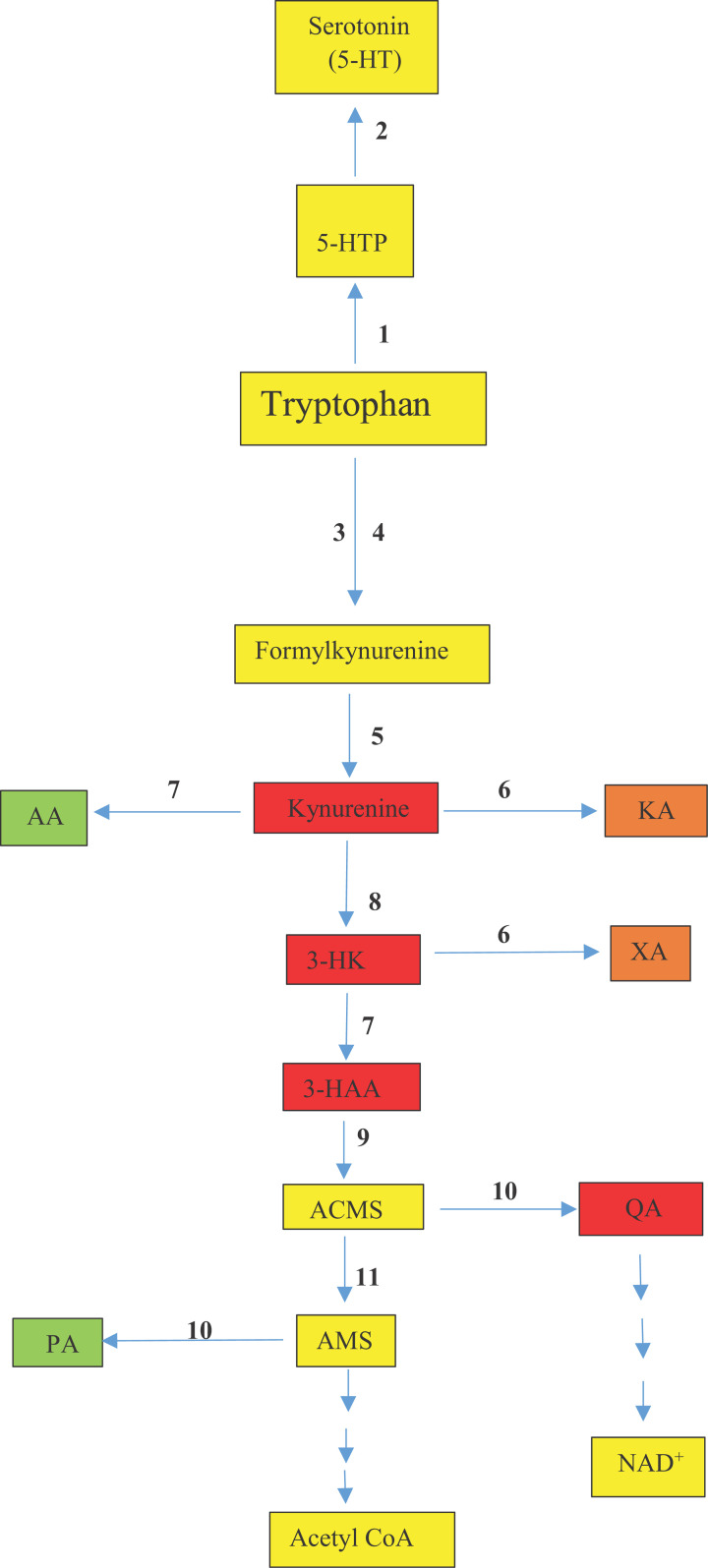
The roles of the kynurenine pathway (KP) of tryptophan (Trp) degradation in serotonin deficiency in major depressive disorder (MDD) and the associated inflammatory state are considered in the present study. Using molecular docking in silico, we demonstrate binding of antidepressants to the crystal structure of tryptophan 2,3-dioxygenase (TDO) but not to indoleamine 2,3-dioxygenase (IDO). TDO is inhibited by a wide range of antidepressant drugs. The rapidly acting antidepressant ketamine does not dock to either enzyme but may act by inhibiting kynurenine monooxygenase thereby antagonising glutamatergic activation to normalise serotonin function. Antidepressants with anti-inflammatory properties are unlikely to act by direct inhibition of IDO but may inhibit IDO induction by lowering levels of proinflammatory cytokines in immune-activated patients. Of six anti-inflammatory drugs tested, only salicylate docks strongly to TDO and apart from celecoxib, the other five dock to IDO. TDO inhibition remains the major common property of antidepressants and TDO induction the most likely mechanism of defective serotonin synthesis in MDD. TDO inhibition and increased free Trp availability by salicylate may underpin the antidepressant effect of aspirin and distinguish it from other nonsteroidal anti-inflammatory drugs. The controversial findings with IDO in MDD patients with an inflammatory state can be explained by IDO induction being overridden by changes in subsequent KP enzymes influencing glutamatergic function. The pathophysiology of MDD may be underpinned by the interaction of serotonergic and glutamatergic activities.
本研究探讨了色氨酸(Trp)降解的犬尿氨酸途径(KP)在重度抑郁症(MDD)中 5-羟色胺缺乏症和相关炎症状态中的作用。通过计算机分子对接,我们证明了抗抑郁药与色氨酸 2,3-加双氧酶(TDO)的晶体结构结合,但不与吲哚胺 2,3-加双氧酶(IDO)结合。TDO 被广泛的抗抑郁药物抑制。快速作用的抗抑郁药氯胺酮既不与任何一种酶结合,但可能通过抑制犬尿氨酸单加氧酶起作用,从而拮抗谷氨酸能激活以恢复 5-羟色胺功能。具有抗炎作用的抗抑郁药不太可能通过直接抑制 IDO 起作用,但可能通过降低免疫激活患者中促炎细胞因子的水平来抑制 IDO 的诱导。在测试的六种抗炎药物中,只有水杨酸盐强烈与 TDO 结合,除了塞来昔布外,其他五种与 IDO 结合。TDO 抑制仍然是抗抑郁药的主要共同特性,而 IDO 诱导是 MDD 中 5-羟色胺合成缺陷的最可能机制。水杨酸盐抑制 TDO 和增加游离 Trp 的可用性可能是阿司匹林抗抑郁作用的基础,并使其区别于其他非甾体抗炎药。在存在炎症状态的 MDD 患者中,IDO 的有争议的发现可以通过影响谷氨酸能功能的后续 KP 酶的变化来解释 IDO 的诱导。MDD 的病理生理学可能是由 5-羟色胺能和谷氨酸能活动的相互作用所支撑。