Department of Biomedical Sciences of Cells & Systems, University Medical Center Groningen, University of Groningen, Groningen, The Netherlands.
Department of Pathology & Medical Biology, University Medical Center Groningen, University of Groningen, Groningen, The Netherlands.
Psychol Med. 2022 May;52(7):1222-1242. doi: 10.1017/S0033291722000897. Epub 2022 May 4.
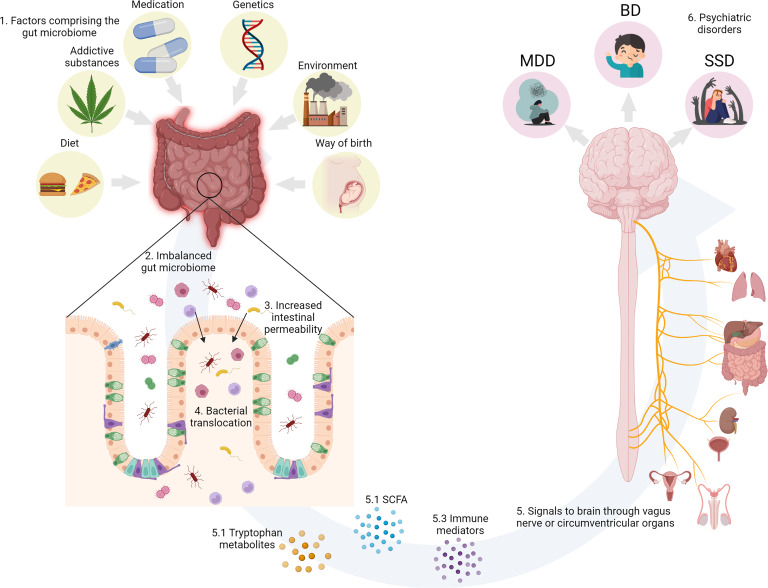
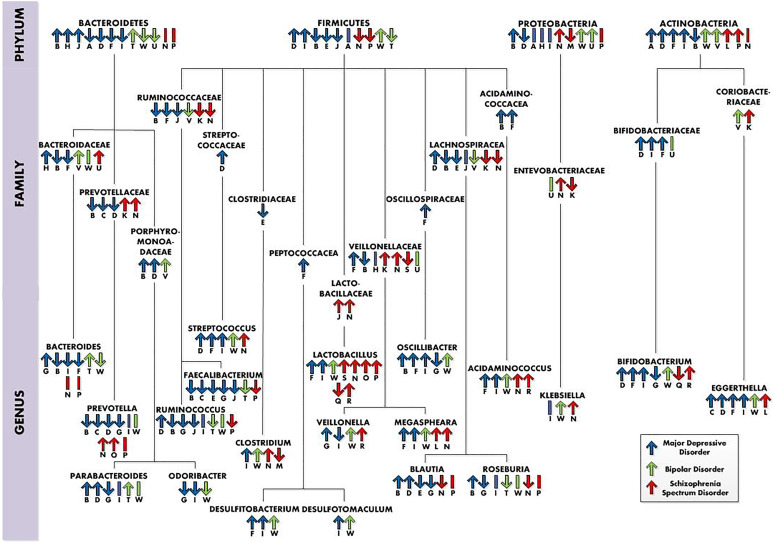
Major depressive disorder (MDD), bipolar disorder (BD) and schizophrenia-spectrum disorders (SSD) are heterogeneous psychiatric disorders, which place significant burden on patient's well-being and global health. Disruptions in the gut-microbiome may play a role in these psychiatric disorders. This review presents current data on composition of the human gastrointestinal microbiota, and its interaction mechanisms in the gut-brain axis in MDD, BD and SSD. Diversity metrics and microbial relative abundance differed across studies. More studies reported inconsistent findings (n = 7) or no differences (n = 8) than studies who reported lower α-diversity in these psychiatric disorders (n = 5). The most consistent findings across studies were higher relative abundances of the genera Streptococcus, Lactobacillus, and Eggerthella and lower relative abundance of the butyrate producing Faecalibacterium in patients with psychiatric disorders. All three increased genera were associated with higher symptom severity. Confounders, such as medication use and life style have not been accounted for. So far, the results of probiotics trials have been inconsistent. Most traditional and widely used probiotics (consisting of Bifidobacterium spp. and Lactobacillus spp.) are safe, however, they do not correct potential microbiota disbalances in these disorders. Findings on prebiotics and faecal microbiota transplantation (FMT) are too limited to draw definitive conclusions. Disease-specific pro/prebiotic treatment or even FMT could be auspicious interventions for prevention and therapy for psychiatric disorders and should be investigated in future trials.
重性抑郁障碍(MDD)、双相情感障碍(BD)和精神分裂谱系障碍(SSD)是异质性精神疾病,给患者的幸福感和全球健康带来了巨大负担。肠道微生物群的紊乱可能在这些精神疾病中起作用。本综述介绍了人类胃肠道微生物群的组成及其在 MDD、BD 和 SSD 中与肠道-大脑轴的相互作用机制的最新数据。多样性指标和微生物相对丰度因研究而异。与报告这些精神障碍中 α 多样性较低的研究(n = 5)相比,更多的研究报告了不一致的发现(n = 7)或无差异(n = 8)。研究结果最一致的是精神障碍患者中链球菌属、乳杆菌属和 Eggerthella 属的相对丰度较高,丁酸产生菌粪杆菌属的相对丰度较低。所有三种增加的属都与更高的症状严重程度有关。混杂因素,如药物使用和生活方式,尚未得到解释。到目前为止,益生菌试验的结果一直不一致。大多数传统和广泛使用的益生菌(由双歧杆菌属和乳杆菌属组成)是安全的,但它们不能纠正这些疾病中潜在的微生物失衡。关于益生元和粪便微生物群移植(FMT)的研究结果还太有限,无法得出明确的结论。针对特定疾病的 Pro/prebiotic 治疗甚至 FMT 可能是预防和治疗精神疾病的有希望的干预措施,应在未来的试验中进行研究。