Center for Monsoon System Research, Institute of Atmospheric Physics, Chinese Academy of Sciences, Beijing, China.
College of Earth Sciences, University of Chinese Academy of Sciences, Beijing, China.
Nat Commun. 2022 May 4;13(1):2437. doi: 10.1038/s41467-022-30104-1.
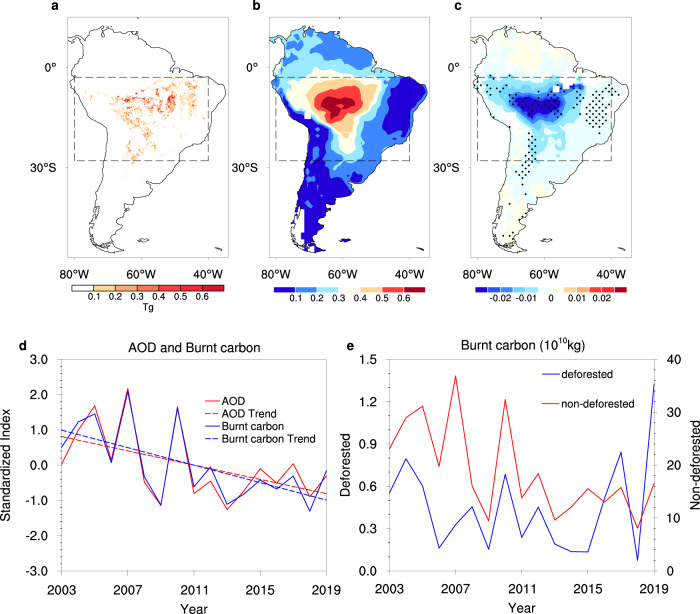
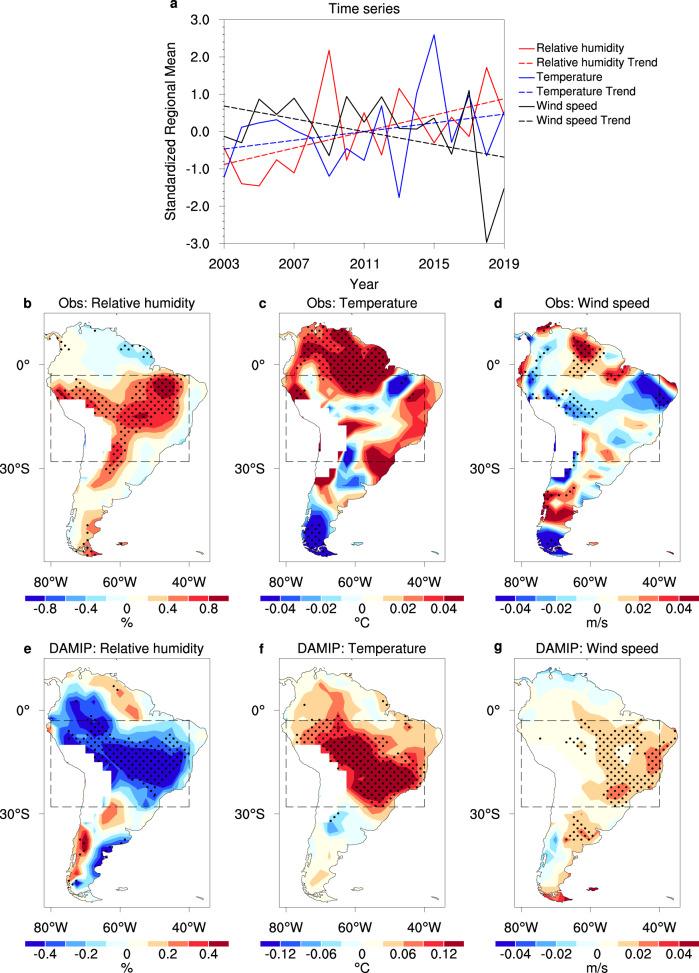
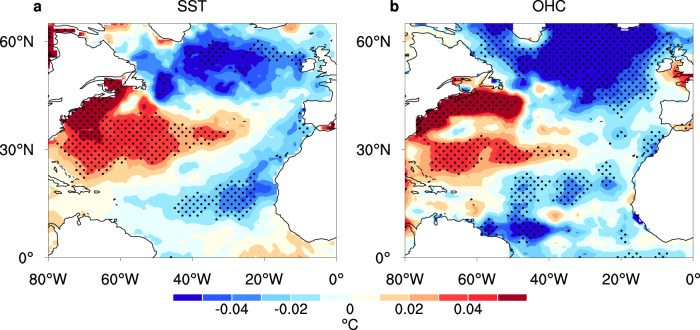
Fires in South America have profound effects on climate change and air quality. Although anthropogenic forcing has exacerbated drought and fire risks, the fire emissions and aerosol pollution in the southern Amazon and the Pantanal region showed a consistent long-term decrease during the dry season (August-October) between 2003 and 2019. Here, we find that the decreasing trend in fire emissions, mainly located in the non-deforested region, was associated with climatic conditions unfavorable for intensifying and spreading fires, including increased humidity and slower surface wind speed. These climatic trends can be attributed to weakening of the positive phase of the Atlantic Multidecadal Oscillation, which has strengthened the northeast trade winds within the region (3°S-13°N) and the northwest winds east of the Andes that transport more moisture into the southern Amazon and the Pantanal region. Our findings show the mitigating effects of weakening of the positive Atlantic Multidecadal Oscillation phase on human-induced intensification of fire risks in South America and warn of potentially increased risks of fires and aerosol pollution under intensified anthropogenic forcing in the future.
南美洲的火灾对气候变化和空气质量有深远的影响。尽管人为因素加剧了干旱和火灾风险,但在 2003 年至 2019 年期间,南部亚马逊地区和潘塔纳尔地区的火灾排放物和气溶胶污染在旱季(8 月至 10 月)一直呈持续长期下降趋势。在这里,我们发现,火灾排放物的减少趋势主要集中在未开垦地区,这与不利于火势加剧和蔓延的气候条件有关,包括湿度增加和地表风速减缓。这些气候趋势可归因于大西洋多年代际振荡正位相的减弱,这加强了该地区(南纬 3 度至北纬 13 度)的东北信风以及安第斯山脉以东的西北风,将更多的水汽输送到南部亚马逊地区和潘塔纳尔地区。我们的研究结果表明,减弱大西洋多年代际振荡正位相对人类引发的南美的火灾风险加剧具有缓解作用,并警告在未来人为因素的强化下,火灾和气溶胶污染的风险可能会增加。