Department of Medical Oncology, St Vincent's Hospital Melbourne, 41 Victoria Parade, Fitzroy, VIC, 3065, Australia.
Department of Medicine, St Vincent's Hospital Melbourne, University of Melbourne, Parkville, VIC, Australia.
BMC Med Res Methodol. 2022 May 4;22(1):133. doi: 10.1186/s12874-022-01603-y.
To perform virtual re-executions of a breast cancer clinical trial with a time-to-event outcome to demonstrate what would have happened if the trial had used various Bayesian adaptive designs instead.
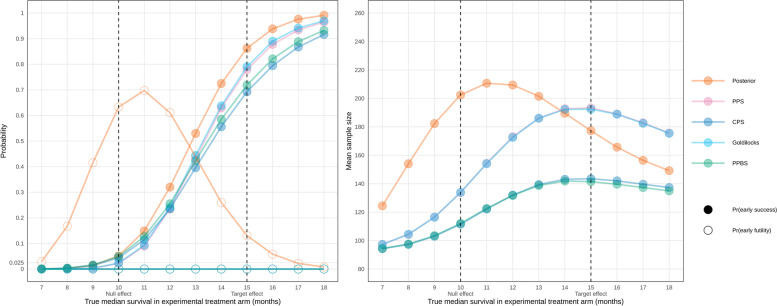
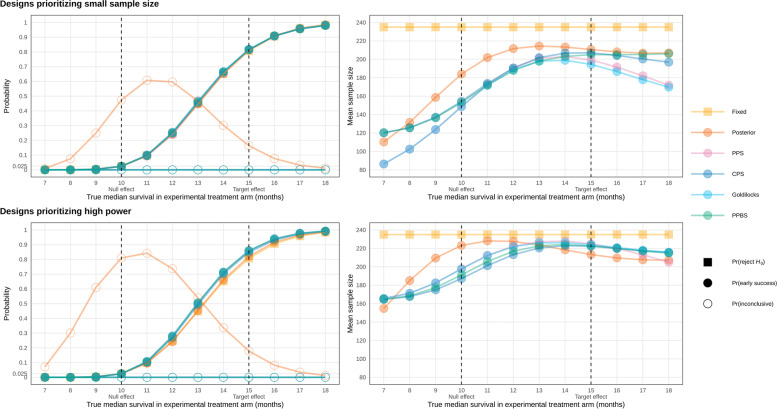
We aimed to retrospectively "re-execute" a randomised controlled trial that compared two chemotherapy regimens for women with metastatic breast cancer (ANZ 9311) using Bayesian adaptive designs. We used computer simulations to estimate the power and sample sizes of a large number of different candidate designs and shortlisted designs with the either highest power or the lowest average sample size. Using the real-world data, we explored what would have happened had ANZ 9311 been conducted using these shortlisted designs.
We shortlisted ten adaptive designs that had higher power, lower average sample size, and a lower false positive rate, compared to the original trial design. Adaptive designs that prioritised small sample size reduced the average sample size by up to 37% when there was no clinical effect and by up to 17% at the target clinical effect. Adaptive designs that prioritised high power increased power by up to 5.9 percentage points without a corresponding increase in type I error. The performance of the adaptive designs when applied to the real-world ANZ 9311 data was consistent with the simulations.
The shortlisted Bayesian adaptive designs improved power or lowered the average sample size substantially. When designing new oncology trials, researchers should consider whether a Bayesian adaptive design may be beneficial.
通过时间事件结局的虚拟重执行来演示如果临床试验使用了各种贝叶斯自适应设计会发生什么。
我们旨在回顾性地“重新执行”一项比较两种化疗方案治疗转移性乳腺癌(ANZ 9311)的随机对照试验,使用贝叶斯自适应设计。我们使用计算机模拟来估计大量不同候选设计和具有最高功率或最低平均样本量的设计的功率和样本量。使用真实世界的数据,我们探讨了如果使用这些入围设计进行 ANZ 9311 会发生什么。
我们入围了十个自适应设计,与原始试验设计相比,这些设计具有更高的功率、更低的平均样本量和更低的假阳性率。优先考虑小样本量的自适应设计在没有临床效果时将平均样本量减少了多达 37%,在目标临床效果时将平均样本量减少了多达 17%。优先考虑高功率的自适应设计将功率提高了高达 5.9 个百分点,而不会相应增加Ⅰ类错误率。自适应设计在应用于真实世界的 ANZ 9311 数据时的性能与模拟结果一致。
入围的贝叶斯自适应设计大大提高了功率或降低了平均样本量。在设计新的肿瘤学试验时,研究人员应该考虑贝叶斯自适应设计是否可能有益。