Gopakumar Sricharan, McDonald Malcolm F, Sharma Himanshu, Tatsui Claudio E, Fuller Gregory N, Rao Ganesh
Department of Neurosurgery, Baylor College of Medicine.
Departments of Neurosurgery, University of Texas MD Anderson Cancer Center, Houston, Texas, USA.
Surg Neurol Int. 2022 Apr 15;13:139. doi: 10.25259/SNI_1208_2021. eCollection 2022.
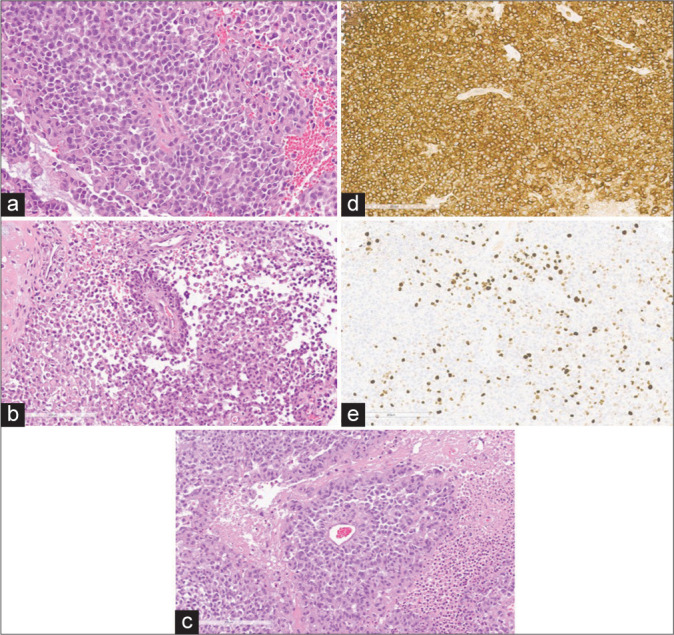
Astroblastoma is a rare primary brain tumor of unclear origin, often occurring in young patients less than 30-years-old. It typically arises supratentorially and is diagnosed based on histological features including vascular hyalinization and perivascular pseudorosettes. Recent molecular characterization of primary CNS high-grade neuroepithelial tumors with meningioma I alteration (HGNET-) found that HGNET- and tumors with morphological signatures of astroblastoma clustered together. Further analysis revealed such astroblastomas have alteration and the 2021 WHO classification of tumors of the CNS now recognizes astroblastoma altered as a new entity.
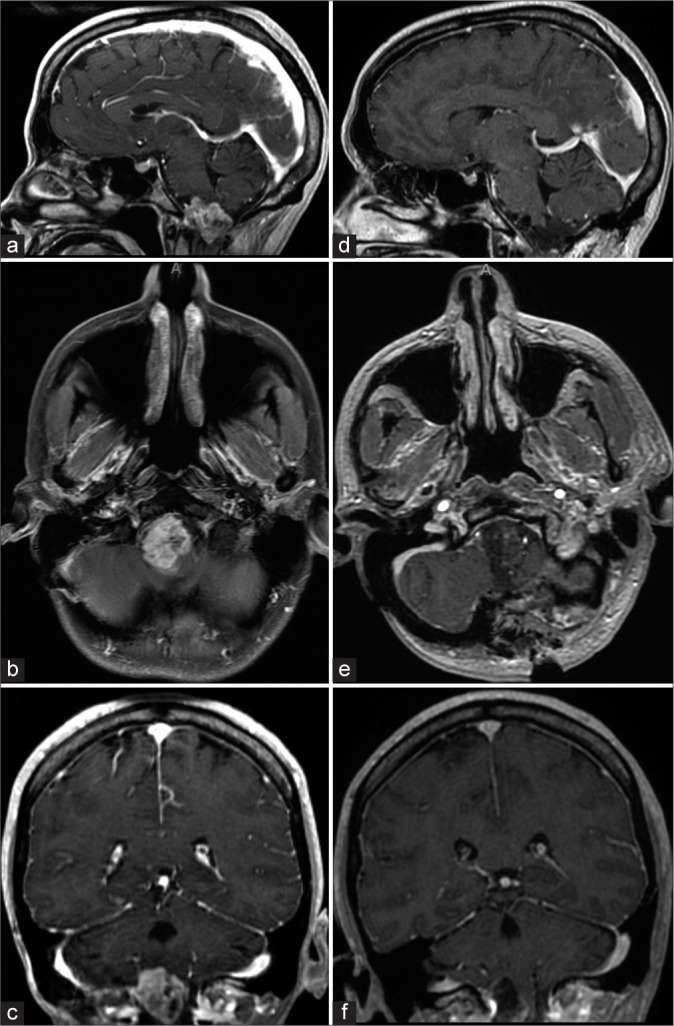
Here, we present the case of a 36-year-old right-handed woman with recurrent low-grade astroblastoma in the cervicomedullary junction. The patient presented with worsening motor and sensory deficits of her upper extremities, pain, ataxia, visual disturbance, and nausea. Due to extensive recurrence and neurological symptoms, the patient underwent reoperation.
We review a rare case of recurrent astroblastoma in the foramen magnum in light of new relevant literature about tumor biology and prognostic significance of the new classification of astroblastoma -altered.
成星形细胞瘤是一种起源不明的罕见原发性脑肿瘤,常发生于30岁以下的年轻患者。它通常发生于幕上,根据包括血管玻璃样变和血管周围假菊形团等组织学特征进行诊断。近期对具有脑膜瘤I型改变的原发性中枢神经系统高级别神经上皮肿瘤(HGNET-)的分子特征分析发现,HGNET-和具有成星形细胞瘤形态特征的肿瘤聚集在一起。进一步分析显示,此类成星形细胞瘤存在[此处原文可能缺失具体改变内容]改变,2021年世界卫生组织中枢神经系统肿瘤分类现已将改变的成星形细胞瘤认定为一种新的实体。
在此,我们报告一例36岁右利手女性,其颈髓交界处出现复发性低级别成星形细胞瘤。患者表现为上肢运动和感觉功能障碍加重、疼痛、共济失调、视觉障碍及恶心。由于广泛复发及神经症状,患者接受了再次手术。
鉴于关于改变的成星形细胞瘤的肿瘤生物学及新分类的预后意义的新相关文献,我们回顾了一例枕骨大孔区复发性成星形细胞瘤的罕见病例。