Pineda Daniel, Pérez Juan, Gaviria Daniel, Ospino-Villalba Karen, Camargo Omar
Facultad de Ciencias Universidad Nacional de Colombia Sede Medellín, Facultad de Ciencias Agrarias, Carrera 65 #59a-110, Medellín, Antioquia, Colombia.
Facultad de Ciencias Agrarias. Carrera 65 #59a-110, Medellín, Antioquia, Colombia.
HardwareX. 2022 Feb 22;11:e00282. doi: 10.1016/j.ohx.2022.e00282. eCollection 2022 Apr.
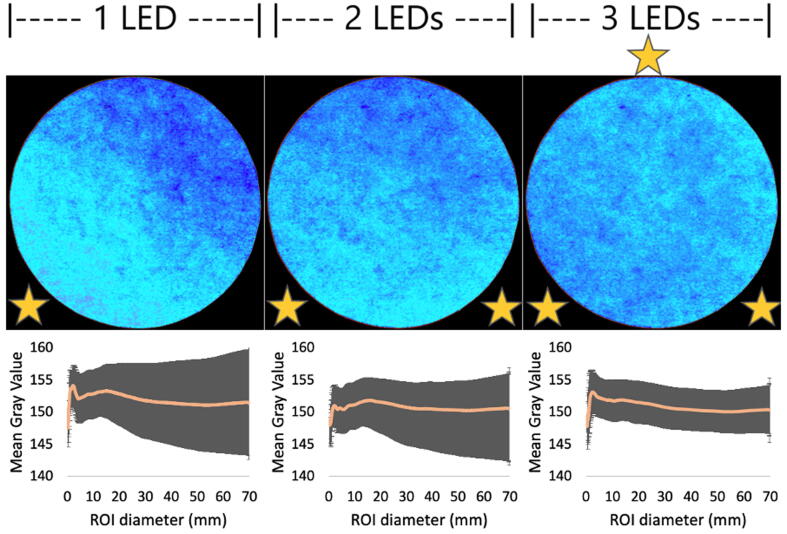
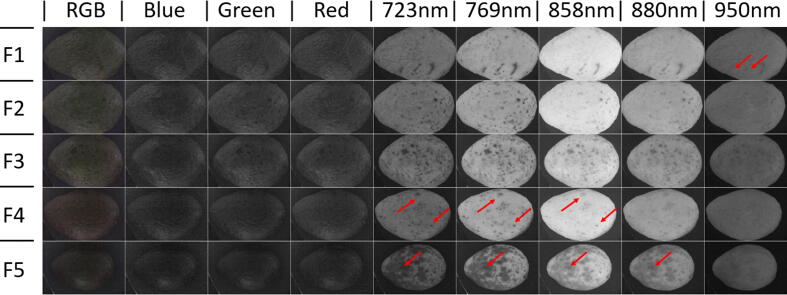
Multispectral imaging is at the forefront of contactless surface analysis. Standard multispectral imaging systems use sophisticated software, cameras and light filtering optics. This paper discloses the building of a customizable and cost-effective multispectral imaging and analysis system. It integrates a web camera, light emitting diodes (LEDs) lighting, a semisphere for even lightening, an open-source Arduino™ development board and a free Python application to automatically obtain and visually analyze multispectral images. The device is hereafter called MEDUSA and its optical performance was tested for repeated Imaging consistency, visible and near infrared band sensitivity and lighting evenness. Four proof of concept tests were run in order to understand the advantageous use of this system, as compared to a simple visual score of diverse samples. Each of three qualitative tests used sets of 12 LED band spectral images to analyze ink changes in a counterfeit bill, surface bruises on Hass avocado fruits and transient changes in petri dish grown bacterial colonies. A fourth test used single band imaging in a set of standard laboratory analyzed plant samples, to quantitatively relate a red band light reflectance to its nitrogen content. These tests indicate that MEDUSA made images may yield qualitative and quantitative spectral information unseen to the naked eye, suggesting potential use in currency counterfeit tests, food quality analyses, microbial phenotyping and agricultural plant chemistry. MEDUSA can be freely reproduced and customized from this research, making it a powerful and affordable analytical tool to analyze a wide range of subtle chemical properties in samples at industrial and science fields.
多光谱成像处于非接触式表面分析的前沿。标准的多光谱成像系统使用复杂的软件、相机和滤光光学器件。本文披露了一种可定制且经济高效的多光谱成像与分析系统的构建。它集成了网络摄像头、发光二极管(LED)照明、用于均匀照明的半球体、开源的Arduino™开发板以及一个免费的Python应用程序,以自动获取并直观分析多光谱图像。该设备此后被称为MEDUSA,并对其光学性能进行了测试,以检验重复成像的一致性、可见光和近红外波段的灵敏度以及照明均匀性。进行了四项概念验证测试,以了解该系统相较于对不同样本进行简单视觉评分的优势用途。三项定性测试中的每一项都使用了12组LED波段光谱图像,来分析假钞上的墨水变化、哈斯鳄梨果实表面的瘀伤以及培养皿中细菌菌落的瞬时变化。第四项测试在一组标准实验室分析的植物样本中使用单波段成像,以定量关联红色波段光反射率与其氮含量。这些测试表明,MEDUSA生成的图像可能会产生肉眼无法看到的定性和定量光谱信息,这表明其在货币真伪测试、食品质量分析、微生物表型分析和农业植物化学方面具有潜在用途。MEDUSA可以根据本研究自由复制和定制,使其成为一种强大且经济实惠的分析工具,可用于分析工业和科学领域样本中的各种细微化学性质。