van Tilburg Joost, Rathsach Andersen Mikkel
Department of Orthopedics, Herlev Gentofte Hospital, Hellerup, Copenhagen, Denmark.
EFORT Open Rev. 2022 May 5;7(5):295-304. doi: 10.1530/EOR-21-0090.
Due to substantial increase in obesity, the demand for total knee arthroplasty (TKA) in obese and morbidly obese patients is higher than ever. This review aims to investigate mid- to long-term complications, revision rates, and outcome for morbidly obese, compared with non-obese after TKA.
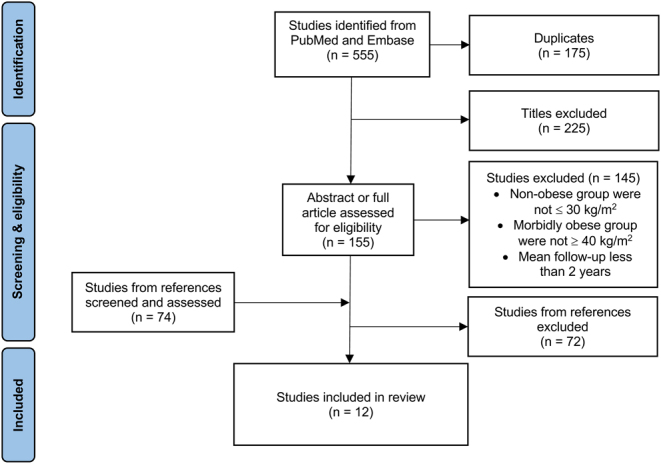
A systematic search was conducted in May 2021. Included studies reported revision rates for morbidly obese and non-obese with a mean follow-up of at least 2 years. Reported knee society score (KSS) has been used to compare the functional outcome. PRISMA protocol was followed, and PROSPERO registered (ID: CRD42021254119).
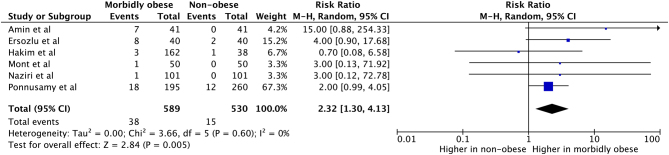
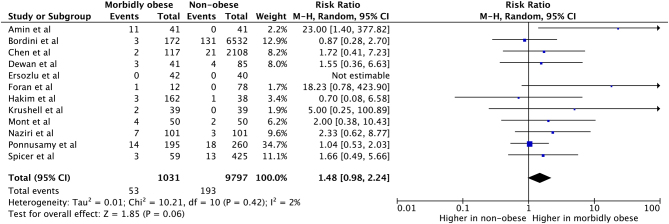
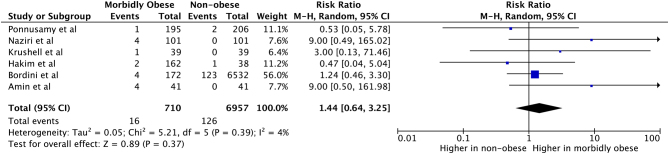
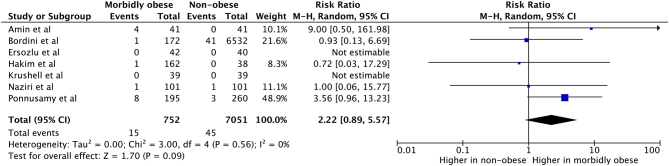
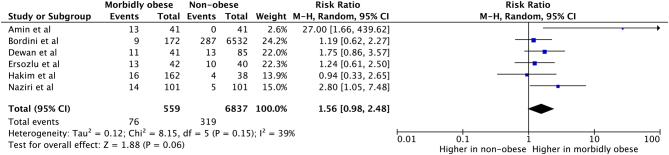
From 12 studies that met the inclusion criteria, a total of 1031 cases of morbidly obese and 9797 cases of non-obese controls were included. The risk ratio for revision was 1.48 for the morbidly obese, compared with non-obese (95% CI: 0.98 to 2.24; P = 0.06). Regarding aseptic and septic revision, the risk ratio was 1.44 (95% CI: 0.64 to 3.25; P = 0.37) and 2.22 (95% CI: 0.89 to 5.57; P = 0.09), respectively. The morbidly obese scored lower in Objective Knee Society Score (OKSS) and Functional Knee Society Score (FKSS) both preoperatively and postoperatively, compared with the non-obese; however, the two groups improved equally in function scores OKSS (P= 0.967) and FKSS (P = 0.834). Overall risk ratio for complications was 1.56 (95% CI: 0.98 to 2.48; P = 0.06).
The gained benefit in functional outcome surpasses the increase in risk of revision and complications for the morbidly obese in TKA surgery.
由于肥胖率大幅上升,肥胖和病态肥胖患者对全膝关节置换术(TKA)的需求比以往任何时候都更高。本综述旨在研究与非肥胖患者相比,病态肥胖患者TKA术后的中长期并发症、翻修率及预后情况。
于2021年5月进行了系统检索。纳入的研究报告了病态肥胖和非肥胖患者的翻修率,平均随访时间至少为2年。采用报告的膝关节协会评分(KSS)来比较功能结局。遵循PRISMA方案,并在PROSPERO注册(注册号:CRD42021254119)。
从12项符合纳入标准的研究中,共纳入1031例病态肥胖患者和9797例非肥胖对照患者。与非肥胖患者相比,病态肥胖患者的翻修风险比为1.48(95%可信区间:0.98至2.24;P = 0.06)。关于无菌性和感染性翻修,风险比分别为1.44(95%可信区间:0.64至3.25;P = 0.37)和2.22(95%可信区间:0.89至5.57;P = 0.09)。与非肥胖患者相比,病态肥胖患者术前和术后的客观膝关节协会评分(OKSS)和功能膝关节协会评分(FKSS)均较低;然而,两组在功能评分OKSS(P = 0.967)和FKSS(P = 0.834)方面的改善程度相同。并发症的总体风险比为1.56(95%可信区间:0.98至2.48;P = 0.06)。
在TKA手术中,病态肥胖患者在功能结局方面获得的益处超过了翻修和并发症风险的增加。