
扫描辅助剂对特制金属模型扫描精度的影响:一项实验室研究。
Effect of scanning-aid agents on the scanning accuracy in specially designed metallic models: A laboratory study.
机构信息
Department of Prosthodontics and Dental Research Institute, School of Dentistry, Seoul National University, Seoul, Republic of Korea.
Dental Life Science Research Institute, Seoul National University Dental Hospital, Seoul, Republic of Korea.
出版信息
PLoS One. 2022 May 5;17(5):e0267742. doi: 10.1371/journal.pone.0267742. eCollection 2022.
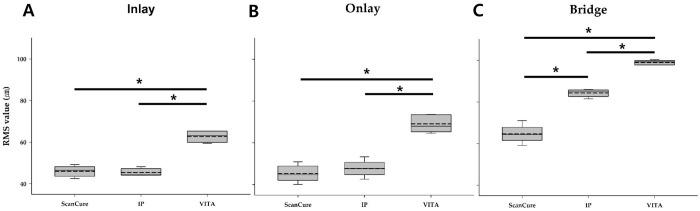
The advent of intraoral scanning methods has caused a paradigm shift in dentistry. However, despite their many advantages, intraoral scanners cannot accurately recognize the metallic surfaces of prothesis. Therefore, this experiment was designed to verify the effect of scanning-aid agents on the scanning accuracy using metallic reference models. Three different types of metallic reference models (inlay, onlay, and bridge) were specially designed and produced using a milling machine to simulate intraoral dental restorations. Three experimental groups (application of ScanCure, IP Scan Spray, and VITA Powder Scan Spray) were set up and scanned images (each n = 5) were acquired using the I500® intraoral scanner. The reference datasets were established by a 3D design that reflected the deviations between the measured distances and previously planned distances on the reference models. All acquired experimental datasets were digitally superimposed and compared with the reference datasets. Intragroup comparisons (precision, n = 10) were also performed. The root mean square (RMS) values of trueness in the ScanCure and IP groups were significantly more accurate than those of the VITA group in the inlay and onlay reference models (p < 0.05). Notably, in the bridge reference model, the liquid-type ScanCure group showed the highest accuracy of trueness, with statistical significance (p < 0.05). However, the RMS values of precision were not significantly different among the groups. These findings suggest that liquid-type scanning agents can be effectively used to obtain more accurate scan images of intraoral metallic dental restorations.
口腔内扫描方法的出现引起了牙科领域的范式转变。然而,尽管它们有许多优点,但口腔内扫描仪无法准确识别修复体的金属表面。因此,本实验旨在通过金属参考模型验证扫描辅助剂对扫描精度的影响。特别设计和制造了三种不同类型的金属参考模型(嵌体、高嵌体和桥体),使用铣床模拟口腔内的牙体修复体。设立了三个实验组(应用 ScanCure、IP Scan Spray 和 VITA Powder Scan Spray),并使用 I500®口腔内扫描仪获取扫描图像(每组 n = 5)。参考数据集通过 3D 设计建立,反映了参考模型上测量距离与先前计划距离之间的偏差。所有获取的实验数据集均进行数字叠加,并与参考数据集进行比较。还进行了组内比较(精度,n = 10)。在嵌体和高嵌体参考模型中,ScanCure 和 IP 组的准确性 RMS 值明显比 VITA 组更准确(p < 0.05)。值得注意的是,在桥体参考模型中,液体型 ScanCure 组的准确性 RMS 值最高,具有统计学意义(p < 0.05)。然而,各组之间的精度 RMS 值没有显著差异。这些发现表明,液体型扫描剂可有效用于获得更准确的口腔内金属牙体修复体的扫描图像。


 Zotero 插件