Department of Radiology, Union Hospital, Tongji Medical College, Huazhong University of Science and Technology, 1277 Jiefang Avenue, Wuhan, 43002, Hubei, People's Republic of China.
Hubei Province Key Laboratory of Molecular Imaging, Wuhan, 430022, People's Republic of China.
Sci Rep. 2022 May 5;12(1):7402. doi: 10.1038/s41598-022-11237-1.
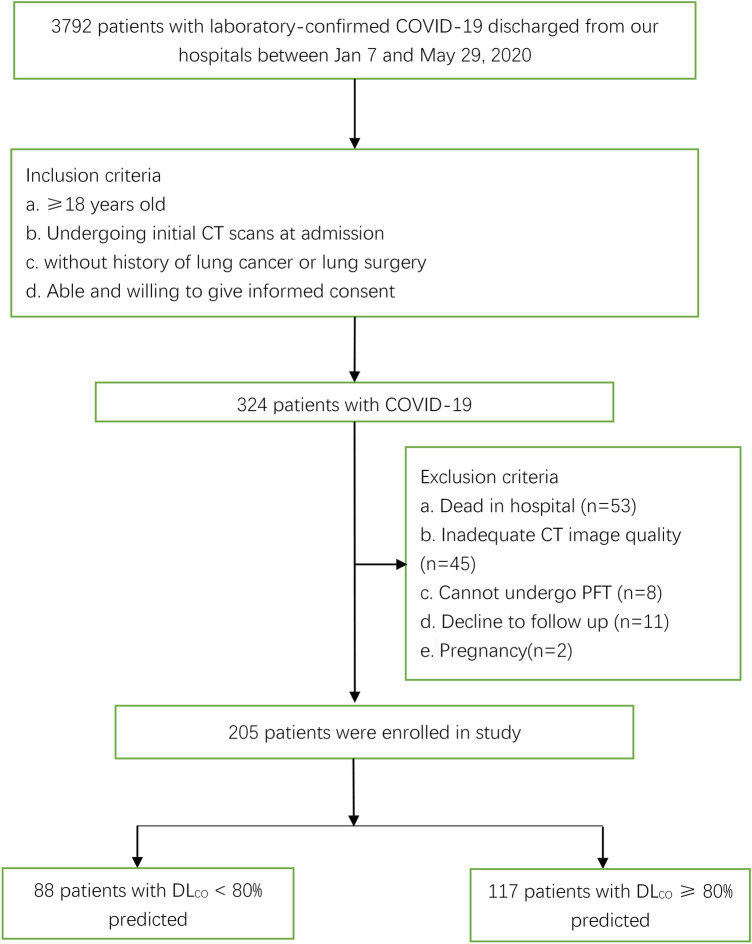
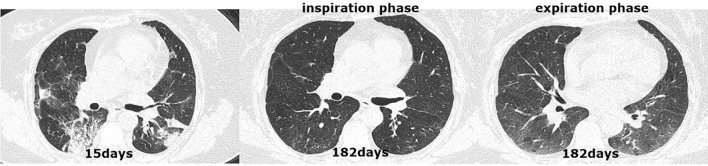
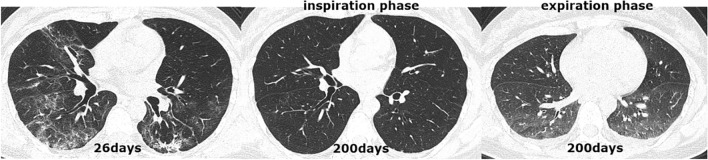
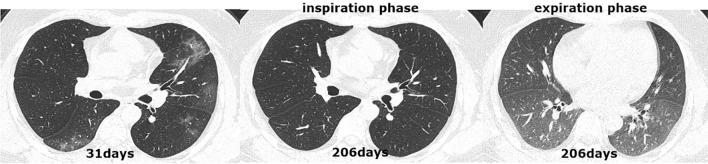
We evaluated pulmonary sequelae in COVID-19 survivors by quantitative inspiratory-expiratory chest CT (QCT) and explored abnormal pulmonary diffusion risk factors at the 6-month follow-up. This retrospective study enrolled 205 COVID-19 survivors with baseline CT data and QCT scans at 6-month follow-up. Patients without follow-up pulmonary function tests were excluded. All subjects were divided into group 1 (carbon monoxide diffusion capacity [DL] < 80% predicted, n = 88) and group 2 (DL ≥ 80% predicted, n = 117). Clinical characteristics and lung radiological changes were recorded. Semiquantitative total CT score (0-25) was calculated by adding five lobes scores (0-5) according to the range of lesion involvement (0: no involvement; 1: < 5%; 2: 5-25%; 3: 26-50%; 4: 51-75%; 5: > 75%). Data was analyzed by two-sample t-test, Spearman test, etc. 29% survivors showed air trapping by follow-up QCT. Semiquantitative CT score and QCT parameter of air trapping in group 1 were significantly greater than group 2 (p < 0.001). Decreased DL was negatively correlated with the follow-up CT score for ground-glass opacity (r = - 0.246, p = 0.003), reticulation (r = - 0.206, p = 0.002), air trapping (r = - 0.220, p = 0.002) and relative lung volume changes (r = - 0.265, p = 0.001). COVID-19 survivors with lung diffusion deficits at 6-month follow-up tended to develop air trapping, possibly due to small-airway impairment.
我们通过定量吸气呼气胸部 CT(QCT)评估 COVID-19 幸存者的肺部后遗症,并探讨了 6 个月随访时异常肺部弥散的危险因素。这项回顾性研究纳入了 205 名有基线 CT 数据和 6 个月随访 QCT 扫描的 COVID-19 幸存者。排除了没有随访肺功能测试的患者。所有患者均分为 1 组(一氧化碳弥散量[DL]<80%预计值,n=88)和 2 组(DL≥80%预计值,n=117)。记录临床特征和肺部影像学变化。通过将五个肺叶的分数(0-5)相加,计算半定量总 CT 评分(0-25),根据病变累及范围(0:无累及;1:<5%;2:5-25%;3:26-50%;4:51-75%;5:>75%)。采用两样本 t 检验、Spearman 检验等方法进行数据分析。29%的幸存者在随访 QCT 中显示空气潴留。1 组的半定量 CT 评分和 QCT 空气潴留参数明显大于 2 组(p<0.001)。DL 降低与随访 CT 评分的磨玻璃影(r=-0.246,p=0.003)、网状影(r=-0.206,p=0.002)、空气潴留(r=-0.220,p=0.002)和相对肺容量变化(r=-0.265,p=0.001)呈负相关。6 个月随访时肺弥散功能下降的 COVID-19 幸存者容易发生空气潴留,可能与小气道损伤有关。