School of Health and Related Research, University of Sheffield, Regent Court, 30 Regent Street, Sheffield, S1 4DA, UK.
Patient. 2022 Nov;15(6):669-678. doi: 10.1007/s40271-022-00580-0. Epub 2022 May 6.
Evaluating quality in mental healthcare is essential for ensuring a high-quality experience for service users (SUs). Policy-defined quality indicators, however, risk misalignment with the perspectives of SUs and mental healthcare professionals (MHPs). There is value in exploring how SUs and frontline MHPs think quality should be measured.
Our study objectives were to: (1) identify aspects that SUs and MHPs deem important for assessing quality in mental healthcare to help support attribute selection in a subsequent discrete choice experiment and (2) explore similarities and differences between SU and MHPs' views.
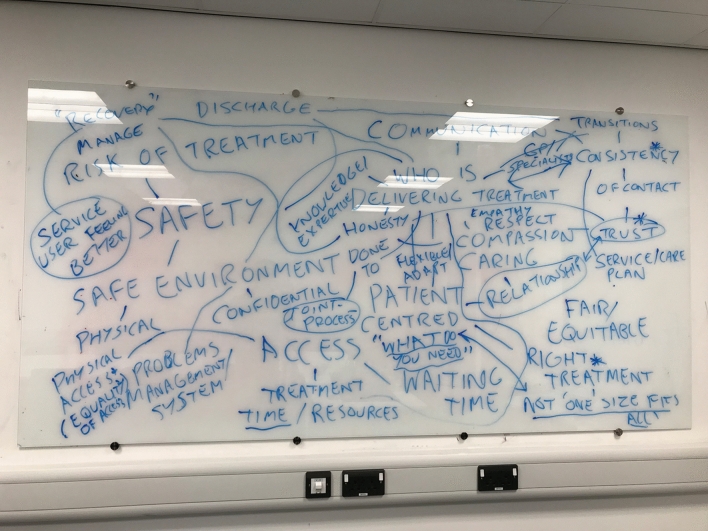
Semi-structured qualitative focus groups (n = 6) were conducted with SUs (n = 14) and MHPs (n = 8) recruited from a UK National Health Service Trust. A topic guide was generated from a review of UK policy documents and existing data used to measure quality in mental healthcare in England. Transcripts were analysed using a framework analysis.
Twenty-one subthemes were identified, grouped within six themes: accessing mental healthcare; assessing the benefits of care; co-ordinated approach; delivering mental healthcare; individualised care; and role of the person providing care. Themes such as person-centred care, capacity and resources, and receiving the right type of care received more coverage than others. Service users and MHPs displayed high concordance in their views, with minor areas of divergence.
We developed a comprehensive six-theme framework for understanding quality in mental healthcare from the viewpoint of the SU and frontline MHP, which can be used to help inform the selection of a meaningful set of quality indicators in mental health for research and practice.
评估精神卫生保健的质量对于确保服务使用者(SU)获得高质量的体验至关重要。然而,政策定义的质量指标可能与 SU 和精神卫生保健专业人员(MHP)的观点不一致。探索 SU 和一线 MHP 如何看待质量应该如何衡量具有重要价值。
我们的研究目的是:(1)确定 SU 和 MHP 认为对于评估精神卫生保健质量重要的方面,以帮助支持随后离散选择实验中的属性选择;(2)探讨 SU 和 MHP 观点之间的相似之处和差异。
从英国国家卫生服务信托机构招募 SU(n = 14)和 MHP(n = 8)进行半结构化定性焦点小组(n = 6)。从英国政策文件和用于衡量英格兰精神卫生保健质量的现有数据的综述中生成了一个主题指南。使用框架分析对转录本进行分析。
确定了 21 个子主题,分为六个主题:获得精神卫生保健;评估护理的益处;协调的方法;提供精神卫生保健;个性化护理;以及提供护理的人的角色。诸如以患者为中心的护理、能力和资源以及接受正确类型的护理等主题比其他主题得到了更多的关注。SU 和 MHP 的观点高度一致,仅有少数分歧。
我们从 SU 和一线 MHP 的角度制定了一个全面的六个主题框架,用于理解精神卫生保健中的质量,这可以帮助为精神卫生研究和实践中选择有意义的质量指标集提供信息。