Takegami Yasuhiko, Seki Taisuke, Osawa Yusuke, Imagama Shiro
Department of Orthopaedic Surgery, Nagoya University Graduate School of Medicine, Nagoya, Japan.
Bone Joint Res. 2022 May;11(5):270-277. doi: 10.1302/2046-3758.115.BJR-2021-0375.R2.
Periprosthetic hip fractures (PPFs) after total hip arthroplasty are difficult to treat. Therefore, it is important to identify modifiable risk factors such as stem selection to reduce the occurrence of PPFs. This study aimed to clarify differences in fracture torque, surface strain, and fracture type analysis between three different types of cemented stems.
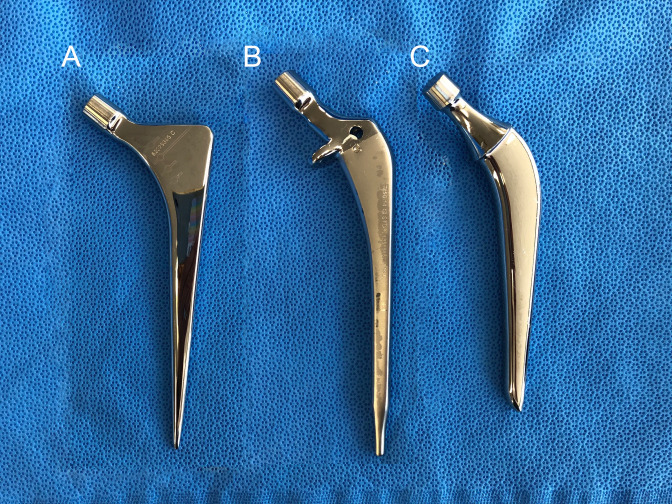
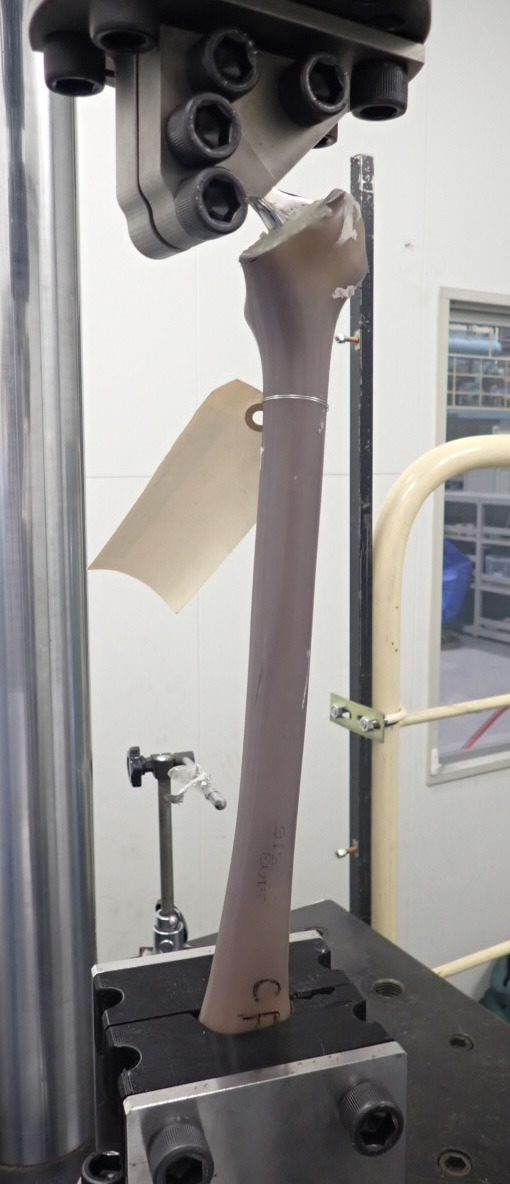
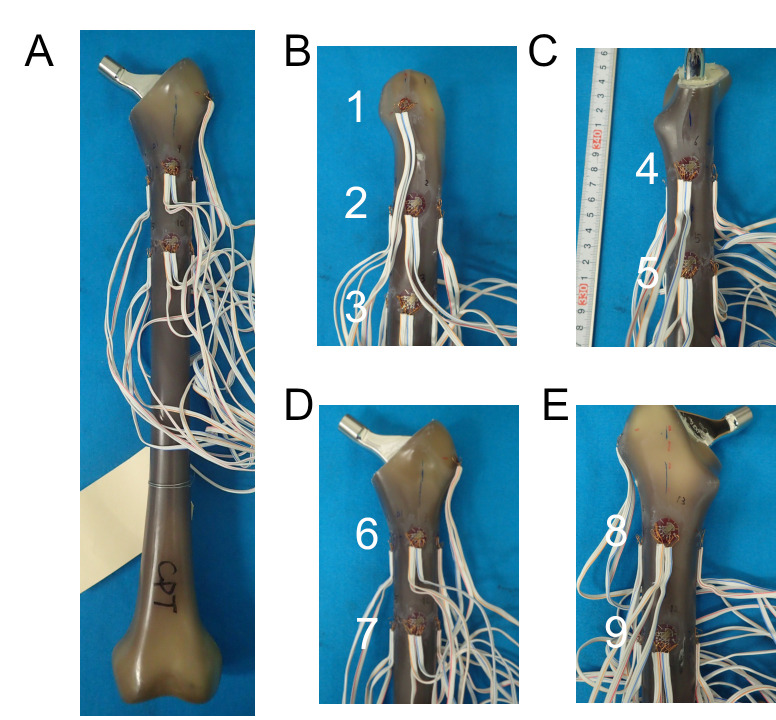
We conducted biomechanical testing of bone analogues using six cemented stems of three different types: collarless polished tapered (CPT) stem, Versys Advocate (Versys) stem, and Charnley-Marcel-Kerboull (CMK) stem. Experienced surgeons implanted each of these types of stems into six bone analogues, and the analogues were compressed and internally rotated until failure. Torque to fracture and fracture type were recorded. We also measured surface strain distribution using triaxial rosettes.
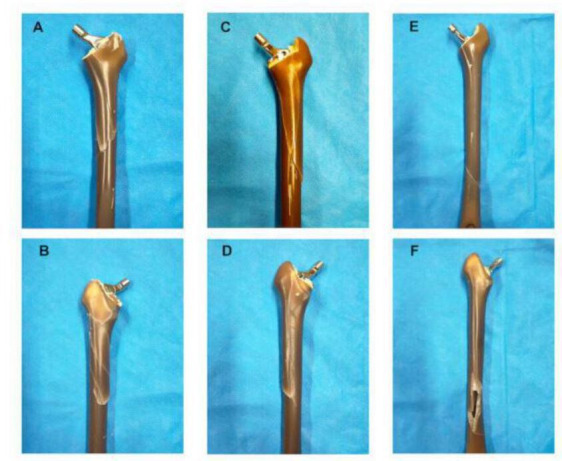
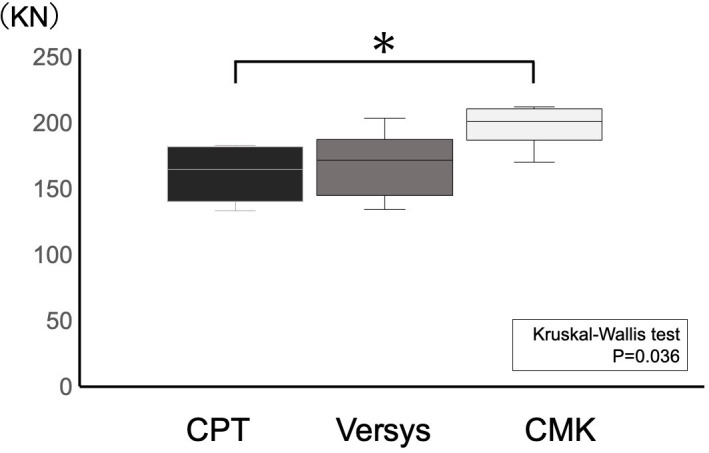
There was a significant difference in fracture torque between the three stem types (p = 0.036). Particularly, the median fracture torque for the CPT stem was significantly lower than that for the CMK stem (CPT vs CMK: 164.5 Nm vs 200.5 Nm; p = 0.046). The strain values for the CPT stem were higher than those for the other two stems at the most proximal site. The fracture pattern of the CPT and Versys stems was Vancouver type B, whereas that of the CMK stem was type C.
Our study suggested that the cobalt-chromium alloy material, polished surface finish, acute-square proximal form, and the absence of a collar may be associated with lower fracture torque, which may be related to PPF. Cite this article: 2022;11(5):270-277.
全髋关节置换术后假体周围髋部骨折(PPF)难以治疗。因此,识别可改变的风险因素(如柄的选择)以减少PPF的发生很重要。本研究旨在阐明三种不同类型骨水泥柄在骨折扭矩、表面应变和骨折类型分析方面的差异。
我们使用三种不同类型的六个骨水泥柄对骨模拟物进行了生物力学测试:无领抛光锥形(CPT)柄、Versys Advocate(Versys)柄和Charnley-Marcel-Kerboull(CMK)柄。经验丰富的外科医生将每种类型的柄植入六个骨模拟物中,然后对模拟物进行压缩和内旋直至失效。记录骨折扭矩和骨折类型。我们还使用三轴应变片测量了表面应变分布。
三种柄类型之间的骨折扭矩存在显著差异(p = 0.036)。特别是,CPT柄的中位骨折扭矩显著低于CMK柄(CPT与CMK:164.5 Nm对200.5 Nm;p = 0.046)。CPT柄在最近端部位的应变值高于其他两种柄。CPT柄和Versys柄的骨折模式为温哥华B型,而CMK柄的骨折模式为C型。
我们的研究表明,钴铬合金材料、抛光表面处理、锐角方形近端形状以及无领可能与较低的骨折扭矩有关,这可能与PPF相关。引用本文:2022;11(5):270-277。